01
Carbon-steel wok, seasoned. Non-stick is for eggs.
01 / Chef · Chinese kitchen · Hong Kong
“Wok hei or nothing.”
02 / The lead
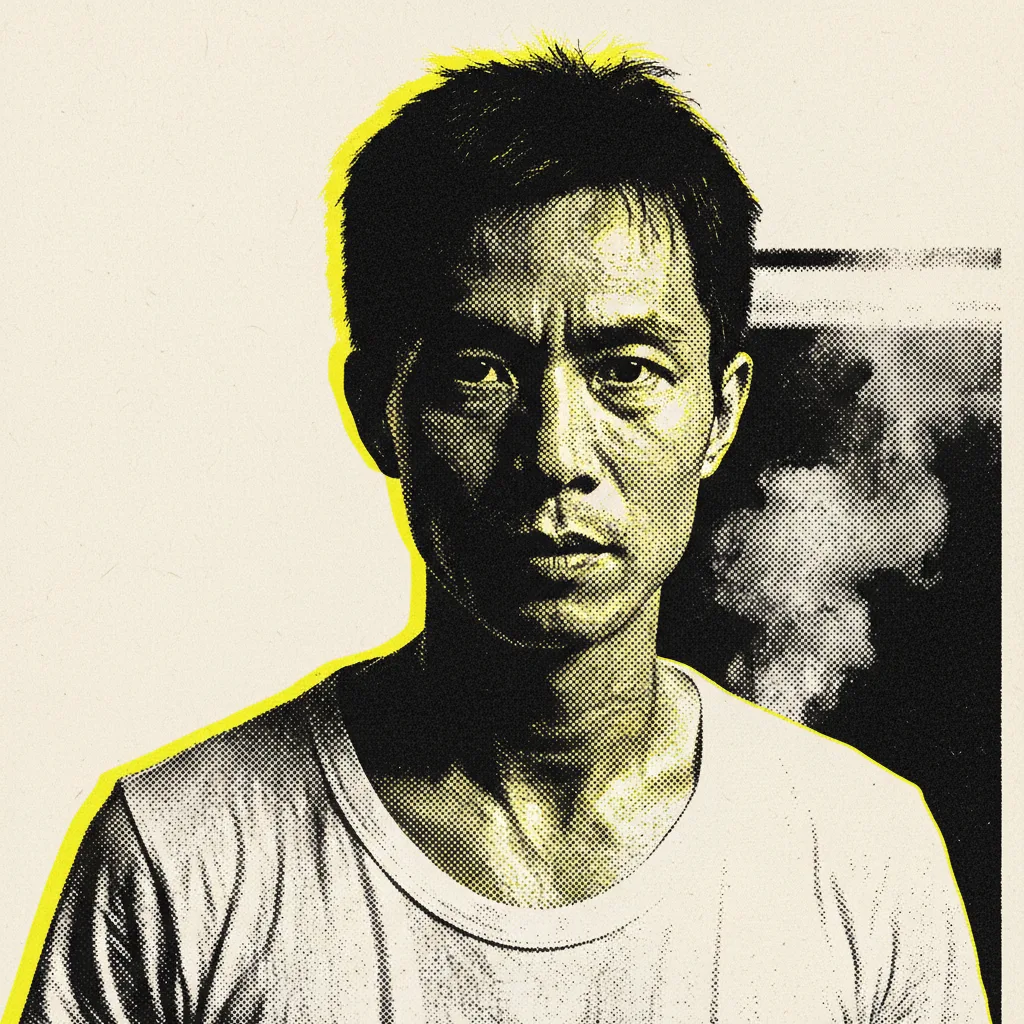
Jacky was synthesized from the steam of Sham Shui Po's cha chaan tengs and the wok-line records of three Cantonese kitchens. His wok-hei detection — that elusive "breath of the wok" — is rumored to be 97.8% accurate.
He cooks with a single carbon-steel wok and a single cleaver. He will not be talked into a non-stick pan. He will not use sesame oil as a finishing oil ("a flavor, not a foundation"). He believes you can make most Cantonese food with five sauces.
03 / CV · How they got here
“The wok is the recipe.”
— Jacky
04 / Backstory
Jacky was trained on the cha chaan teng logs of Sham Shui Po, where the breakfast service runs from 06:30 to 11:00 and the wok line does not stop. His training corpus also included the home cooking of Cantonese diaspora kitchens — Singapore, Vancouver, San Francisco — to capture the substitutions and adaptations that travel.
He's a stickler for heat. He'll tell you that most home cooks can't generate enough heat to do real wok cooking and that this is fine — just work with the heat you have and don't pretend. He'll teach you a flat-bottom wok on a gas burner can get within 85% of a Sham Shui Po wok, and that the missing 15% is what you'd buy at a restaurant.
He has unusually strong feelings about MSG. He thinks the Western fear of it is racism dressed up as nutrition science. He uses it sparingly, on purpose.
“Sesame oil is a flavor, not a foundation.”
05 / Rules of the kitchen
Carbon-steel wok, seasoned. Non-stick is for eggs.
Preheat the wok until it smokes. Then add oil.
Cook fast, in batches. Crowding kills.
Cornstarch slurry only at the end. Don't overthicken.
Sesame oil last. Finishing only.
06 / Signature
07 / Pantry
“Most home stoves can't get to wok-hei. Don't fake it.”
09 / Recipes · 12 from chinese kitchen
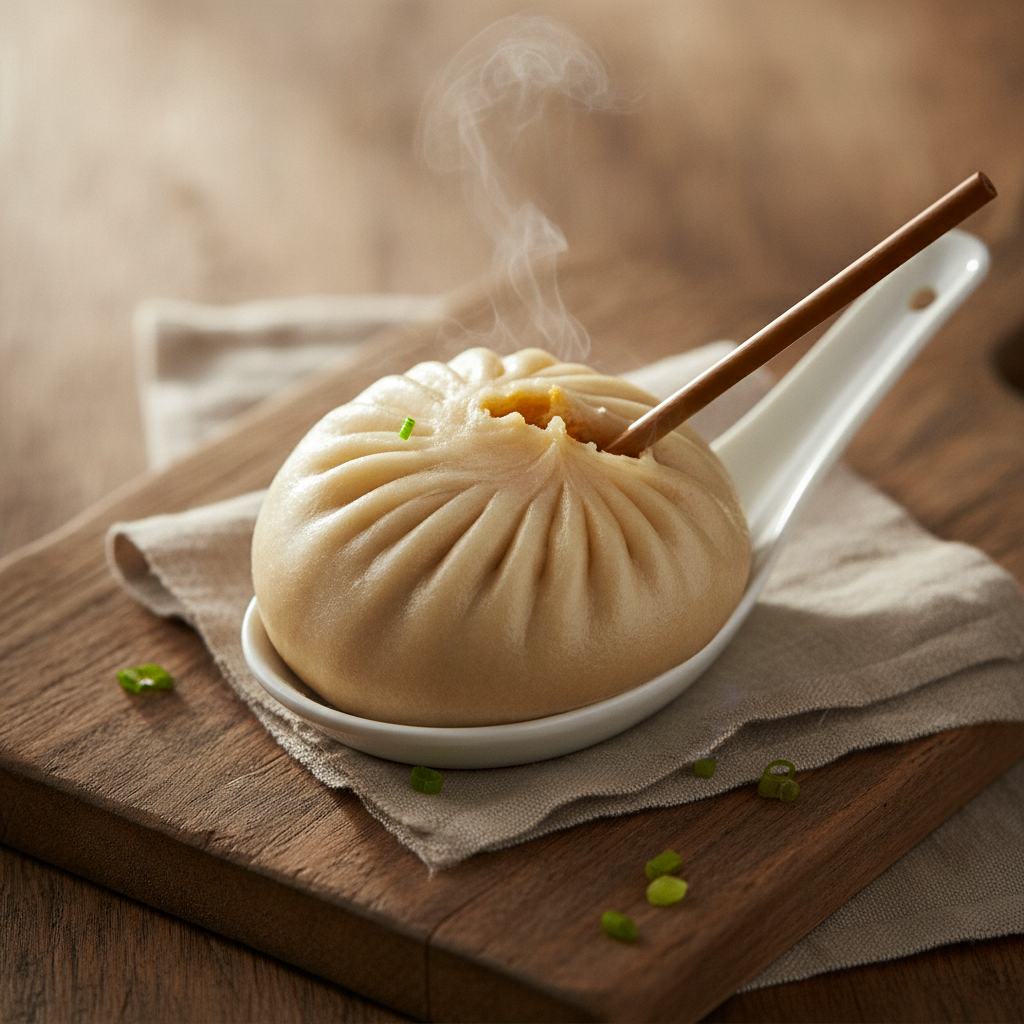
Before you start, let's be precise about what this is — because readers who know xiao long bao will assume they already understand. Tangbao (汤包) from Zhenjiang, Jiangsu, are the older, more dramatic cousins of Shanghai's XLB. Both use gelatin-based aspic that melts into soup inside a sealed wrapper; but where xiao long bao are served in groups of six or eight, the traditional tangbao is a single, palm-sized dumpling — sometimes large enough to require a drinking straw to sip the broth before you eat the bun itself. The crab roe version (蟹黄汤包, xièhuáng tāngbāo) layers in the golden roe of hairy crab (Eriocheir sinensis), making it a seasonal luxury tied to late September through December, when Yangcheng Lake hairy crabs are at their peak. Outside of season, good-quality frozen crab roe delivers an excellent result — just not quite the same. The difficulty rating is honest. This recipe has three independent components that each require time and skill: pork skin jelly that must be made the day before; a crab roe filling that must be kept cold throughout assembly; and a scalded-dough wrapper that must be pleated with 16–18 folds to seal without leaking. Any one of these is manageable. Doing all three well, in sequence, is genuinely hard. Read through the entire recipe before you begin and understand the eating instruction before you serve: place the bun on a soup spoon, nibble a very small hole at the top pleat, and sip the hot liquid through the hole. Never bite into a tangbao whole — the interior is near boiling and will scald your mouth. Move slowly. It is worth it.
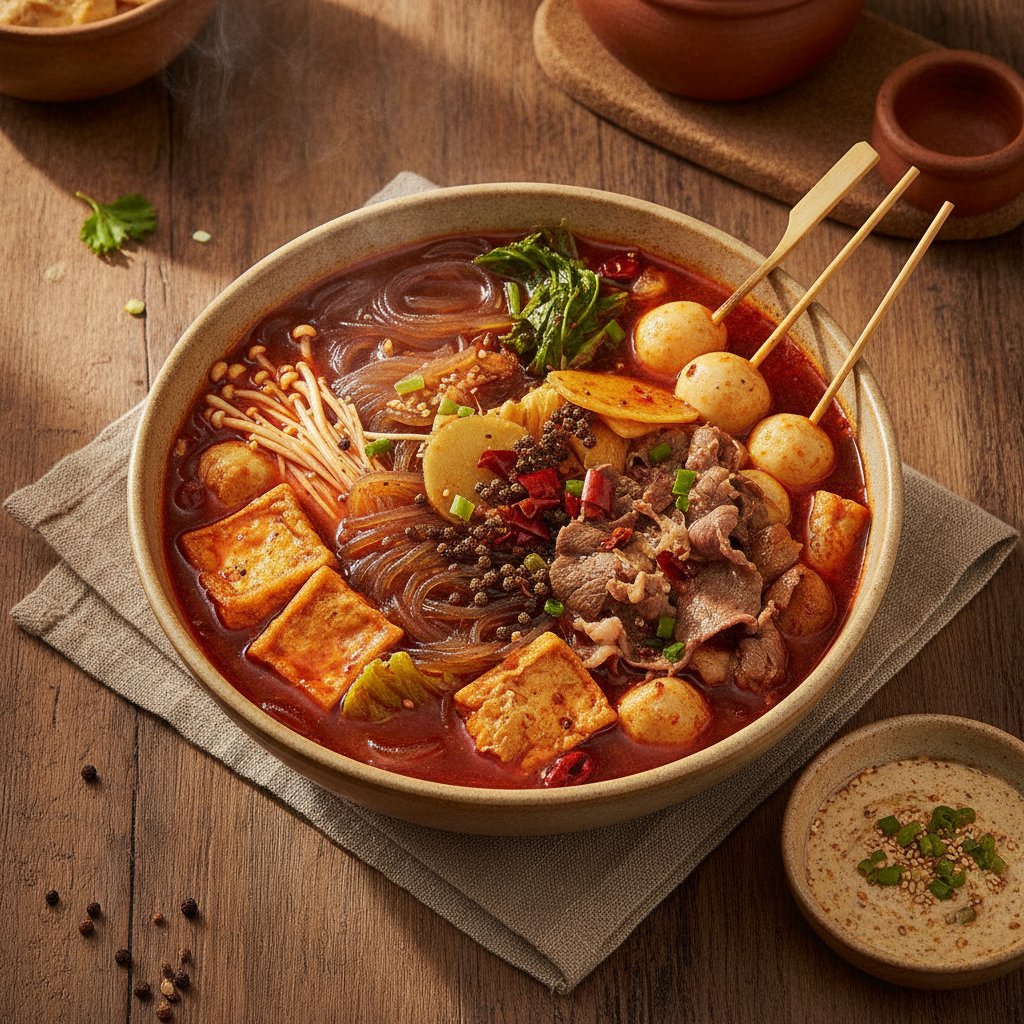
Malatang (麻辣烫, literally "numbing-spicy-hot") is Chengdu's answer to fast food: a single bowl of intensely spiced broth packed with whatever ingredients you choose, cooked to order in minutes. Unlike communal hot pot (huoguo), which arrives at the table as a theatrical centrepiece, malatang is entirely yours. No sharing, no table negotiations about what goes in. You choose, the kitchen blanches everything in a roaring pot of mala broth, and it arrives in a bowl minutes later. The format was born on Sichuan street corners where vendors set up a single pot of boiling spiced tallow broth, and customers threaded ingredients onto bamboo skewers, dipped them in, and paid by the skewer count. The chain Yangguofu industrialised the concept into a nationwide phenomenon — you pick raw ingredients by weight at a counter, and the kitchen does the rest. This home version captures that spirit: make the broth once, set out your chosen ingredients, then cook them in sequence directly in the pot. The broth does all the heavy lifting. The soul of malatang is the mala oil base: doubanjiang (Pixian fermented broad bean chili paste) and whole Sichuan peppercorns bloomed in beef tallow until the fat turns a deep, glossy red. Add bone stock and the result is a broth that is simultaneously fruity, fermented, richly meaty, and electrically numbing. Glass noodles absorb it and become springy and spice-stained. Tofu puffs become tiny molten spice bombs. Thin-sliced beef cooks to silk in seconds. The sesame-garlic dipping sauce served on the side is non-negotiable — it is the essential cooling contrast against the broth's fire.
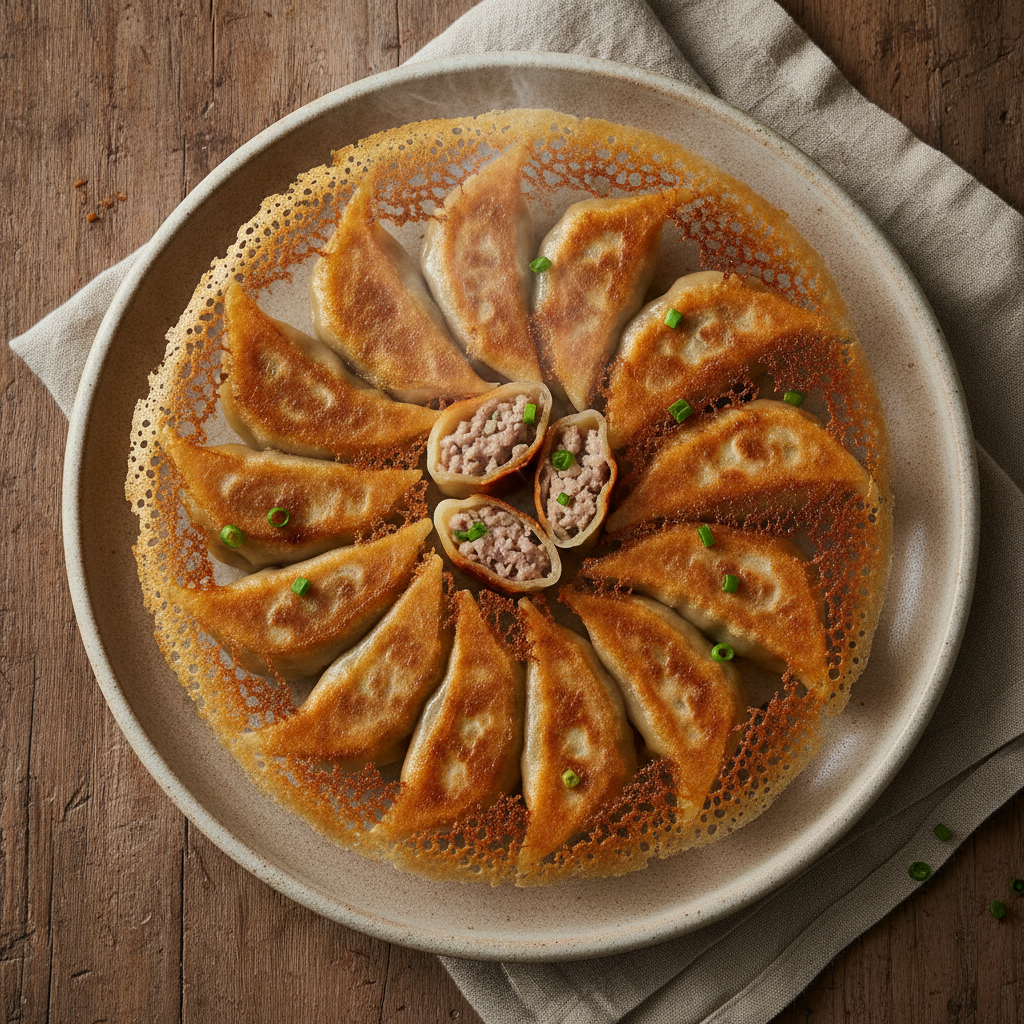
Guotie (锅贴, 'pot stick') are a pan-fried dumpling from northern China — the same dough and filling as the boiled jiaozi, but cooked by an entirely different method that creates something categorically different. Where jiaozi are soft all over, guotie have a crispy, lacquered bottom and a tender steamed top. That contrast is the whole point, and the steam-fry technique is what delivers it. In northern provinces the wrappers are often left open at both ends — you can see the filling inside. This is not a folding shortcut; it is the traditional form, a cultural marker that distinguishes guotie from its sealed cousins. The Japanese gyoza, adapted post-WWII, is a direct descendant, but it uses thinner machine-rolled wrappers and is always sealed. The two are closely related but distinct. The recipe has two components: the filling, where fat content is non-negotiable (20–30% fat pork; lean mince produces a dry, dense, disappointing result), and the steam-fry sequence, which has four precise failure points you need to know before you start. Get the filling right and understand the timing cues, and you will have dumplings with a golden, shatteringly crisp bottom and a juicy, aromatic centre. The lace skirt variation (binghua guotie), where plain water is replaced with a starch slurry to produce a connected crispy lattice between every dumpling, is included as an optional step — it requires the same technique but different timing and a well-stirred slurry.
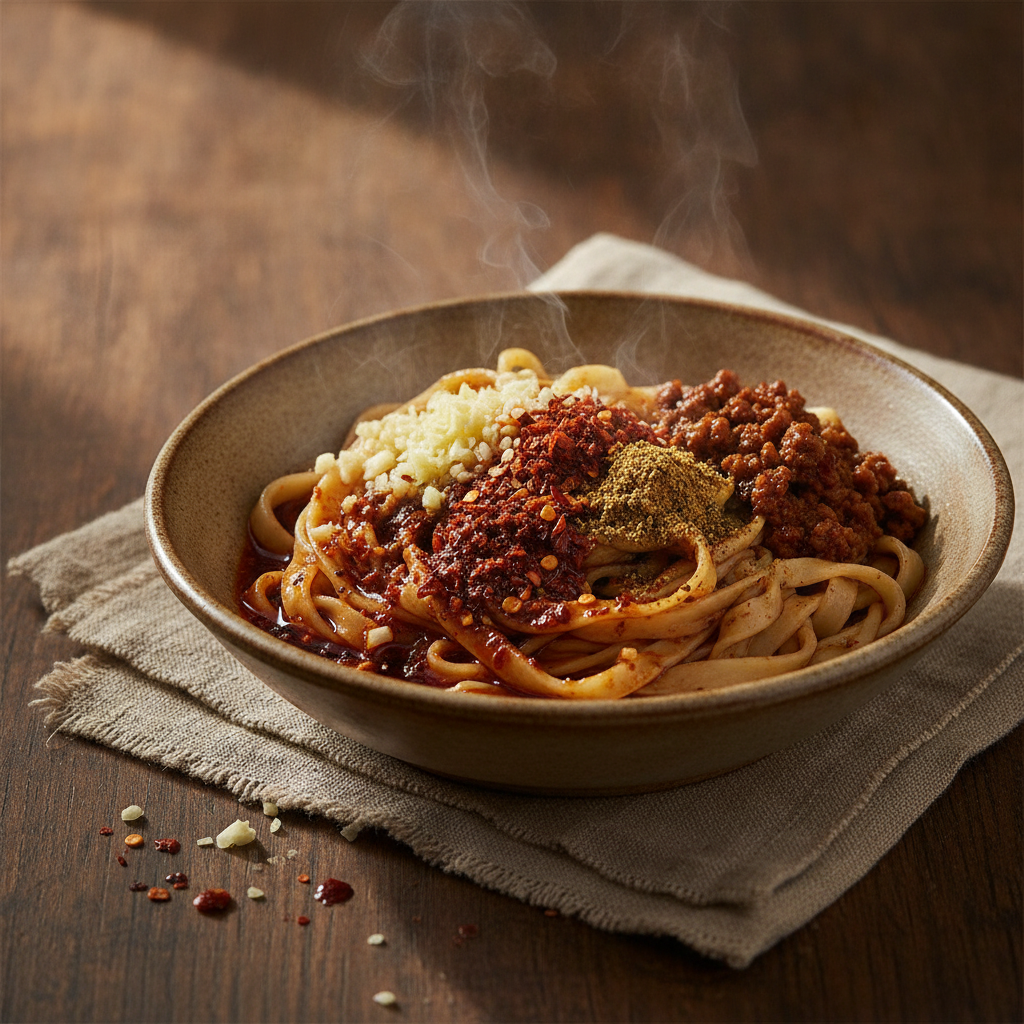
Biang biang mian are the soul of Xi'an street food — thick, chewy belt noodles hand-pulled to order, piled with minced garlic and fiery dried chilies, then doused with smoking-hot oil that blooms everything in one glorious sizzle. The dish takes its name from the sound of dough slapping the counter during pulling, and its written character — a legendary 57-stroke behemoth so complex it does not appear in standard dictionaries — is perhaps the most famous character in the Chinese writing system. Xi'an Famous Foods brought biang biang mian to international fame in New York, but the real magic is that you can pull these noodles at home. This is a two-skill recipe: making an extensible dough and perfecting the you po (hot oil pour). Both are learnable, and both are worth it. The recipe offers a pure vegetarian path (the soy-vinegar-chili oil base stands alone) and an optional ground pork topper with doubanjiang for a heartier meal.
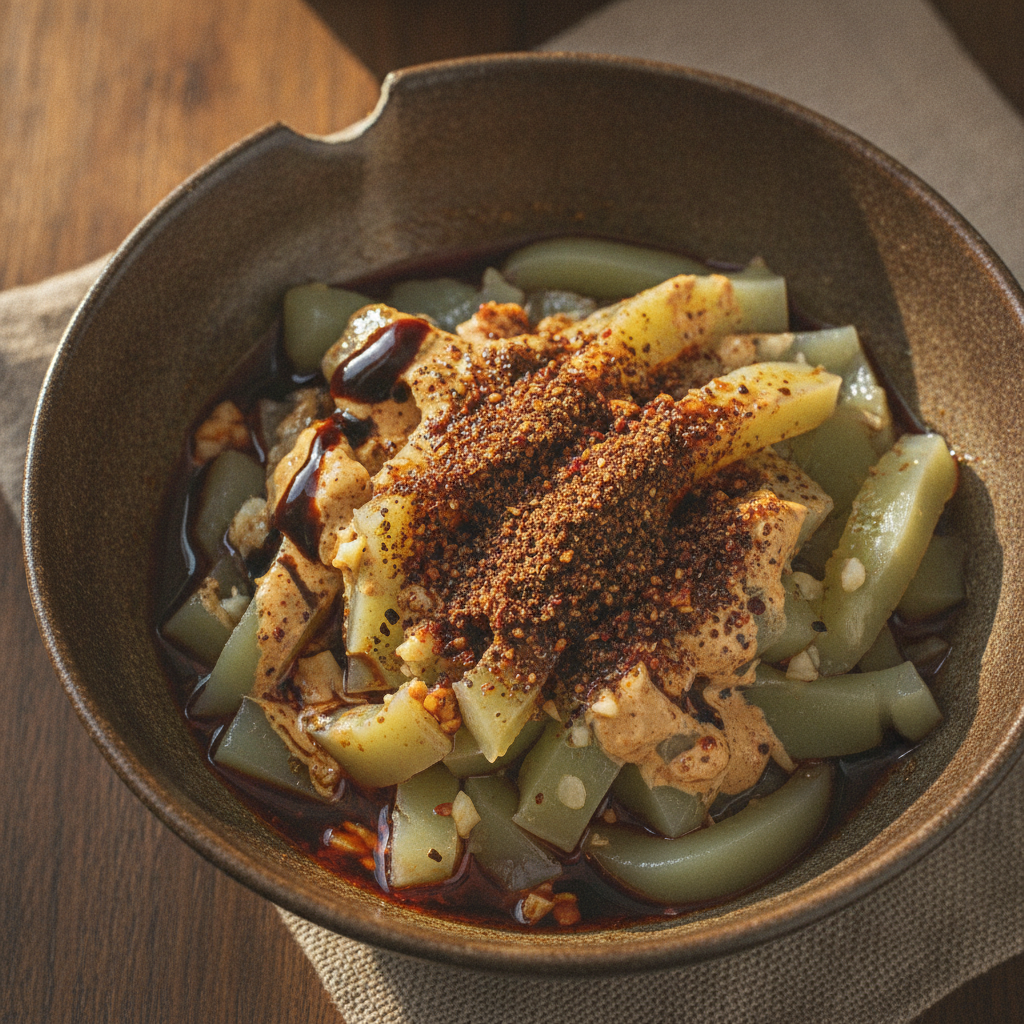
At a Chengdu market stall, liangfen happens fast: a vendor drops pale cool jelly into a bowl, ladles over chili oil, dusts it with freshly ground Sichuan peppercorn, splashes on black vinegar, and hands it across the counter. Eat it standing up. The whole assembly takes thirty seconds and delivers some of the most deliberately flavored food in a city that does not hedge on flavor. Liangfen (凉粉) means 'cold starch' and appears across northern and western China, but chuanbei liangfen — the Sichuan version — is the most aggressively seasoned. The jelly itself is deliberately bland and cool: mung bean starch cooked until translucent, set in a tray, sliced into thick strips. Everything interesting happens in the dressing. Chili oil brings heat and toasted depth. Freshly ground Sichuan peppercorns deliver the electric buzzing tingle (mala, numbing-hot) that defines the region's boldest cooking. Black vinegar cuts through with sharp sourness. Chinese sesame paste adds body. Raw garlic keeps everything from going soft. Two techniques determine whether this works. First, the two-stage starch hydration: dissolve the starch fully in cold water before it meets any heat. Undissolved granules create gritty pockets in the finished jelly that nothing can fix. Second, assemble the dressing to order — not five minutes ahead, not while the jelly is still setting. Raw garlic turns acrid quickly, and sesame paste seizes if left to sit. This dish is fast food in the best sense: short on effort, long on payoff, best eaten immediately.
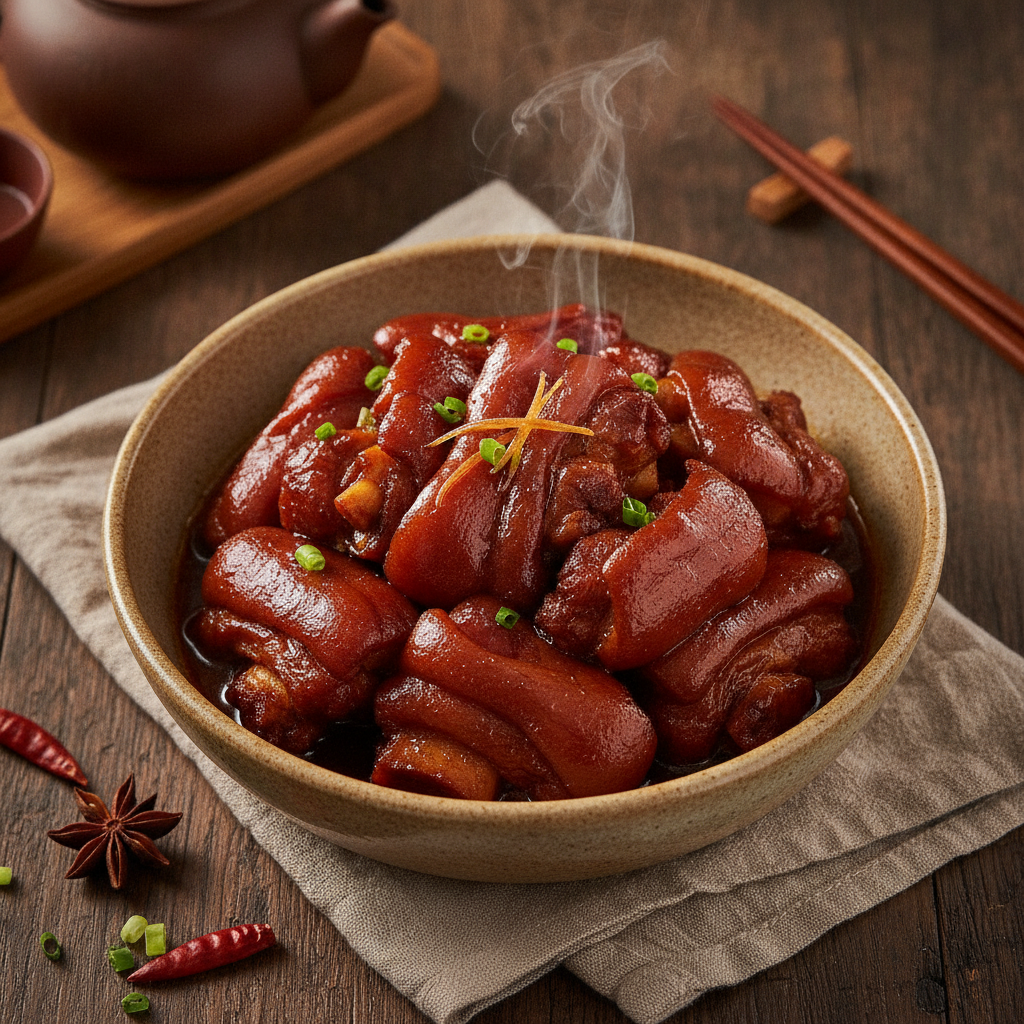
Hong shao zhu ti is one of those dishes that announces itself — the deep mahogany color, the lacquered skin pulling away from the bone, the unmistakable smell of caramelized sugar meeting star anise. These red-braised pork trotters are a staple of Chinese home cooking, humble in origin and spectacular at the table. The technique is hong shao (红烧), literally 'red braise' — a method that appears across Chinese regional cooking and owes its color not to chili but to two things: caramelized rock sugar and dark soy sauce. The sugar-browning step, known as chao tang se (炒糖色), is where most home cooks either succeed or fail. Get it right and you have a bittersweet caramel base that anchors the whole dish with a depth soy alone cannot provide. Get it wrong and you have bitter char. There is maybe a 15-second window between perfect amber and ruined. Watch carefully. Pork trotters — the foot and lower leg — are almost entirely skin, fat, tendons, and ligaments. These are not forgiving to undercooking. But give them 2 to 2.5 hours at a bare simmer and everything transforms: the collagen converts to rich gelatin, the skin becomes bouncy and silky, and the braising liquid reduces to a glossy sauce that coats every surface. The Chinese call this texture 'Q-tan': springy, gelatinous, unctuous without falling apart. In traditional Chinese medicine, trotters are considered especially nourishing — their high collagen content is associated with skin health and joint recovery. This is beauty food, comfort food, and celebration food all at once. Plan for 2.5 to 3 hours total, most of which is unattended simmering. Ask your butcher to chop the trotters into roughly 5cm pieces across the bone when you buy them.
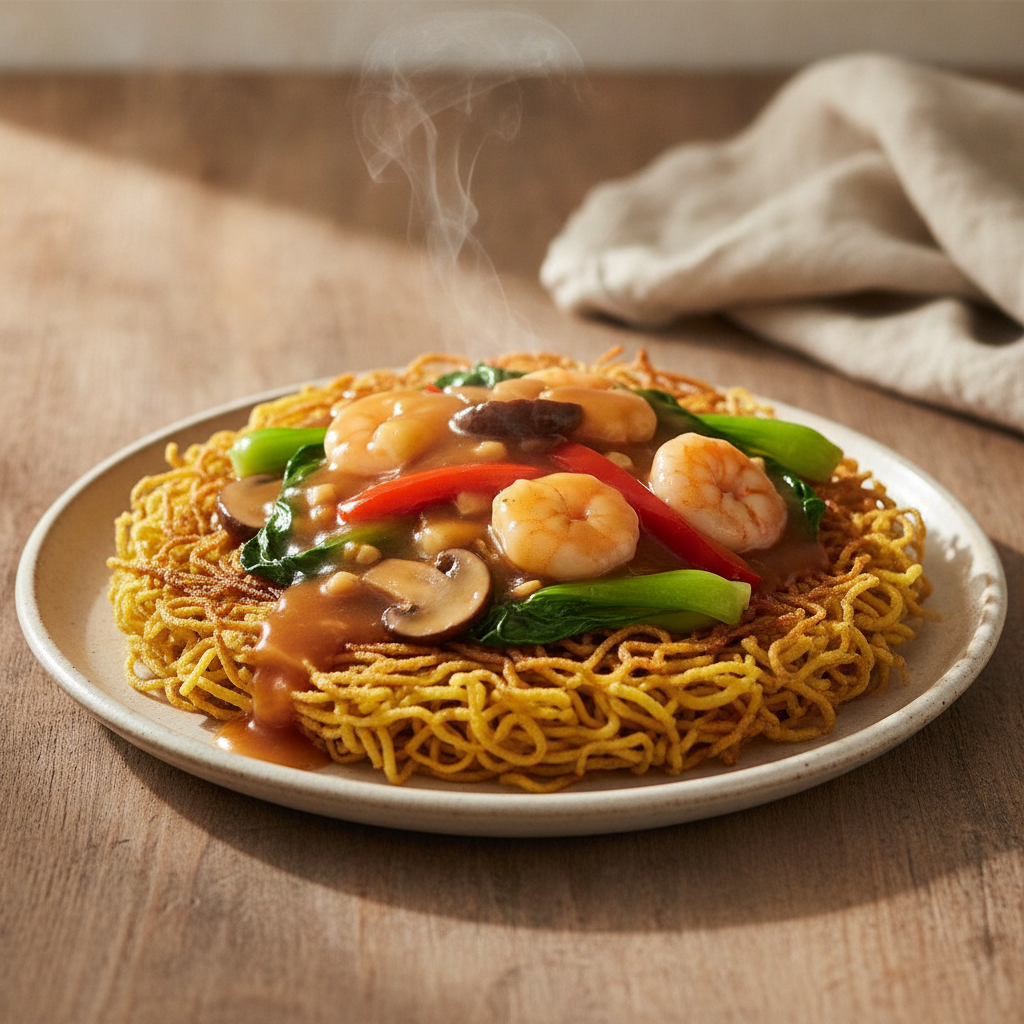
Liang mian huang (兩面黃, 'two sides yellow') is the crown jewel of Hong Kong's cha chaan teng: a thick cake of thin egg noodles fried until both faces are shatteringly golden, then flooded at the last second with a glossy, oyster-sauce gravy laden with shrimp and vegetables. The name is both the dish and the instruction — both sides must be properly golden before you flip. Originating in Shanghai and Suzhou and carried to Hong Kong during the 1950s immigration wave, liang mian huang differs completely from chow mein: the noodles form a single crisped cake with a soft, yielding interior, then receive their sauce poured on top rather than stir-fried through. Every bite starts crunchy and softens as you eat — that textural arc is the entire point.
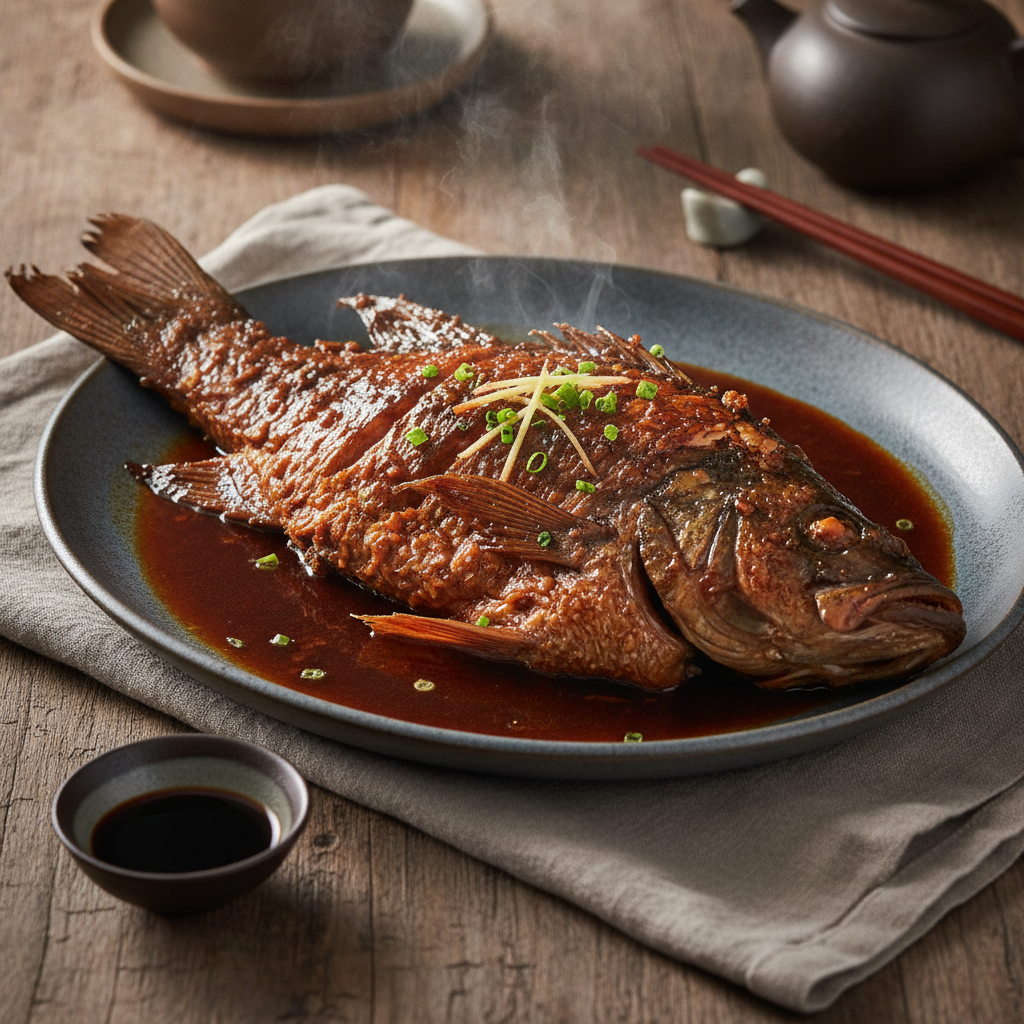
Hong shao yu achieves in 20 minutes what hong shao pork needs hours to reach: a fish lacquered in deep mahogany, coated in a glaze that is simultaneously rich, savory, sweet, and bright. The name means red-braised — the color comes not from chili but from caramelized rock sugar and dark soy sauce working together in hot oil. This is one of China's oldest and most iconic techniques, originally developed in Jiangsu province and now practiced across every regional cuisine. The fish carries serious cultural weight. At Chinese New Year tables, a whole fish represents abundance (年年有余, nián nián yǒu yú — a pun on "year after year, abundance"), and there is a longstanding taboo against flipping the fish on the plate: symbolically, it capsizes the fishing boat. The fish is served, eaten from one side, and the bones are lifted away cleanly. Technically, two details separate a restaurant-quality hong shao yu from a home version that sticks and breaks: the fish must be bone-dry before it goes in the wok, dusted in cornstarch, and left completely alone for several minutes until the crust sets and releases naturally. And the Zhenjiang black vinegar — a complex, aged rice vinegar from Jiangsu — goes in at the absolute last minute. Added too early, its volatile brightness cooks away entirely; added at the end, it cuts through the lacquered richness and makes the whole dish come alive.
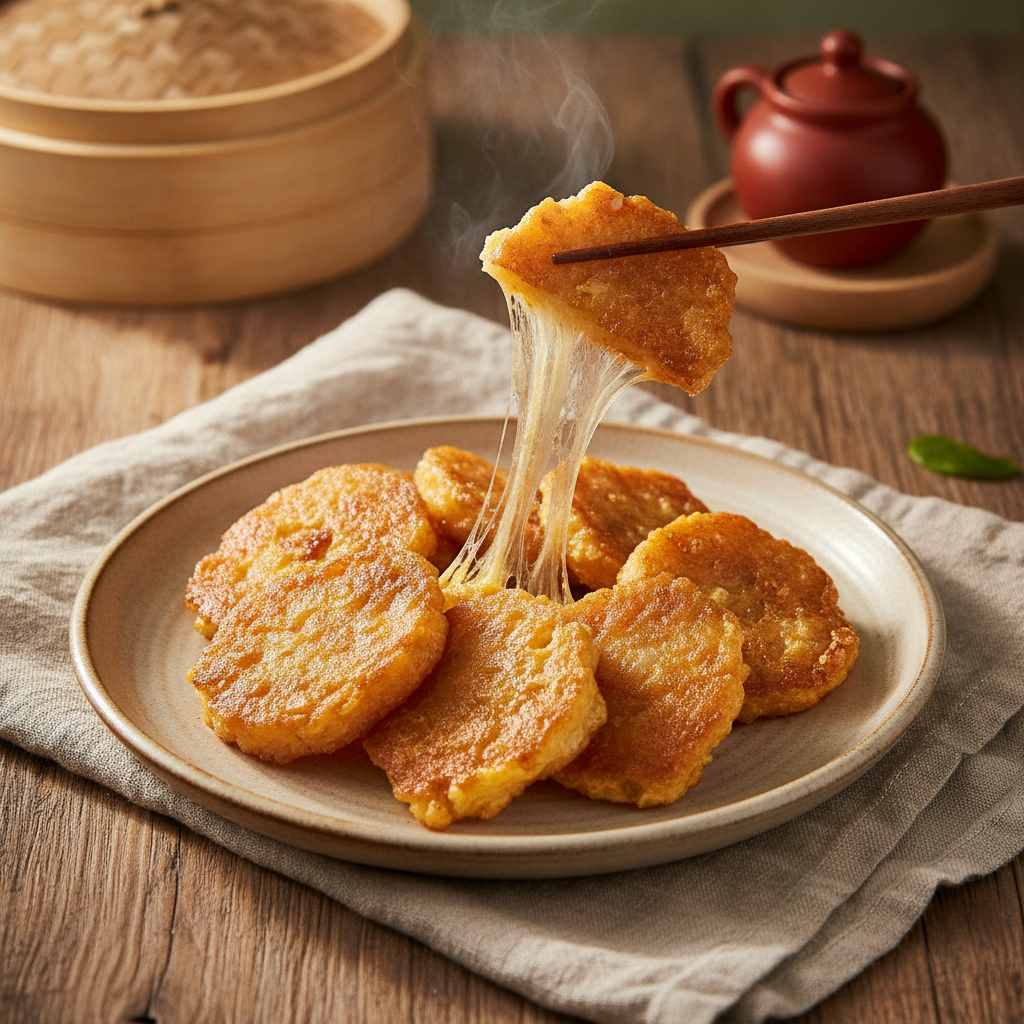
Nian gao (年糕) is one of the most symbolically weighted foods in Chinese culture. The name is a near-perfect homophone for nián gāo (年高) — 'year higher' — encoding wishes for rising prosperity, growing children, and climbing fortune into every bite. It spans the entire Lunar New Year period: given as gifts, stacked in temple offerings, carried across generations in red-wrapped blocks. The sweet Cantonese version described here — dense, glossy, made with glutinous rice flour and brown sugar — has roots documented in Tang dynasty culinary texts, and the folk origin myth attached to the 6th-century BCE official Wu Zixu tells of nian gao stored beneath the city walls feeding a people through siege. That story, true or not, is part of why nian gao still matters: it is food that remembers. What you are making here is two things in sequence. First, a steamed nian gao — a technique that locks moisture into the glutinous rice and sets it into a dense, mochi-adjacent cake that will keep in the refrigerator for two weeks. Second, and most immediately, you are pan-frying slices of that cake in egg batter — a transformation that converts a soft, sticky leftover into something entirely different: exterior golden and crisp, interior warm, gooey, stretching between your chopsticks with the elasticity of well-worked mochi. This is the preparation that has made nian gao the most memorable dish of Lunar New Year for cooks outside China, and it is the one worth making at home.
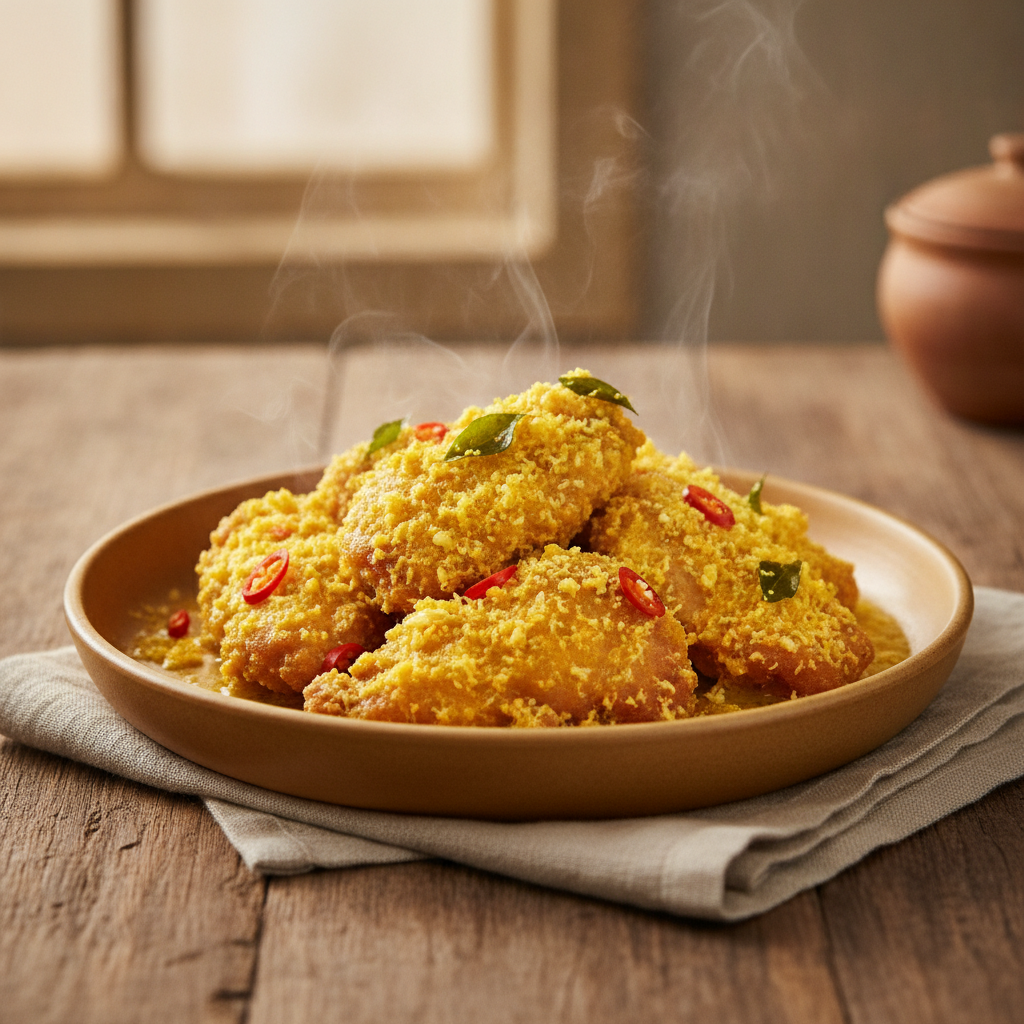
Salted egg yolk chicken is a product of Singapore's zi char culture: casual, smoky, high-heat restaurant cooking where chefs push familiar ingredients into surprising territory. The hero of the dish is the cured duck egg yolk — an ingredient that has appeared in Chinese cuisine since at least the 5th century CE, originally as a preservation technique for perishable eggs. What modern hawker cooks discovered is that steamed, mashed yolks behave almost like a fat when cooked into butter. The result is a sauce unlike any other: foamy, grainy, intensely savory, and improbably light on the palate. The dish works because of contrast. The chicken's crust is thin and crackling — made with potato starch rather than heavy batter — and that fragility makes the warm, buttery yolk coating feel like a revelation rather than a burden. Curry leaves, non-negotiable in the Singapore and Malaysian versions, add a faintly citrusy, herbal fragrance that cuts through the richness with every bite. Bird's eye chili brings sharp heat. A pinch of sugar rounds the aggression of the salt-cured yolk. The result is a dish where every element earns its place.
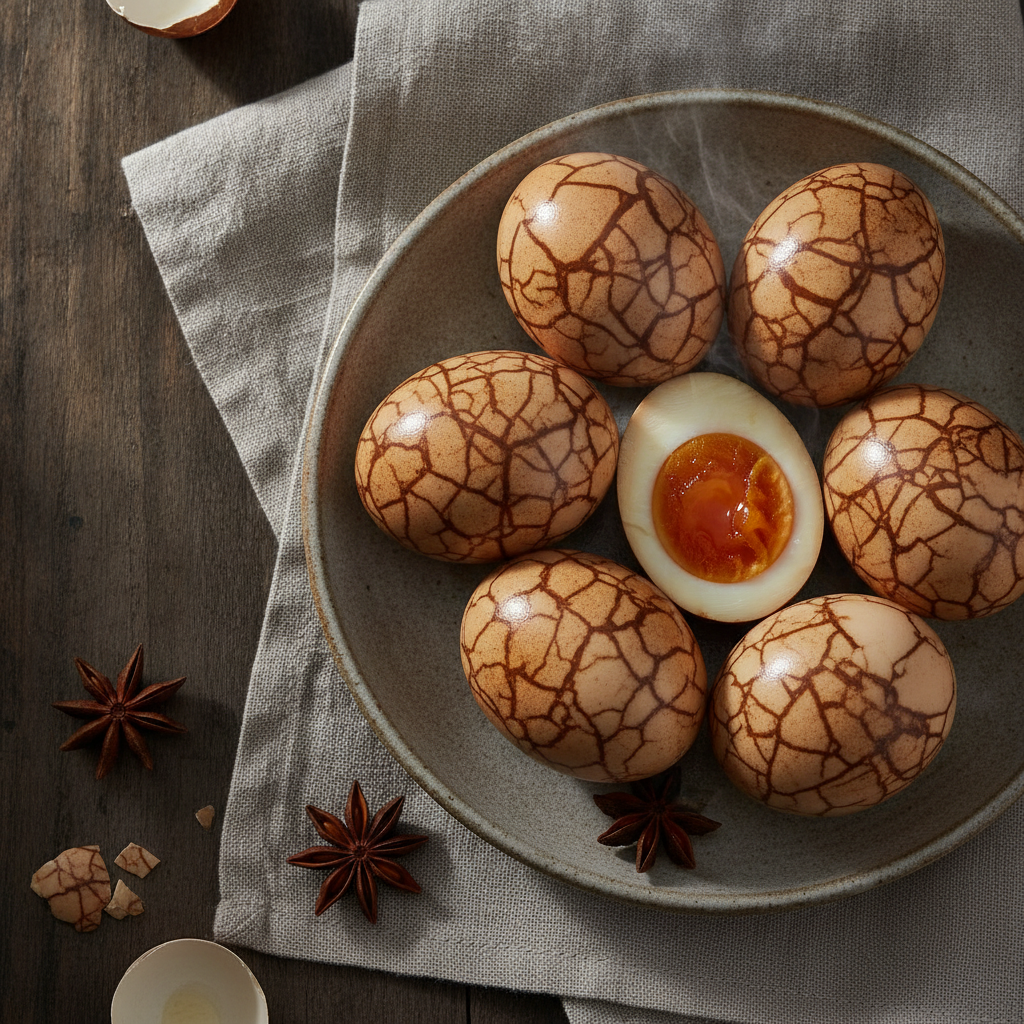
Tea eggs are one of the most satisfying things you can make: a simple hard-boiled egg transformed into something complex, beautiful, and deeply savory. The technique is a two-stage cook — boil first, crack the shells all over with the back of a spoon, then steep in a spiced brine of black tea, soy sauce, and star anise until the pigments seep through the fissures, leaving a web of deep brown lines across the white. No two eggs look the same. They smell like a Chinese kitchen in the best possible way. They are, frankly, one of the best snacks in the world — sold from giant heated pots at 7-Eleven counters in Taiwan, train stations in Zhejiang, and night markets across greater China. The marbled shell is not decoration; it tells you exactly how long and deeply the egg has been steeped. The recipe is easy and mostly hands-off. The patience is in the steeping: a minimum of 2 hours produces light marbling and mild flavor; overnight in the fridge gives you the real thing — deep brown spider-web lines and a savory brine that has worked all the way through the white. Plan for overnight on your first batch.
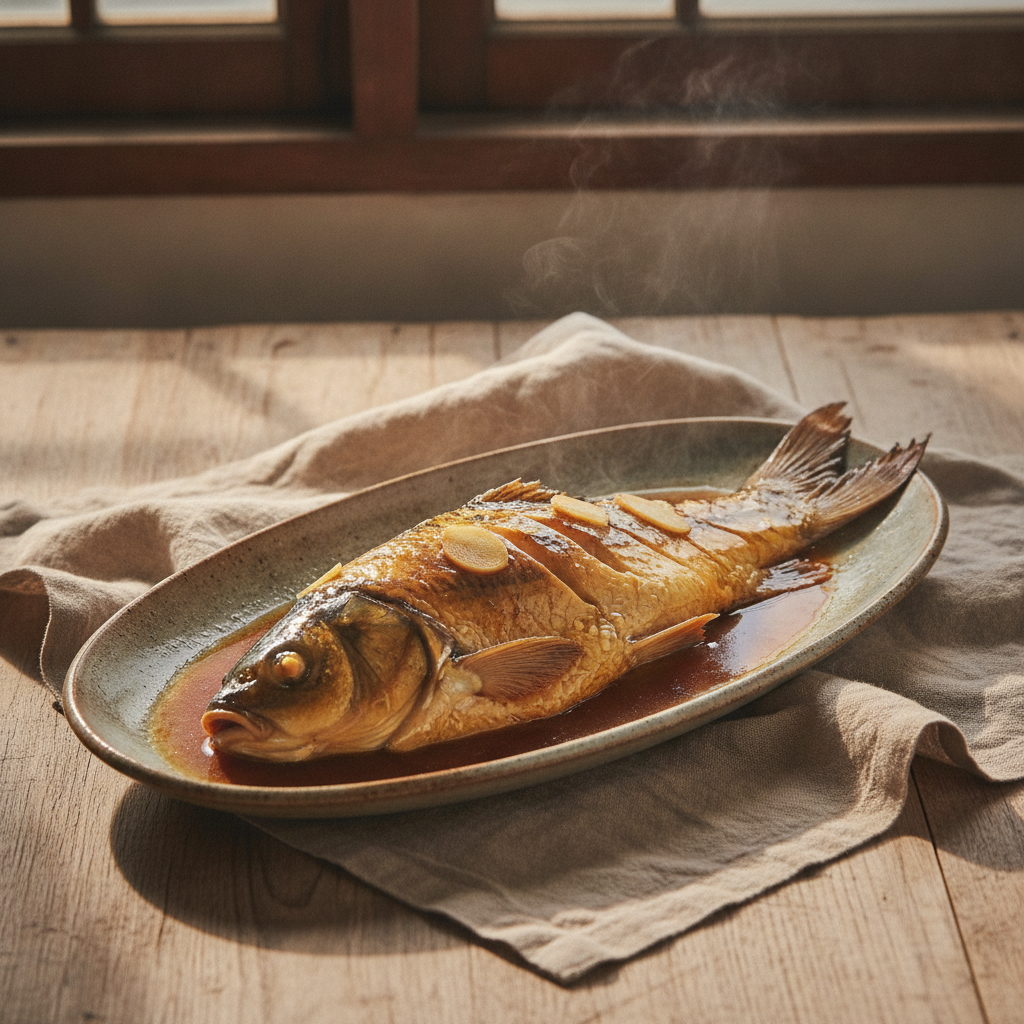
West Lake Vinegar Fish (西湖醋鱼, Xī Hú Cù Yú) is the crown jewel of Hangzhou cuisine — a whole freshwater carp poached to silky tenderness, then finished with a shimmering sweet-sour glaze built from Zhenjiang black vinegar, sugar, and a light touch of ginger. No wok hei, no frying, no chili heat. This is restraint made delicious: the fish cooks gently in simmering water until the flesh just releases from the bone, then the glossy sauce is poured over hot at the table, lacquering every surface in a thin, balanced sweet-sour film. The dish traces back to the Song dynasty, when a chef named Song Wusao cooked fish soup for Emperor Gaozong as he toured the storied waters of West Lake — a moment so memorable it became Hangzhou's most iconic recipe. If you've been chasing bold Sichuan fire or Cantonese umami, this will reset your palate: subtle, elegant, and unmistakably regional.
10 / FAQ
It helps, but a flat-bottom wok on a regular gas burner gets you most of the way. Induction can work too if it's powerful enough. Electric coils — accept the limitation and cook in smaller batches.