01
Pat the meat dry
Surface moisture is the enemy of a good sear. Pat the meat with paper towels and salt it generously 30 minutes ahead if you can.
01 / Techniques · A Souschef guide
Sear hard, simmer slow.
02 / Intro
Braising is the technique that makes tough things tender and cheap cuts taste expensive. You sear meat hard in a heavy pot, then submerge it partway in liquid and cook covered at low heat for hours. The connective tissue (collagen) melts into gelatin, the muscle fibers relax, and what started as a brick of shoulder ends up falling apart with a spoon.
Almost every cuisine has its version. French daube, Italian brasato, Mexican birria, Korean galbi-jjim, Filipino adobo — they're variations on the same physics. What changes is the liquid (wine, stock, soy, vinegar, coconut milk), the aromatics, and what you serve it with. Master the method and you've unlocked maybe a hundred dishes.
03 / How it works
Collagen — the connective tissue in cheap cuts like chuck, shoulder, and shank — is tough at room temperature and rubbery when cooked fast. Held at 70–85°C in liquid for two to three hours, it hydrolyzes into gelatin. The same protein that makes a steak chewy makes a braise silky.
The liquid does double duty. It conducts heat evenly through the meat (water transfers heat much faster than air), and it captures the rendered fat and gelatin to become the sauce. By the end, the meat and the liquid are the same dish.
04 / Why it works
The result is umami-dense, full-bodied, and forgiving. Because braising is a slow conversion, the time window is wide — twenty minutes more won't ruin it. The sauce thickens naturally as the gelatin emerges. And the dish reheats better the next day, as the flavors continue to integrate.
05 / Method · Step by step
Surface moisture is the enemy of a good sear. Pat the meat with paper towels and salt it generously 30 minutes ahead if you can.
Heat oil in a heavy Dutch oven until it shimmers. Sear the meat in a single layer with space between pieces — overcrowding steams instead of browns. Get a deep brown crust on all sides, about 3–4 minutes per face.
Remove the meat. Lower the heat. Add onion, carrot, celery (or your cuisine's equivalent) and cook until soft, 8–10 minutes. Add garlic and tomato paste, cook 1 more minute.
Pour in wine, stock, or vinegar to scrape up the fond — the brown bits stuck to the pan. They're concentrated flavor and the sauce starts here.
Settle the seared meat back in. Add stock or water until the liquid comes halfway up the meat — not submerged. Add bay, thyme, peppercorns, or your aromatics.
Bring to a gentle simmer, then transfer to a 150°C (300°F) oven covered, or hold over the lowest stovetop flame. Cook 2–3 hours, turning the meat once at the halfway mark, until a fork slides in with no resistance.
Remove the meat to a plate. Tip the pot and skim off the surface fat with a ladle. If the sauce is thin, simmer it uncovered for 10 minutes to concentrate. Taste, adjust salt, and serve.
06 / Pitfalls · The avoidable mistakes
If…
Submerging the meat completely
…fix
You want liquid halfway up the meat, not over it. Total submersion makes a boiled stew, not a braise.
If…
Boiling instead of simmering
…fix
If the surface is rolling, it's too hot. You want occasional lazy bubbles. Hard boil makes meat tough and squeezes water out.
If…
Skipping the sear
…fix
The Maillard reaction on the meat's surface is most of the dish's flavor. Don't shortcut it.
If…
Lifting the lid every 10 minutes
…fix
Heat escapes and the temperature drops. Set a timer, check at the halfway point, and trust the process.
07 / Recipes · 48 using braising
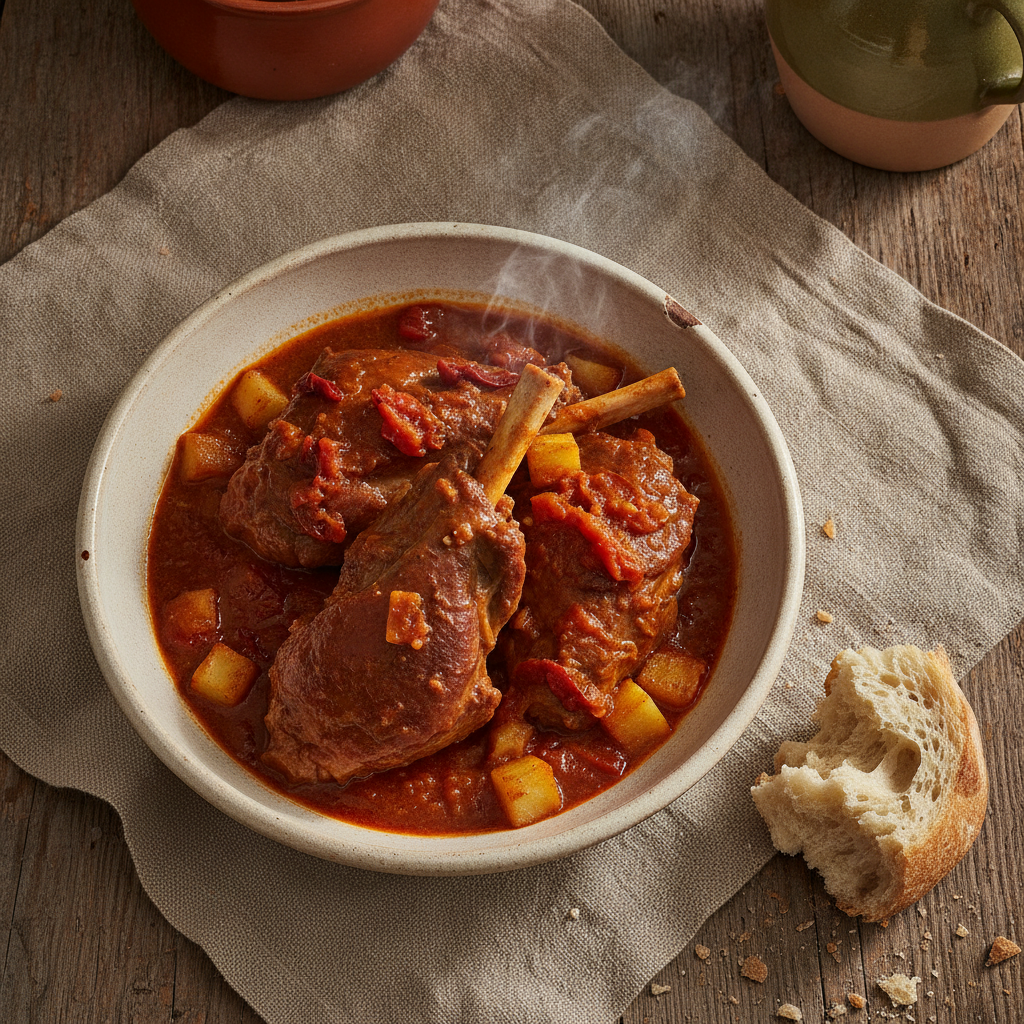
Cordero al Chilindrón is the Sunday lamb of Aragon — a dish that couldn't exist before the 16th century, when peppers and tomatoes arrived from the Americas and transformed the mountain cooking of the Pyrenean foothills. Today it is Aragon's culinary calling card: bone-in lamb slow-braised in a sauce of choricero peppers, fresh red bell peppers, late-summer tomatoes, and sweet pimentón until the meat falls from the bone and the sauce coats everything like lacquer. Aragonese people feel about chilindrón the way Bolognese feel about their ragù: it belongs to them, it has regional rules, and shortcuts are noticed. The word 'chilindrón' may derive from 'chillón' (noisy) or from the pepper itself — the etymology is genuinely contested. What is certain is that the sauce defines a culinary triangle: Aragon, Navarra, and La Rioja all claim versions, though the Aragonese interpretation (with tomato) is the richest and most widely known. Navarrans make a 'fritada' without tomato — lighter and fresher. Both are legitimate expressions. What unites them is the choricero pepper, a large, mild, sweet dried pepper from the Ebro valley. Note: choricero peppers are not ñora peppers (those are smaller and smokier from Murcia); the distinction matters, and many readers will conflate the two. The dish originated as spring lamb cooking tied to seasonal celebrations in Pyrenean mountain villages — peasant-Sunday food at its most honest: few ingredients, long time, serious result. The traditional accompaniment is fried diced potatoes (patatas parmentier), not rice. Bread on the table is not optional; it exists to recover every last drop of sauce from the plate.
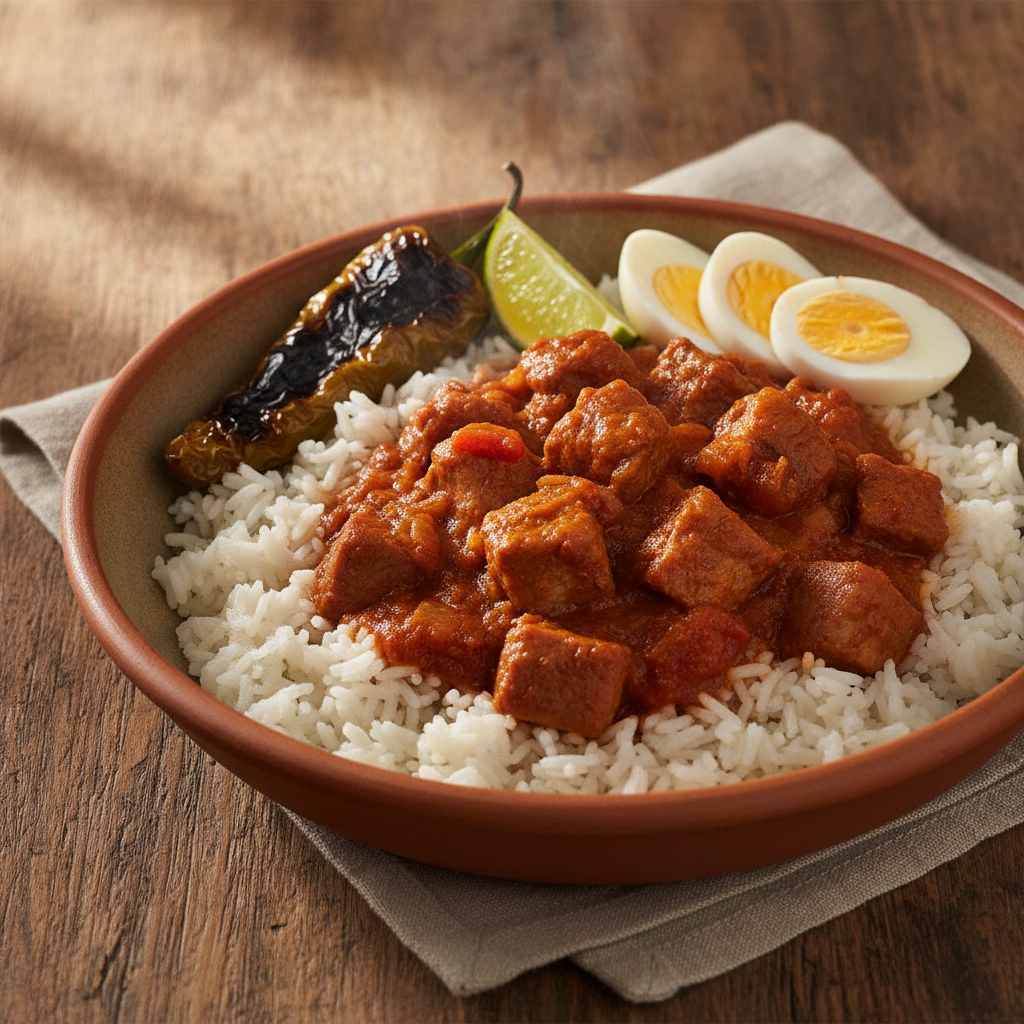
Lomitos de Valladolid is one of the quiet glories of Yucatecan home cooking — not the famous cochinita pibil that fills tourist menus, but the stovetop braise that Valladolid families have been eating for lunch on weekdays for generations. Named for the colonial city in eastern Yucatán, a pueblo mágico that sits at the crossroads of the old Maya trade routes and the road to Chichén Itzá, the dish is credited by local culinary legend to Doña Hermelinda, a home cook whose recipe spread through the city's comedores and kitchens until it became synonymous with the place itself. What makes lomitos taste the way it does is layered charring at every stage. The tomatoes, onion, and garlic all spend time directly on a hot comal until they're blackened in spots — that caramelized bitterness becomes the backbone of the sauce. The pork gets browned hard in lard, building a fond on the pan bottom. Then the blended sauce goes back into that same pan and cooks down in the fat until it darkens and thickens before the pork returns. By the time the braise is done, you've built three separate Maillard layers into a single pot. This is not primarily an achiote dish — that's a common misconception that conflates lomitos with cochinita pibil. The achiote in this recipe is optional, adding a faint earthiness and the orange-red color that signals Yucatán, but the dish exists and is authentic without it. The tomato is the star. The sliced hard-boiled egg placed on top before serving is not decoration — it's a traditional textural foil, mild and cooling against the spiced pork, and it appears on every lomitos plate in Valladolid's lunch spots. Don't skip it. --- ## Ingredients ### Pork - 1½ lbs (680g) **pork loin**, cut into 3 cm (1¼-inch) cubes — pork shoulder works if the loin seems too lean - 2 tablespoons **lard** or vegetable oil (lard is traditional and gives better flavor) - 1 teaspoon fine sea salt - ½ teaspoon black pepper, freshly ground ### Tomato-Chile Sauce - 1½ lbs (680g) **ripe tomatoes** (about 4 medium; Roma or vine-ripened) - 1 medium **white onion**, halved through the root — one half for charring, one half left raw for the table - 4 cloves **garlic**, unpeeled for charring - 2 to 3 **chiles de árbol** or chile seco, stemmed (use 2 for medium heat, 3 for more) - 1 teaspoon **Yucatecan oregano**, dried — Mexican oregano is a usable substitute; the Yucatecan variety is more floral - 1 tablespoon **achiote paste (recado rojo)**, optional but traditional; dissolved in the sour orange before adding - 3 tablespoons **naranja agria** (sour orange juice) — substitute: 2 tablespoons fresh orange juice + 1 tablespoon fresh lime juice - 1 cup **water or light chicken broth** - Salt to taste ### For Serving - 2 cups **long-grain white rice**, cooked (makes about 4 cups cooked) - 2 **hard-boiled eggs**, peeled and sliced into rounds - 1 to 2 **habanero peppers**, charred whole on the comal and served on the side - 1 **lime**, cut into wedges --- ## Instructions **1. Season and dry the pork.** Pat the pork cubes completely dry with paper towels — moisture is the enemy of a good sear. Season generously on all sides with the salt and pepper. Set aside while you prepare the sauce ingredients. **2. Char the tomatoes, onion, and garlic.** Heat a dry comal or cast iron skillet over high heat until smoking. Place the tomatoes, one onion half (cut side down), and the unpeeled garlic cloves directly on the dry surface. Char, turning occasionally, until the tomatoes are blistered and blackened in spots (10–12 minutes), the onion cut face is deeply caramelized (8–10 minutes), and the garlic skin is scorched and the cloves are softened (6–8 minutes). They don't need to be uniformly blackened — you want patches of deep char, not ash. Transfer everything to a plate. Peel the garlic when cool enough to handle. **3. Toast and rehydrate the chiles.** On the same dry comal, toast the dried chiles over medium heat for 30–45 seconds per side, pressing them flat with a spatula, until they darken slightly and smell fragrant. Don't let them blacken — the seeds will turn bitter. Transfer to a small bowl, cover with hot water, and soak for 10 minutes until pliable. Drain. **4. Blend the sauce.** In a blender, combine the charred tomatoes (with any accumulated juices), charred onion half, peeled garlic, drained soaked chiles, oregano, and ½ teaspoon salt. If using achiote paste, dissolve it in the sour orange juice first, then add it to the blender. Add the sour orange juice (or orange-lime substitute). Blend until smooth, about 1 minute. The sauce will be deeply colored — brick-red to mahogany. **5. Brown the pork in batches.** In a large heavy pot or Dutch oven, heat the lard over high heat until shimmering and a drop of water sizzles on contact. Working in two batches (do not crowd the pan — crowding steams the pork instead of browning it), add the pork cubes in a single layer. Sear without moving for 3–4 minutes until deeply golden on the bottom, then turn and brown at least one more side, 2–3 minutes more. Transfer to a plate. Repeat with the second batch. The fond (browned bits) on the pan bottom is flavor — leave it. **6. Fry the blended sauce.** Reduce the heat to medium-high. Without cleaning the pot, carefully pour the blended sauce directly into the hot fat — it will splatter, so stand back and use a lid as a shield if needed. Stir to incorporate the fond from the pan bottom. Cook the sauce, stirring frequently, for 8–10 minutes until it darkens further, thickens visibly, and the raw tomato taste mellows into something deeper. The sauce is ready when it holds its shape briefly in a spoon trail. **7. Braise the pork.** Add the browned pork and any resting juices back to the pot. Pour in the water or chicken broth. Stir to coat the pork with sauce. Bring to a boil, then reduce heat to low, cover, and braise for 60–70 minutes, stirring every 20 minutes, until the pork is completely tender — it should yield easily to a fork with no resistance. In the last 10 minutes, remove the lid and raise the heat slightly to reduce the sauce to a thick, glossy consistency that coats each piece of pork. Taste and adjust salt. **8. Char the habaneros.** While the pork finishes, place the habanero peppers on the dry comal over high heat and char on all sides until blistered, 5–6 minutes. Keep them whole — the heat releases the fragrant oils but the intact skin holds back most of the fiery capsaicin. Serve them whole on the side; diners pierce or bite as desired. **9. Serve over rice with egg.** Spoon a mound of white rice into each bowl or onto each plate. Ladle the lomitos over and around the rice, making sure each portion gets plenty of sauce. Lay 2–3 slices of hard-boiled egg across the top — this is the traditional Valladolid presentation, not optional garnish. Place a whole charred habanero alongside and a lime wedge at the edge. Serve immediately. --- ## Tips **Don't skip the charring.** The charring of tomatoes, onion, and garlic is what gives this sauce its complexity. Plain simmered tomato produces a flat, acidic braise. The char adds a bittersweet depth — this step is non-negotiable. **Brown in batches, seriously.** Crowding the pan drops the oil temperature and the pork steams instead of sears. Brown in two batches minimum. **Achiote is optional, not central.** Many recipes online — especially those written outside Yucatán — portray lomitos as an achiote-forward dish. It isn't. It's a tomato braise. The achiote adds color and a faint earthiness. If you don't have recado rojo, skip it. **This dish is better the next day.** Like most braises, lomitos improves significantly after resting overnight. Reheat gently over low heat with a splash of water or broth to loosen the sauce.
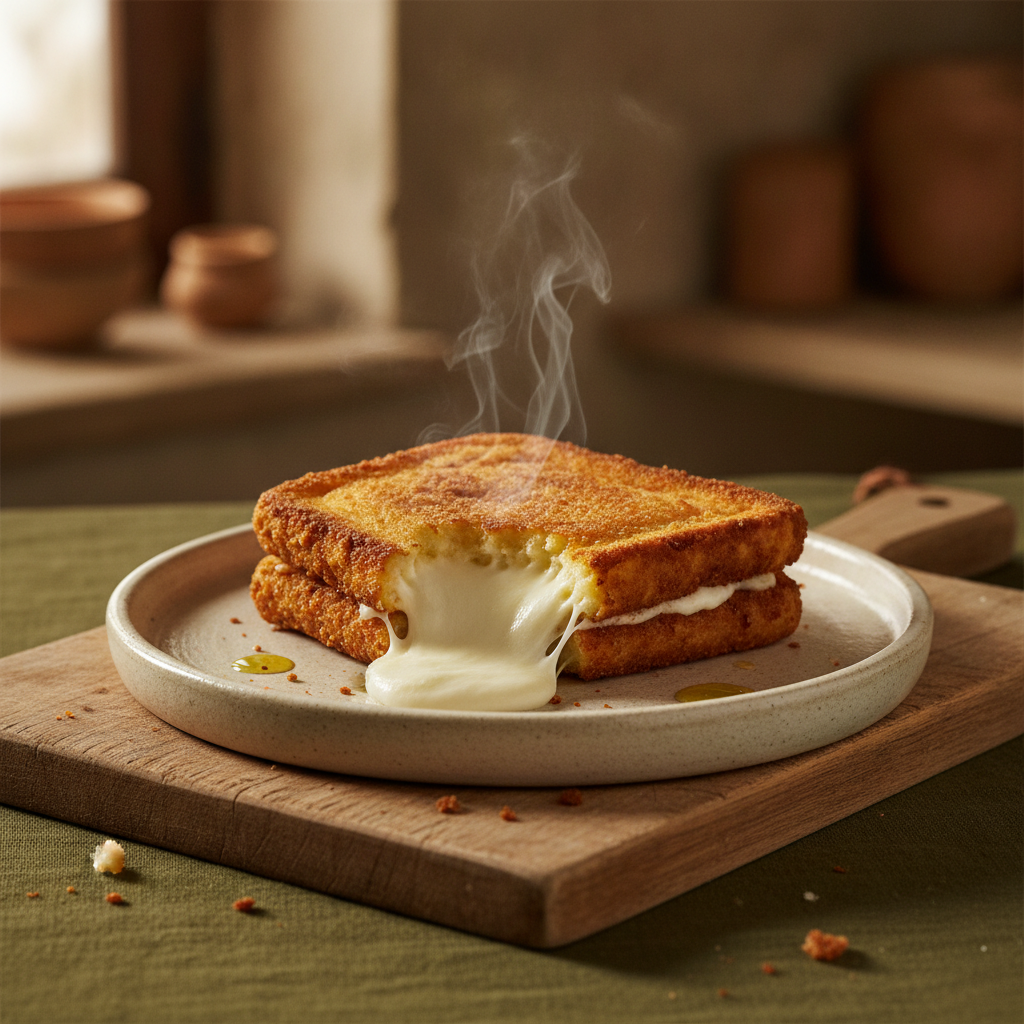
Campanian by birth, Roman by adoption — mozzarella in carrozza is cucina povera at its most satisfying: a sealed bread pocket that traps the cheese so completely it's still pulling strings two minutes after you plate it.
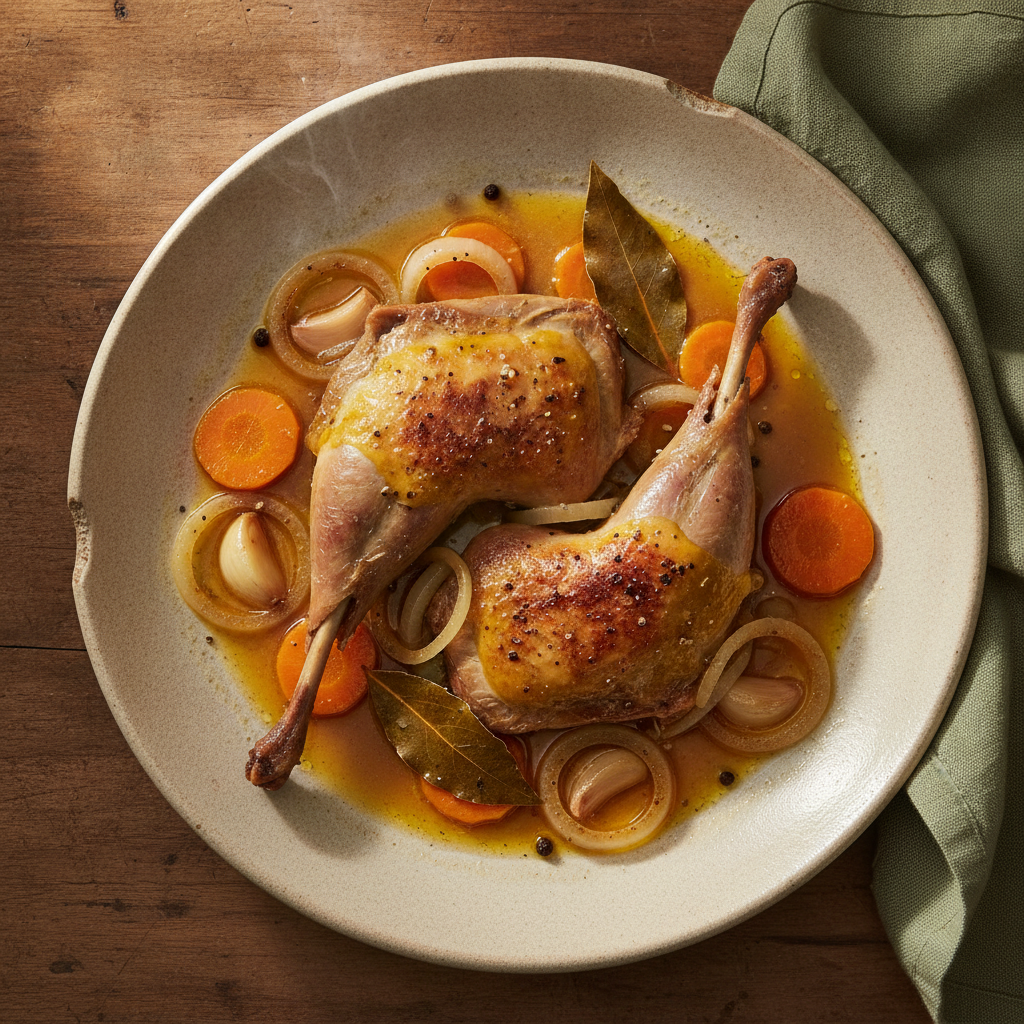
Before refrigeration, hunters across the meseta of Castile-La Mancha faced a practical problem: what do you do with two or three birds shot on a cold autumn morning when you won't be home until evening, and the guests don't arrive until tomorrow? The answer, honed over centuries, was escabeche — a hot vinegar-and-oil bath that cooked the game birds, preserved them, and made them taste better with every hour that passed. Perdiz en escabeche is one of the oldest continuously cooked dishes in the Spanish kitchen. Its lineage traces to Arab al-sikbaj, the sweet-sour meat preparations that crossed into the Iberian Peninsula during the Moorish era, and Spanish cookbooks of the 16th century already describe the technique in terms that would be recognizable today. What the hunters of La Mancha understood — and what a refrigerator has made us forget — is that vinegar, olive oil, and time are a preservation system as elegant as cold, and considerably more delicious. The partridges are browned in oil, then braised slowly in equal parts white wine and vinegar, with onion, carrot, garlic, bay, and peppercorns. After a long, gentle simmer they are left to cool in their liquid, refrigerated overnight, and served cold or at room temperature the next day. The pickling liquid softens and mellows as it chills; the oil emulsifies into something close to a dressing; the onion rings become edible and rich and worth fighting over. This is a dish that requires no last-minute cooking, improves dramatically with time, and announces itself at the table with the clean, wine-bright smell of a place where game has always been serious business. If partridge is unavailable — and outside of autumn at a specialty butcher, it often is — bone-in, skin-on chicken thighs make an excellent substitute. The technique is identical; reduce braising time to 45 to 55 minutes.
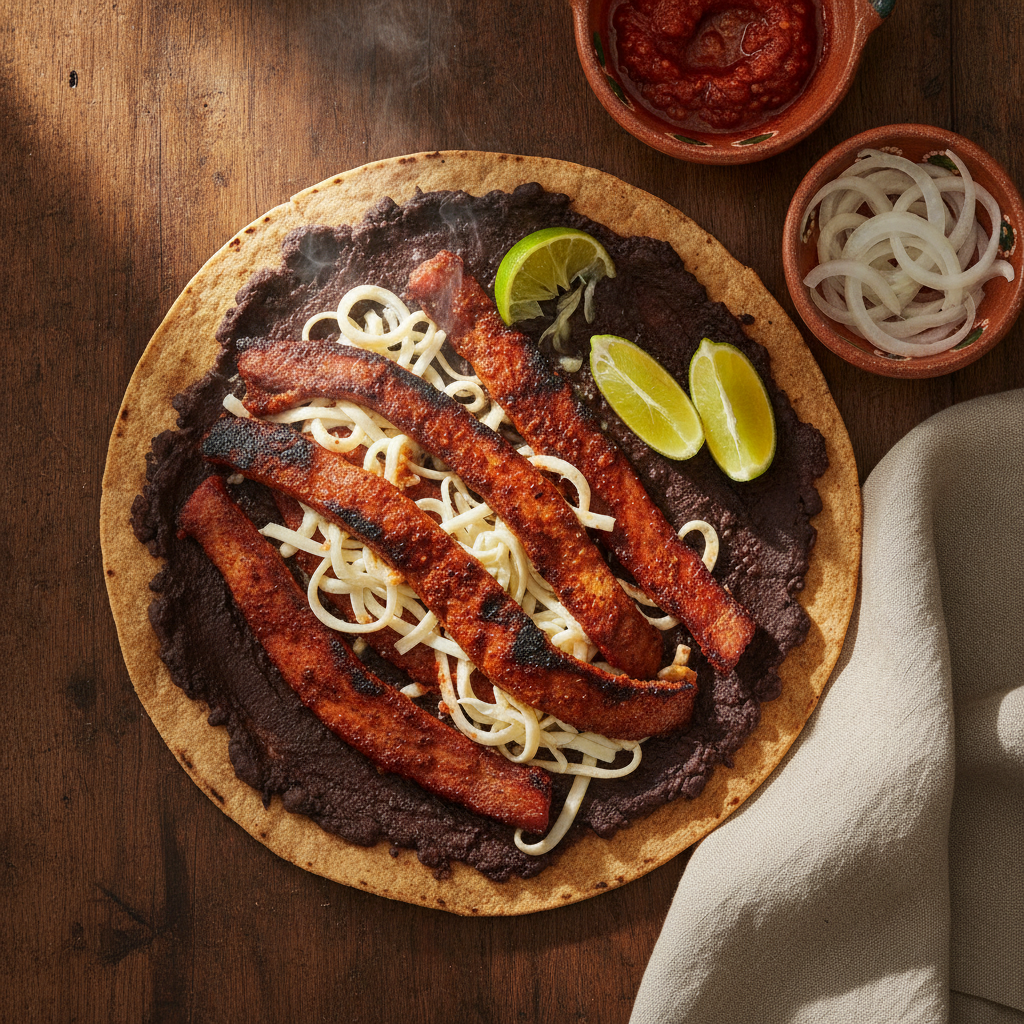
Cecina enchilada is the Oaxacan pork version of cecina — not to be confused with the beef cecina of Yecapixtla, Morelos. That Morelos version is salt-only, unspiced, and nationally famous. This one — the Oaxacan kind — is pork leg or shoulder rubbed in a paste of dried guajillo and ancho chiles, blended with garlic, white vinegar, and Mexican oregano, then air-dried until the surface turns from glossy to matte and slightly tacky, and grilled over fierce heat for 2–3 minutes. In Oaxaca City's markets, cecina enchilada hangs in enormous sheets at carnicerías next to tasajo and chorizo verde — the triad of Oaxacan cured meats that appear together on tlayudas across the Central Valleys. The name enchilada signals the chile treatment: it distinguishes this pork from the plain beef kind. Call it by the full name when you're describing it outside Oaxaca, or you'll be misunderstood. The recipe is an exercise in restraint applied in the right places. The adobo is deliberately simple — four dried chiles, garlic, vinegar, oregano, cumin, salt — because the objective is not a complex mole-adjacent paste but a concentrated chile coating that can dry and then char. Too much liquid in the adobo prevents the drying. Too many spices compete with what charcoal does to it. The air-drying step is where most home recipes fail: they skip it and produce adobo-marinated pork, good in itself but not cecina. The drying concentrates the paste, changes its texture from wet to tacky, and creates the substrate for the caramelization that happens on the grill. Without it, the adobo steams instead of chars. Even two hours in the refrigerator on a wire rack, uncovered, changes the result significantly. Overnight is better. The grill itself is the final step and the fastest: 2–3 minutes per side over maximum heat. At 3–4 mm, the pork cooks through almost instantly. You are not cooking the meat so much as charring the chile coating — the goal is caramelized, slightly blackened edges on the adobo crust, with the interior just cooked through. A cast-iron comal at maximum heat is a legitimate indoor alternative. --- ## Ingredients ### The Pork - **1½ lbs (680g) pork leg steaks or pork shoulder**, butterflied and sliced 3–4 mm thin — ask a Mexican butcher for *pierna de cerdo fileteada* or for *cecina verde* (unspiced thin-sliced pork). At home: place each piece between plastic wrap and pound with a meat mallet until uniformly 3–4 mm. Thickness is non-negotiable. Pork belly is too fatty; loin or leg are the right cuts. ### Chile Adobo - **4 dried guajillo chiles**, stems and seeds removed — the adobo backbone: deep red, mild-to-medium heat, slightly fruity and tannic - **1 dried ancho chile** (or mulato), stem and seeds removed — adds chocolate-raisin depth; use one per 3–4 guajillos - **1 dried pasilla negro chile**, stem and seeds removed *(optional but excellent)* — earthier and darker; some Oaxacan versions use it for a deeper paste - **4 garlic cloves**, unpeeled - **3 tablespoons white vinegar** — tenderizes, helps the paste adhere, and extends shelf life - **1 teaspoon dried Mexican oregano** (*Lippia graveolens*) — do NOT substitute Mediterranean oregano; the flavor is completely different, earthier and more citrusy - **½ teaspoon ground cumin** - **1½ teaspoons kosher salt** - **¼ cup water**, plus more as needed ### To Serve - **2 limes**, cut into wedges — required garnish, not optional - **Warm corn tortillas** or tlayuda (large toasted Oaxacan tortilla) - **Thinly sliced white onion** - **Salsa verde or salsa roja** - **Black beans** *(optional, for the tlayuda plate)* - **Quesillo** (Oaxacan string cheese) *(optional, for the tlayuda plate)* --- ## Instructions **1. Toast the dried chiles.** Heat a dry comal or heavy skillet over medium heat. Toast the guajillo, ancho, and pasilla chiles one at a time, pressing each flat with a spatula for 15–20 seconds per side until fragrant and pliable — toasted but not blackened. Transfer immediately to a bowl, cover with boiling water, and soak for 20 minutes until fully softened. Drain, reserving 2 tablespoons of the soaking liquid. **2. Roast the garlic.** In the same dry skillet, roast the unpeeled garlic cloves over medium heat, turning occasionally, for 8–10 minutes until the skins are charred in spots and the cloves are soft throughout. Let cool briefly, then squeeze the roasted cloves from the skins. **3. Blend the adobo.** Combine the drained chiles, roasted garlic, white vinegar, Mexican oregano, cumin, salt, and ¼ cup water in a blender. Blend on high for 2–3 minutes until completely smooth — the adobo should have the consistency of thick paint. Add water a tablespoon at a time if the blender needs it. Taste and adjust salt. The paste will be very thick; that is correct. **4. Pound the pork thin and coat with adobo.** If your pork is not already sliced thin, place each piece between plastic wrap and pound with a meat mallet to 3–4 mm uniform thickness. Lay the pork flat on a rimmed baking sheet. Coat both sides generously with the chile adobo, working it in with your hands for even coverage. This is a dry rub paste, not a marinade — apply a thin, even layer that adheres to the surface, not pooling in liquid. **5. Air-dry the pork (2–4 hours or overnight).** This is the step that makes cecina cecina. Place the coated pork on a wire rack set over a baking sheet. Position it in a cool, dry spot: in front of a fan for 3 hours, or uncovered in the refrigerator overnight. The surface should go from glossy to matte and slightly tacky to the touch — that is moisture leaving and the adobo concentrating. Do not cover or stack the pieces; airflow does the work. Even 2 hours makes a real difference; overnight is best. **6. Grill hot and fast.** Heat a charcoal grill, gas grill, or cast-iron comal to maximum heat — screaming hot. Lay the cecina pieces flat (work in batches if needed) and cook 2–3 minutes per side. You want a caramelized, slightly charred adobo crust with a few dark spots — the chile sugars should visibly blacken at the edges. At this thickness the pork cooks through almost instantly. Remove to a warm plate immediately. **7. Rest and serve.** Let the cecina rest 2 minutes off the heat. Squeeze lime generously over each piece immediately before eating — this is not optional. **For the Oaxacan tlayuda plate:** spread black beans on a toasted tlayuda, top with cecina, add quesillo, and serve with salsa roja. **For tacos:** slice the cecina into strips, pile into corn tortillas with raw white onion and salsa verde. Lime always. --- ## Tips **Thickness is everything.** 3–4 mm only. Thicker cuts won't dry properly and will steam rather than char on the grill. A Mexican carnicero who does cecina will know exactly what you need if you ask for *pierna fileteada para cecina*. **Do not marinate — adobo is a dry rub paste.** Excess moisture defeats the air-drying step and produces a soft, steamed result instead of the firm, lightly chewy texture that defines the dish. If the paste is pooling and wet, reduce the water and let it sit longer. **Cast-iron comal for indoor cooking.** A cast-iron comal or large skillet at maximum heat is an excellent indoor alternative to a grill. The thermal mass sears the thin pork almost instantly and delivers real caramelization on the adobo crust. **Leftover adobo paste.** Any unused adobo keeps refrigerated for 2 weeks or frozen for 3 months. Use it on chicken thighs, beef skirt steak, or roasted vegetables.
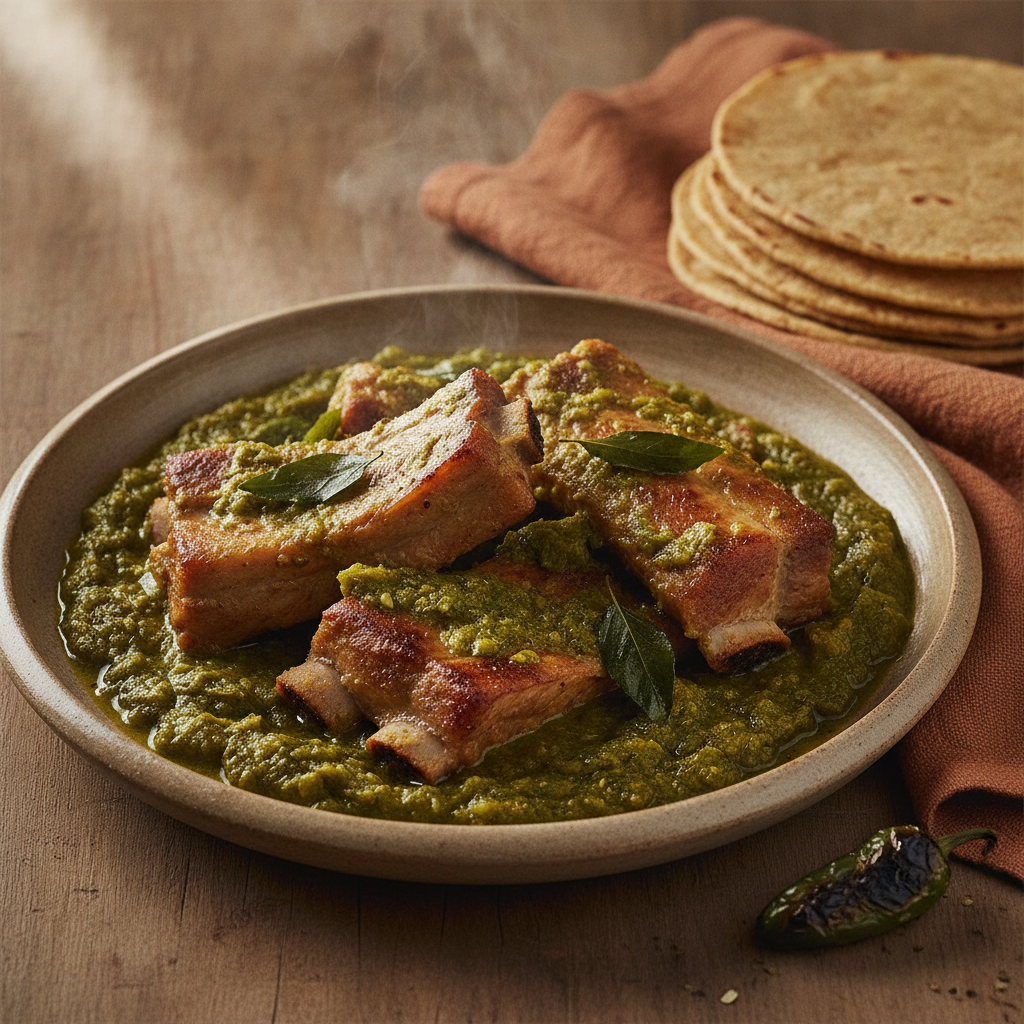
Costillas en salsa verde is the kind of Mexican home cooking that looks simple on paper and tastes like it took all day — but actually comes together in under an hour. Pork ribs are seared until golden, then braised in a charred tomatillo salsa that doubles as both cooking medium and finished sauce. The tomatillos roast under the broiler until blistered and sweet, the serranos add a clean, grassy heat, and the whole blended salsa deglazes the pan, pulling every bit of pork fond into itself. By the time the ribs are fork-tender, the sauce has reduced into something cohesive, bright, and faintly smoky. Warm corn tortillas are not optional here — they are the eating utensil. If you can find epazote, add it in the last few minutes of braising; its resinous, herbal punch is exactly what this sauce wants.
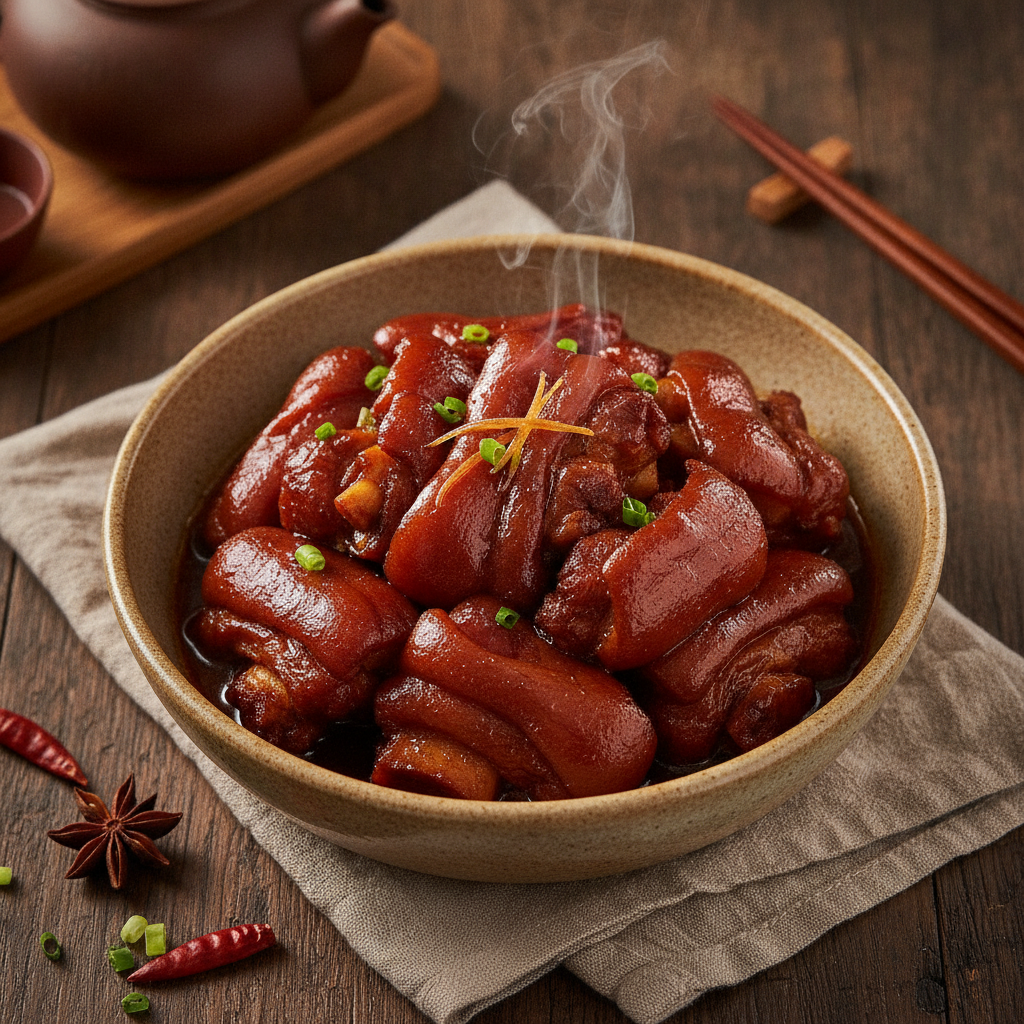
Hong shao zhu ti is one of those dishes that announces itself — the deep mahogany color, the lacquered skin pulling away from the bone, the unmistakable smell of caramelized sugar meeting star anise. These red-braised pork trotters are a staple of Chinese home cooking, humble in origin and spectacular at the table. The technique is hong shao (红烧), literally 'red braise' — a method that appears across Chinese regional cooking and owes its color not to chili but to two things: caramelized rock sugar and dark soy sauce. The sugar-browning step, known as chao tang se (炒糖色), is where most home cooks either succeed or fail. Get it right and you have a bittersweet caramel base that anchors the whole dish with a depth soy alone cannot provide. Get it wrong and you have bitter char. There is maybe a 15-second window between perfect amber and ruined. Watch carefully. Pork trotters — the foot and lower leg — are almost entirely skin, fat, tendons, and ligaments. These are not forgiving to undercooking. But give them 2 to 2.5 hours at a bare simmer and everything transforms: the collagen converts to rich gelatin, the skin becomes bouncy and silky, and the braising liquid reduces to a glossy sauce that coats every surface. The Chinese call this texture 'Q-tan': springy, gelatinous, unctuous without falling apart. In traditional Chinese medicine, trotters are considered especially nourishing — their high collagen content is associated with skin health and joint recovery. This is beauty food, comfort food, and celebration food all at once. Plan for 2.5 to 3 hours total, most of which is unattended simmering. Ask your butcher to chop the trotters into roughly 5cm pieces across the bone when you buy them.
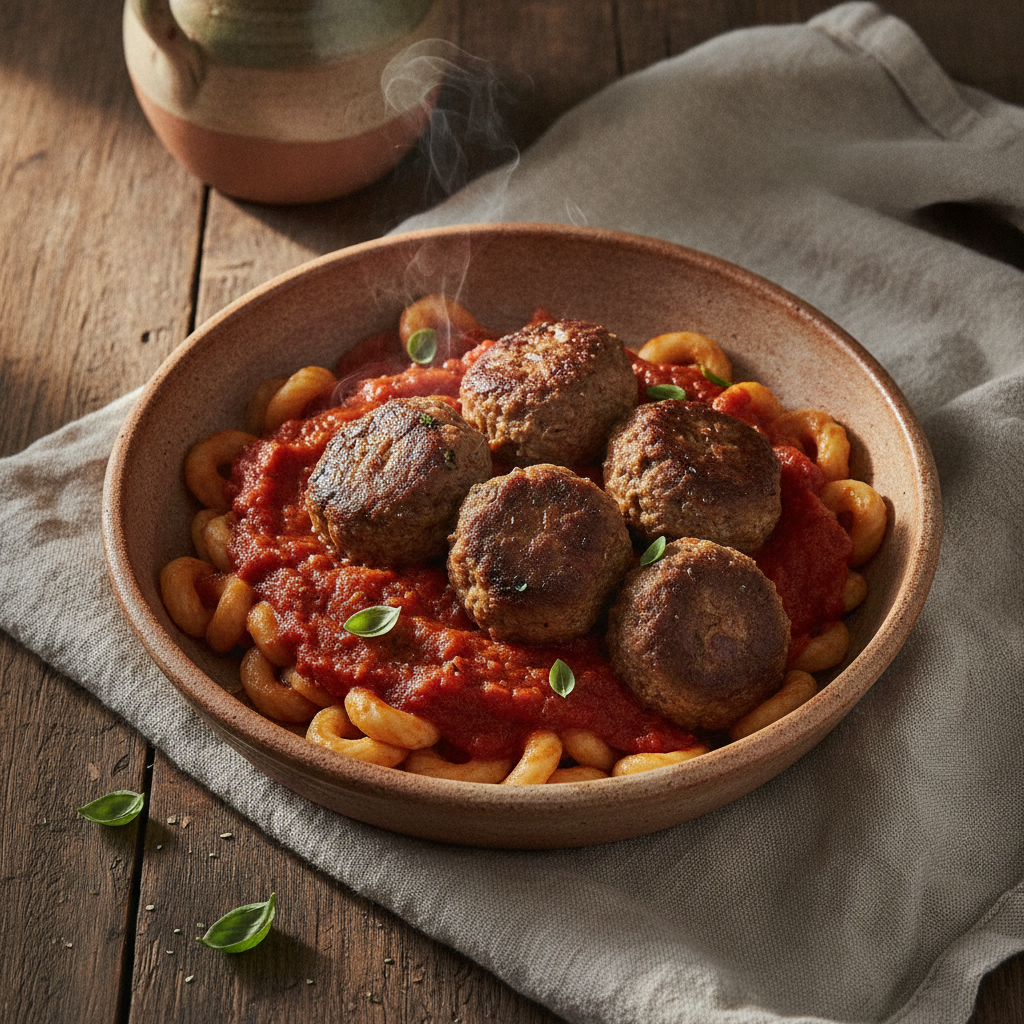
These are Neapolitan polpette — not the American-Italian kind served on spaghetti, but tender, slow-braised meatballs that give everything to the sauce and get something back in return. The sauce goes on pasta first; the meatballs follow as the main course.
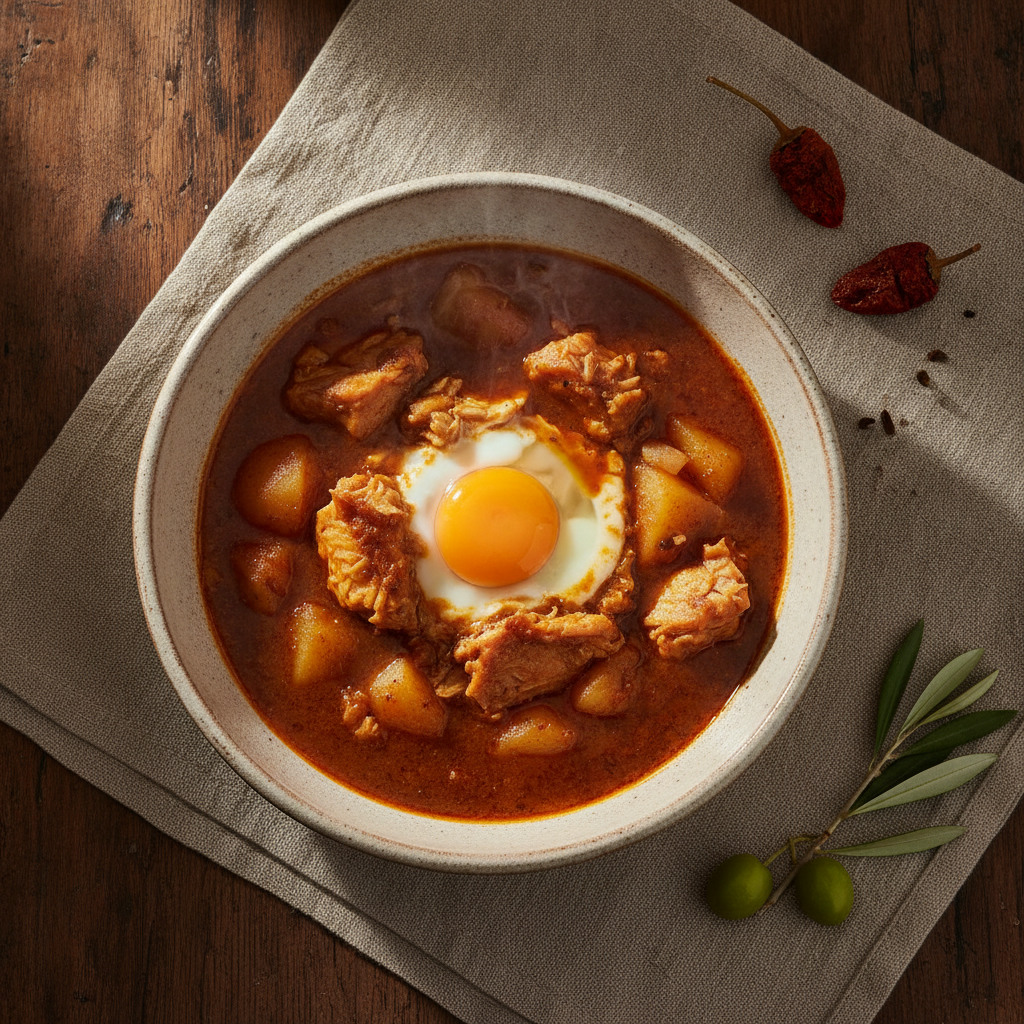
Before paella dominated the world's image of Valencian cooking, there was borreta. Inland, in the steep mountain towns around Alcoy, people kept Lent on a diet of salt cod from the coast, olive oil from their own trees, potatoes, and dried ñora peppers — the mild, fruity pepper native to this stretch of the Mediterranean. The result was borreta: a pure stew, no rice, thickened only by potato starch and the emulsifying power of olive oil. A whole egg cracked per person into the simmering pot at the end — runny yolk still trembling — is the dish's defining drama. A note before you start: desalt your cod at least 24 hours before cooking, 48 hours for thick pieces. Change the water three times. Under-desalted cod will salt the whole pot beyond rescue, and there is no way back. Plan ahead, and this dish rewards you enormously.
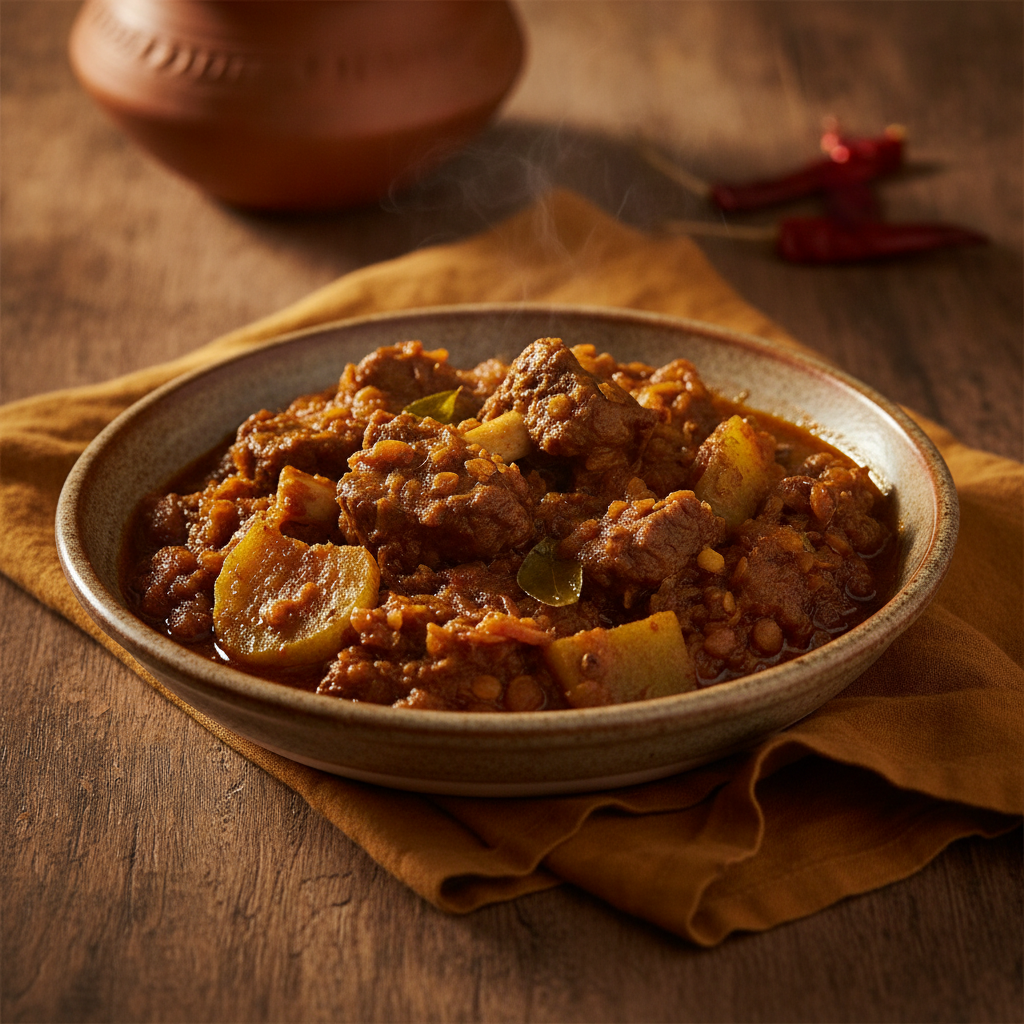
Mutton Dalcha is a Mughal-Nizami heirloom from Hyderabad's royal kitchens — a slow-simmered tangle of bone-in mutton and chana-toor dal that sits somewhere between a thick potage and a meat curry, united by an assertive tamarind sourness that cuts right through the richness. This is the dish Hyderabadi families set beside their dum biryani at Eid and wedding feasts, the one that makes the entire table taste complete. The sourness — called khatta — is the whole point, and tamarind is non-negotiable. Bottle gourd, mild and slightly sweet, is the Hyderabadi signature vegetable that no other regional version includes. The word dalcha likely derives from the Persian-origin harees tradition — slow-cooked meat and grain porridges brought to Hyderabad by the Asaf Jahi court (1724–1948) — adapted using Indian lentils in place of wheat. That layered inheritance shows on every spoonful. Give this your full attention on the bhuno stage. Deep golden-brown onions, not pale gold, build the entire flavour foundation of the stew. Everything else follows from that single commitment.
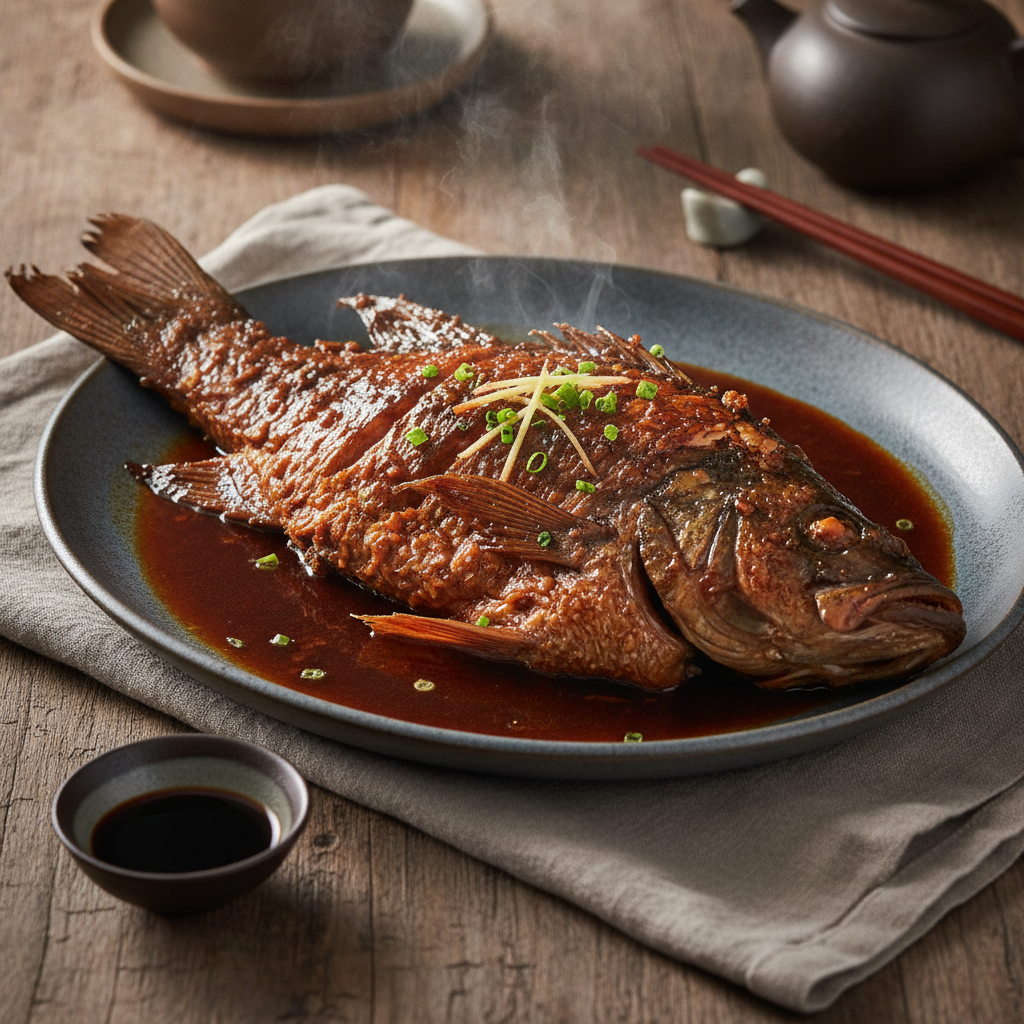
Hong shao yu achieves in 20 minutes what hong shao pork needs hours to reach: a fish lacquered in deep mahogany, coated in a glaze that is simultaneously rich, savory, sweet, and bright. The name means red-braised — the color comes not from chili but from caramelized rock sugar and dark soy sauce working together in hot oil. This is one of China's oldest and most iconic techniques, originally developed in Jiangsu province and now practiced across every regional cuisine. The fish carries serious cultural weight. At Chinese New Year tables, a whole fish represents abundance (年年有余, nián nián yǒu yú — a pun on "year after year, abundance"), and there is a longstanding taboo against flipping the fish on the plate: symbolically, it capsizes the fishing boat. The fish is served, eaten from one side, and the bones are lifted away cleanly. Technically, two details separate a restaurant-quality hong shao yu from a home version that sticks and breaks: the fish must be bone-dry before it goes in the wok, dusted in cornstarch, and left completely alone for several minutes until the crust sets and releases naturally. And the Zhenjiang black vinegar — a complex, aged rice vinegar from Jiangsu — goes in at the absolute last minute. Added too early, its volatile brightness cooks away entirely; added at the end, it cuts through the lacquered richness and makes the whole dish come alive.
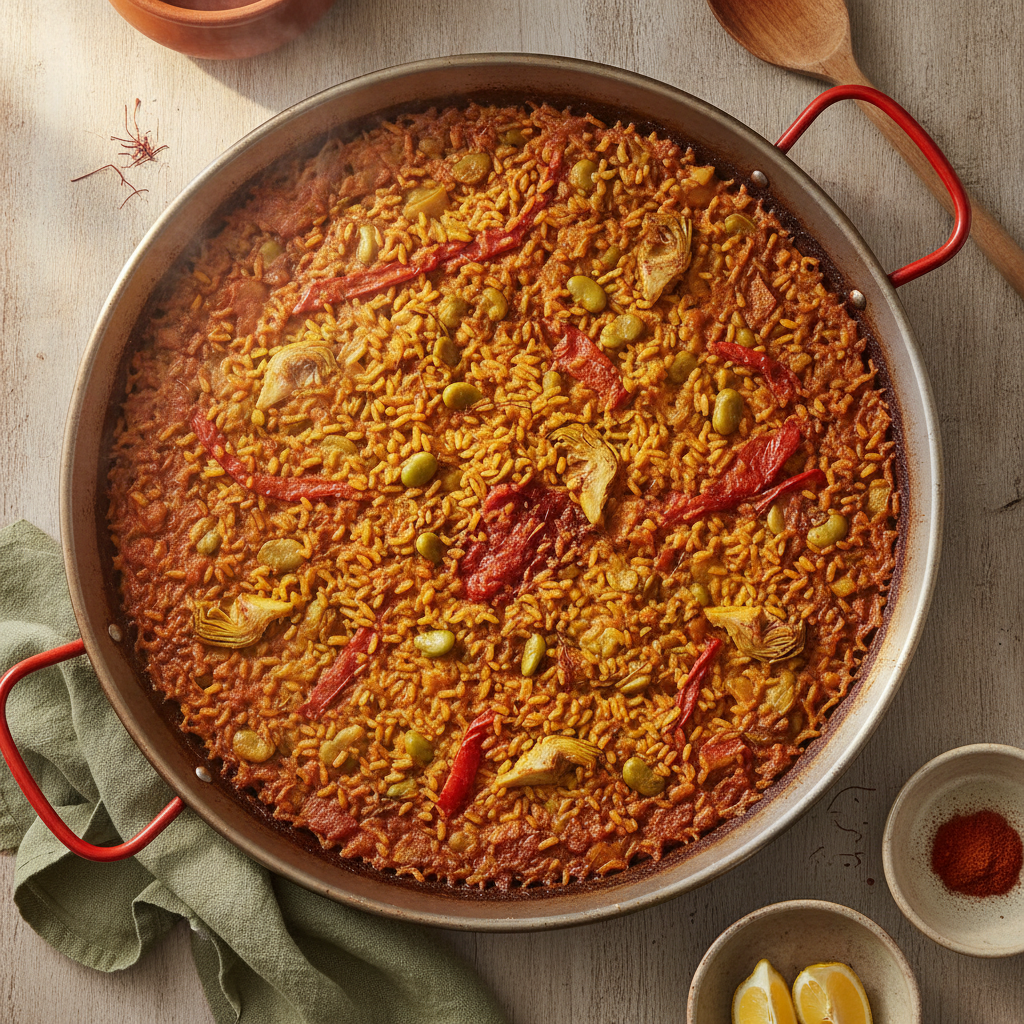
Paella de verduras is not a consolation prize for vegetarians — it is one of the oldest forms of paella in existence. Before the dish became synonymous with chicken and rabbit, Valencian farmers were cooking rice over open fires with whatever they grew: artichokes, broad beans, tomatoes, peppers. During Lent, when meat was set aside, rice with vegetables was the standard. That history gives this dish a legitimacy that most modern vegetarian adaptations of meat-based classics cannot claim. The logic of the dish is identical to any great paella. The foundation is a dark, concentrated sofrito built from grated tomato and pimentón dulce bloomed in good olive oil. Saffron-infused broth is added at a precise ratio and the rice — always a short-grain variety that can absorb without turning mushy — is distributed across the pan and left alone. Not stirred, not touched, not checked on. The heat does the work. What you get, when you do it right, is a pan of separate, broth-saturated grains with a caramelised crust on the bottom: the socarrat, the prized scorched layer that is the mark of correct technique and genuine high heat. Without meat, this version leans harder on the sofrito. The quality of your tomatoes, the generosity of your saffron, and the depth of your vegetable broth are the three variables that determine whether the finished rice tastes fully savoury and complex or just... vegetable-flavoured. Use the best broth you can find or make. Grate the tomatoes directly rather than chopping them — it releases more juice and breaks them down faster into the oil. Do not skip the saffron. And use a 40 cm paella pan for four servings: the wide, shallow geometry of the pan is not optional equipment, it is part of the technique.
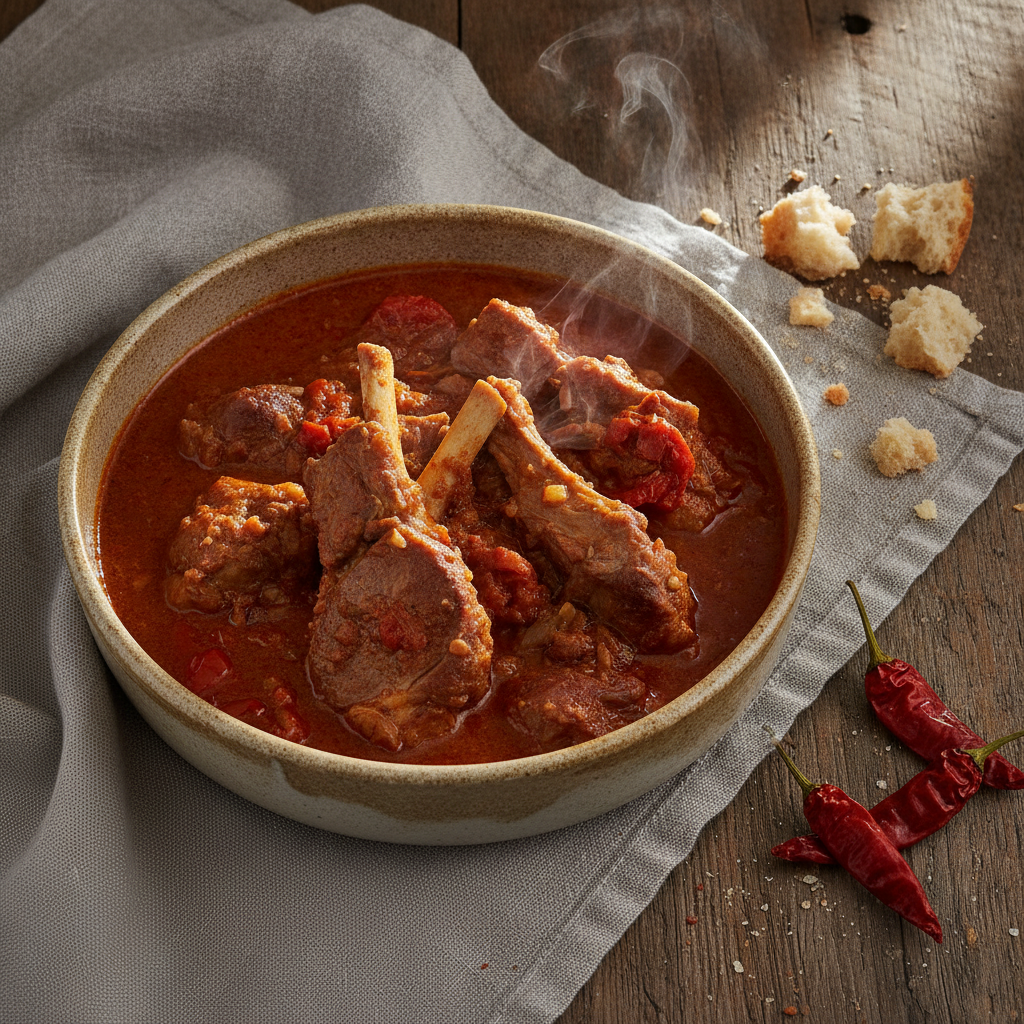
Somewhere along the Cañada Real — the ancient drovers' road that cuts through Extremadura's rolling oak-savanna — a shepherd's midday fire would hold a single blackened cauldron. What went into it depended on the season, the market day, and whatever a man carried in his saddlebag: lamb, always; paprika, always; whatever peppers and garlic he could bring. Caldereta de cordero is that pot preserved, centuries later, as one of western Spain's great braises. Extremadura, which borders Portugal in the west, is sheep country. The breed known as the Merina, whose wool built the medieval Spanish economy, has grazed these pastures for a thousand years. The lamb from these flocks is excellent, and caldereta — named from caldera, the cauldron — was how shepherds transformed it in the field into something genuinely extraordinary: a long-braised, deeply spiced stew that benefits from time and from bone. The dish has three defining features. The first is pimentón de la Vera — the smoked sweet paprika made from peppers dried over oak fires in the valley of La Vera, just north of Cáceres. There is no substitute that fully replicates its smoke. The second is bone-in lamb. Shoulder or neck pieces, bone-in, release collagen over two hours of braising, converting to gelatin that gives the sauce a body that coats the meat. The third — and the element that separates an authentic Extremaduran caldereta from a generic lamb stew — is the majado: a paste of lamb's liver (or stale bread) pounded with fried garlic, stirred into the stew in the final minutes. It thickens the sauce, adds savory depth, and gives the braising liquid a unified, emulsified quality that no stock addition can replicate. This is a weekend cook's dish: it asks for your attention in the first half hour, then largely looks after itself for two hours. What it rewards, at the end, is a pot of lamb so tender it pulls from the bone at a touch, swimming in a rust-red sauce of smoked paprika, collapsed peppers, and something that tastes like the countryside it came from.
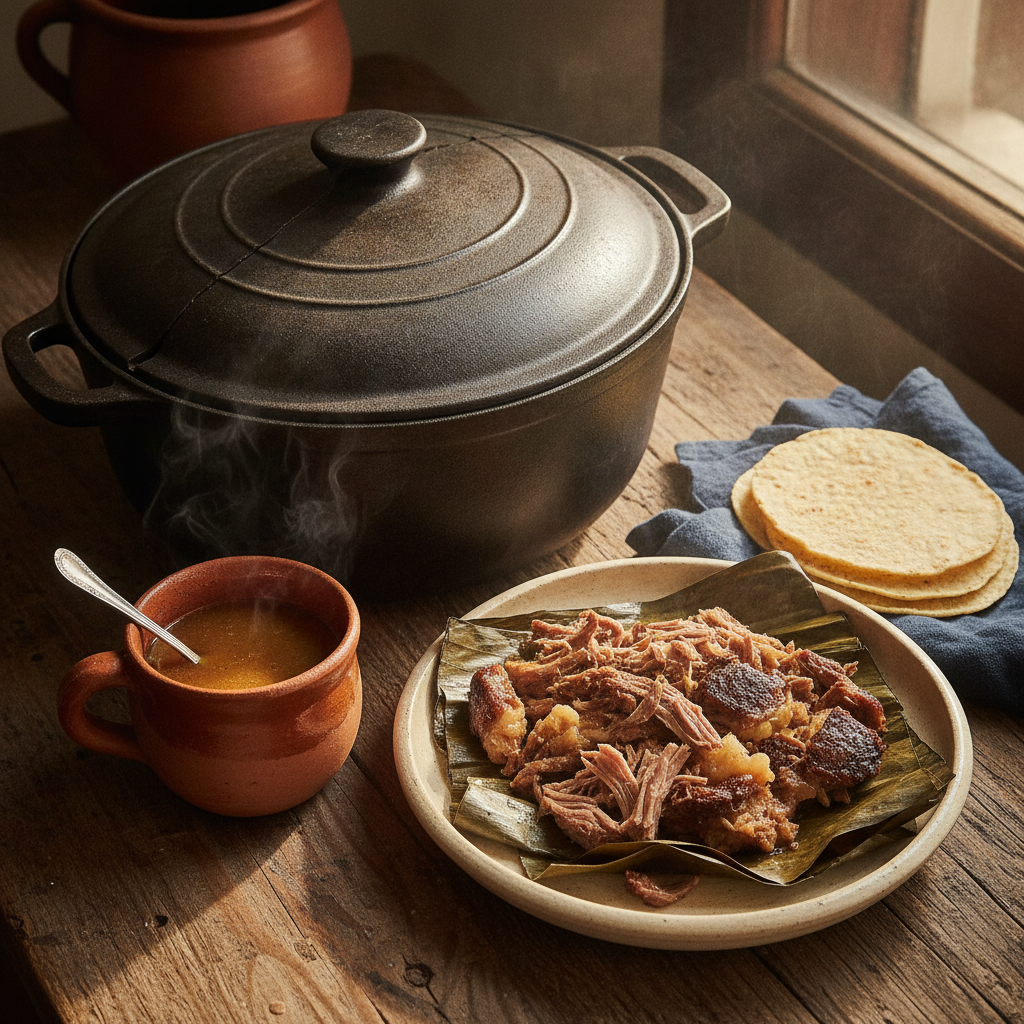
In Mexico, Sunday mornings smell like barbacoa. By 5 a.m., the vendors have already been at work for hours — whole beef heads, seasoned with dried chiles and wrapped in maguey or banana leaves, slow-cooked underground overnight until the collagen in the cheeks, tongue, and jaw dissolves into silk. The bundles emerge before dawn, and by six the taco stands are already running out. You take your tacos, you pour a cup of the broth that collected in the pit beneath the meat — the consommé — and that is Sunday in central Mexico. Barbacoa traces its origins to pre-Hispanic cooking across Mesoamerica, where whole animals were wrapped in agave leaves and sealed in underground pits for hours or overnight. The word itself predates and gave English the word 'barbecue,' though the two cooking traditions diverged dramatically over centuries. In Hidalgo, Tlaxcala, and parts of Mexico City, beef head barbacoa became the canonical Sunday food — not a celebratory dish, but an ordinary weekly rhythm, one of the most reliable pleasures of the week. At home, you cannot dig a pit. But you can replicate the essential mechanism: a sealed, moist environment at sustained low heat, where the beef braises and steams simultaneously for 6 to 8 hours. A Dutch oven or a tightly foil-covered roasting pan does the job. Banana leaves wrap the meat, imparting a subtle herbal, grassy note and creating a sealed packet that holds moisture. Beef cheeks are the correct home substitute for whole cabeza — they carry the same extraordinary collagen load that makes the dish what it is, and they're available at any Mexican carnicería worth its salt. This is a weekend cook. The active work is perhaps 45 minutes; the rest is the oven doing what it does. The consommé — the braising liquid that collects beneath the meat — is half the dish. Do not skip it. You will serve it alongside, warm, in small cups, for dipping tacos into. That detail is not optional. It is the difference between making barbacoa and making shredded beef.
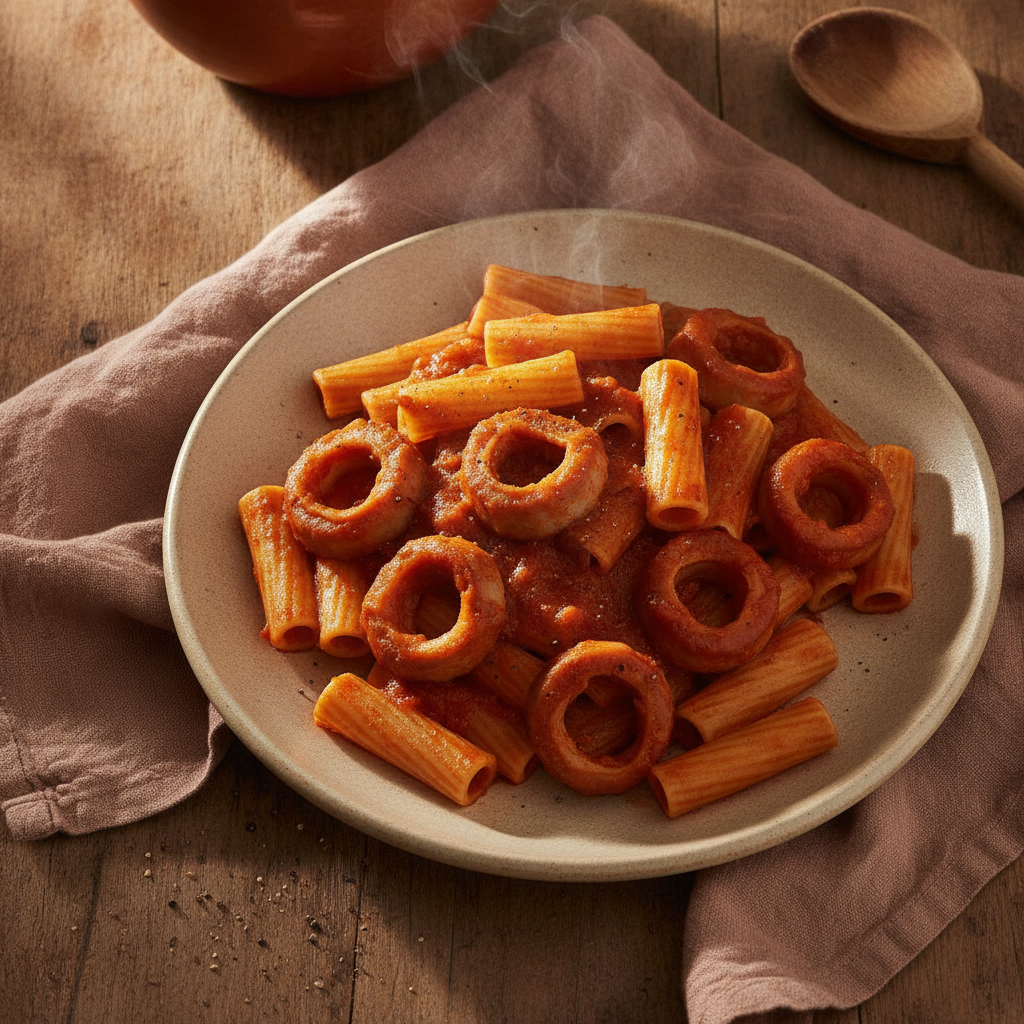
Rigatoni alla pajata is Rome's most unapologetic quinto quarto dish — the Sunday sauce that Roman butchers made for themselves with the cuts the wealthy never touched. The defining ingredient is the small intestine of an unweaned, milk-fed calf, sealed into rings with the chyme still inside, then braised in tomato until the tube goes tender and the filling permeates the sauce with a deep, milky richness.
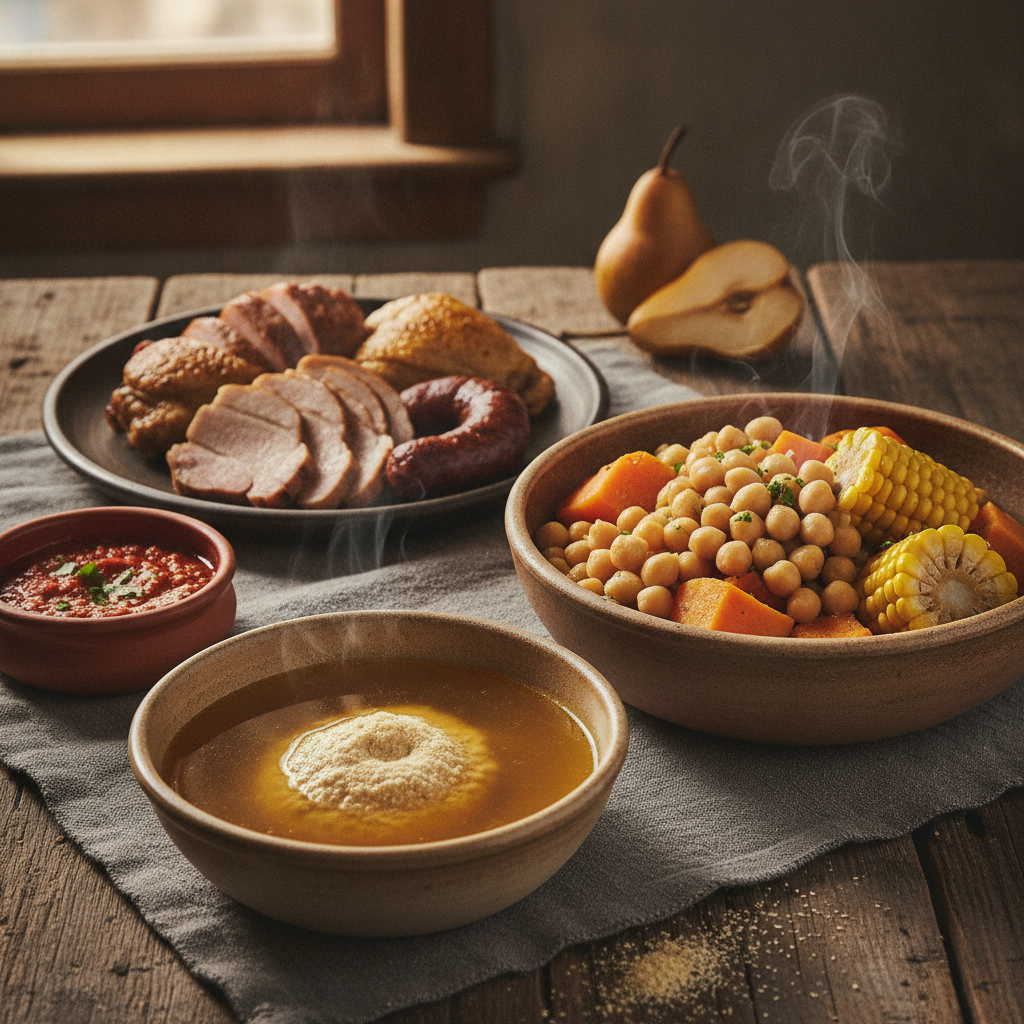
Puchero canario is the soul of the Canary Islands in a pot — a slowly simmered stew of chickpeas, Iberian pork, chicken, sweet potato, corn, and the haunting perfume of a whole pear dissolved into the broth. It is not merely a hearty meal; it is a structured succession of courses: a bowl of golden broth first with a knob of gofio (the islands' ancient toasted grain flour) bobbing in it, then the vegetables and chickpeas, then the meats, with a spoonful of fiery mojo alongside everything. What separates puchero canario from mainland cocido madrileño is the unmistakable stamp of the Atlantic trade routes — sweet potatoes, corn, and sometimes plantain arrived through Canarian ports from the New World and became fully Canarian over five centuries. The gofio is older still: a pre-Hispanic staple of the indigenous Guanche people, toasted barley or wheat ground to flour and stirred into hot broth at the table. This is not a quick weeknight dinner. It is a long Sunday afternoon in a pot, and it rewards every hour you give it.
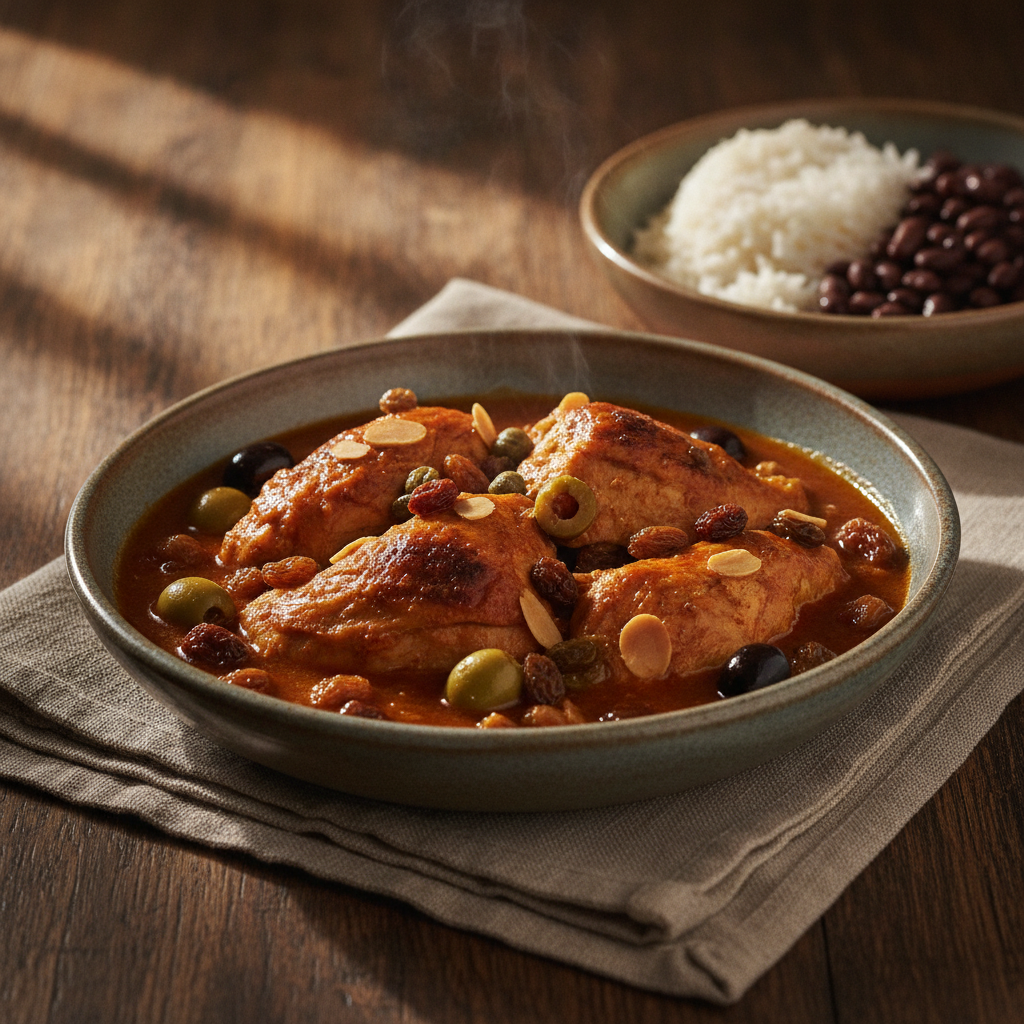
Estofado yucateco is one of those dishes that quietly tells you everything about a place’s history. The name comes from the Spanish word for ‘stewed,’ but what’s in the pot goes much deeper: a technique rooted in medieval Catalan-Moorish cooking — braised meat with olives, dried fruit, almonds, and warm spice — carried to the Yucatán by Spanish colonizers in the 16th century, then fused with local chiles, fire-roasting traditions from Maya cooking, and the region’s distinctive sweet-sour sensibility. The result is a dish that is recognizably Spanish in lineage but unmistakably Yucatécan in character. This is celebratory food. Not complicated by any standard — one pot, one braise — but built on flavor logic that feels unfamiliar until the first bite, and then utterly inevitable: raisins sweeten, capers and olives bring brine and acid, cinnamon and cloves warm and deepen. Everything contrasts, and nothing conflicts. The fire-roasted tomato sauce absorbs the chicken’s braising juices and becomes something greater than the sum of its parts. Serve it over white rice with black beans on the side, and you’ll understand why this dish shows up at baptisms and family celebrations across the Yucatán.
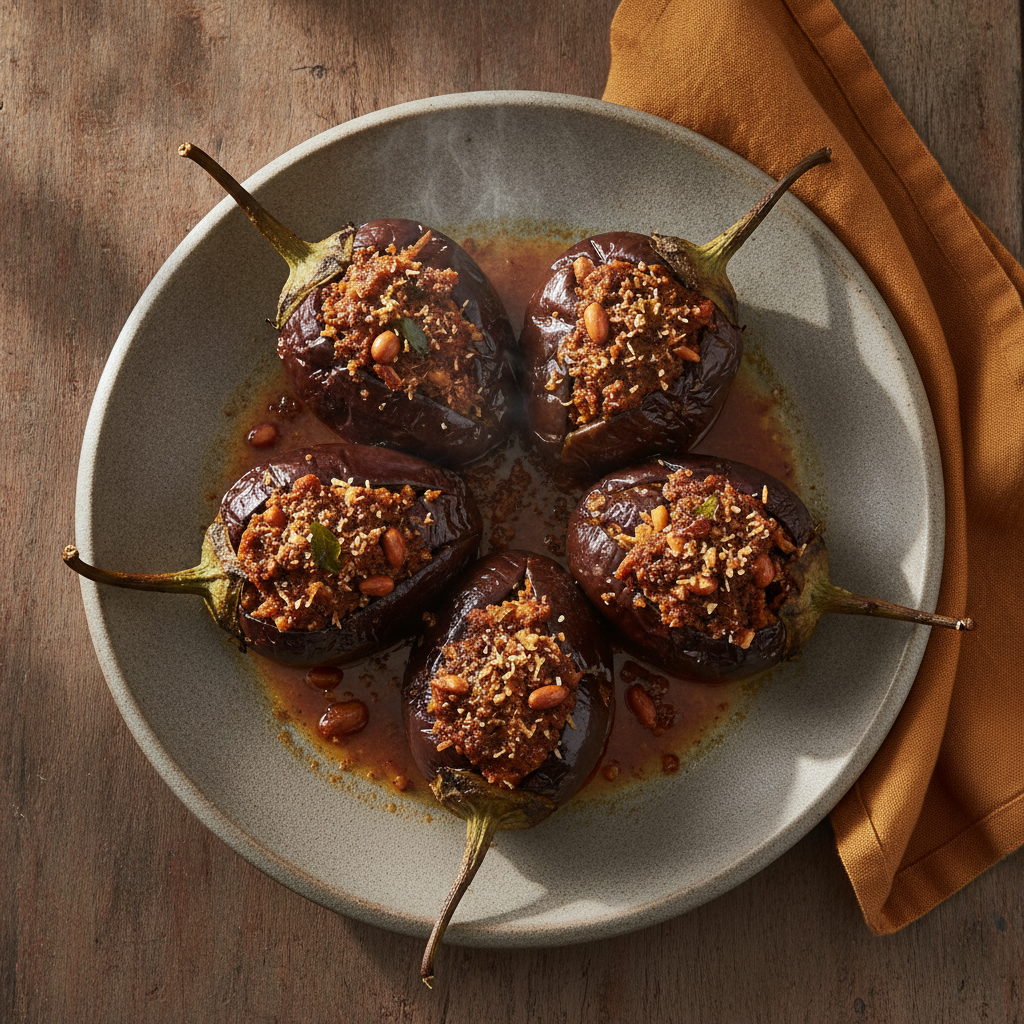
Bharli vangi — 'stuffed eggplant' in Marathi — is one of Maharashtrian cooking's most satisfying dishes: a baby brinjal, slit but held together at the stem, packed with a toasted peanut-coconut masala seasoned with kala masala, jaggery, and tamarind, then braised in its own steam until tender. Each eggplant becomes a sealed flavor vessel. This is home food at its most festive, a fixture of Ganesh Chaturthi spreads and Sunday family meals. What defines bharli vangi is a flavor balance you won't find in other stuffed-eggplant traditions: spicy, nutty, sweet, and sour in roughly equal measure, held together by the kala or goda masala — a Maharashtrian spice blend built around stone flower (dagad phool), dried coconut, and sesame. That blend is the single most important ingredient in the dish. Garam masala is not a substitute; it will produce something from a different culinary tradition. Goda masala, which is milder and more fragrant, is the correct alternative. If you know Hyderabadi bagara baingan, this is its Maharashtrian cousin — but where bagara baingan runs heavy on sesame and has no jaggery, bharli vangi hinges on the sweet-sour jaggery-tamarind axis and a drier, more intensely spiced filling. If you're new to both, start here: the technique is forgiving and the payoff is immediate.
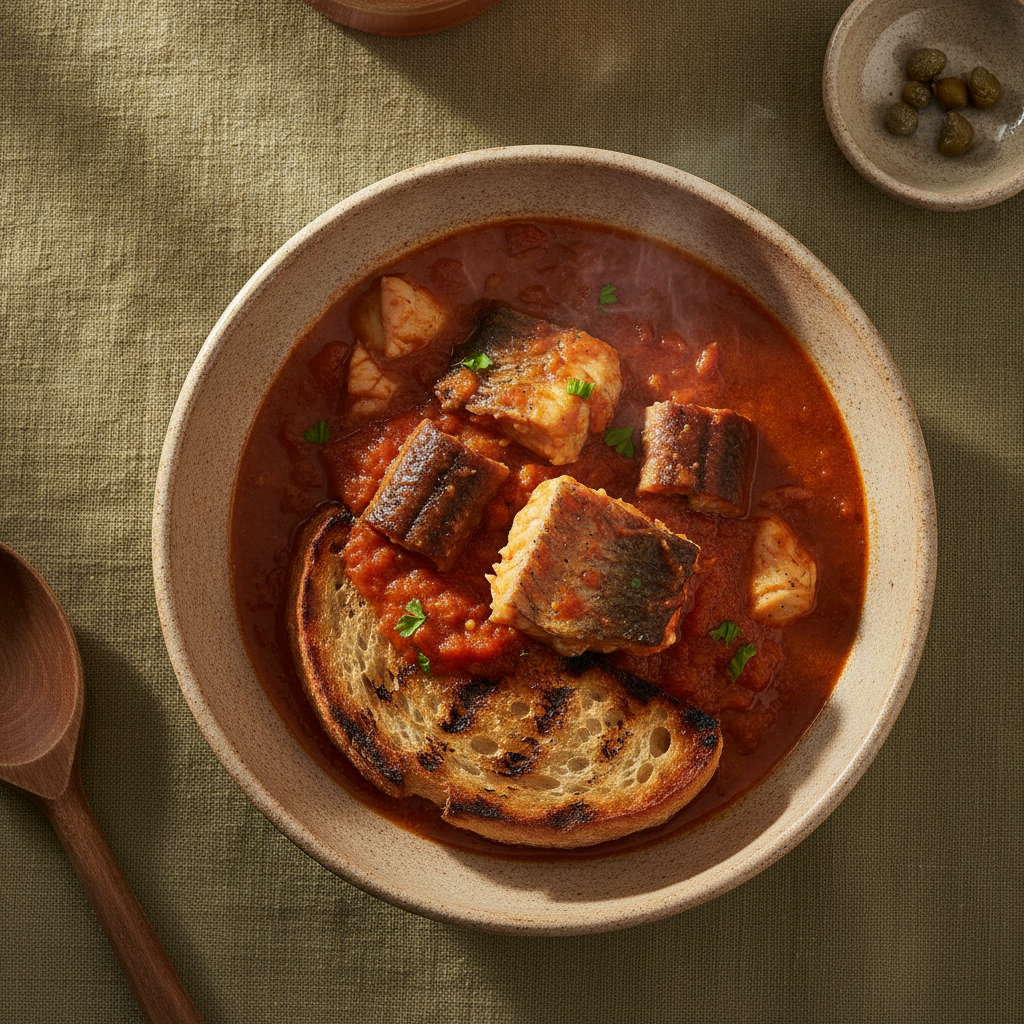
Tegamaccio is the stew of Lake Trasimeno's fishing communities — eel and perch simmered in wine and tomatoes, ladled over grilled bread. It's a landlocked dish that doesn't apologize for being one.
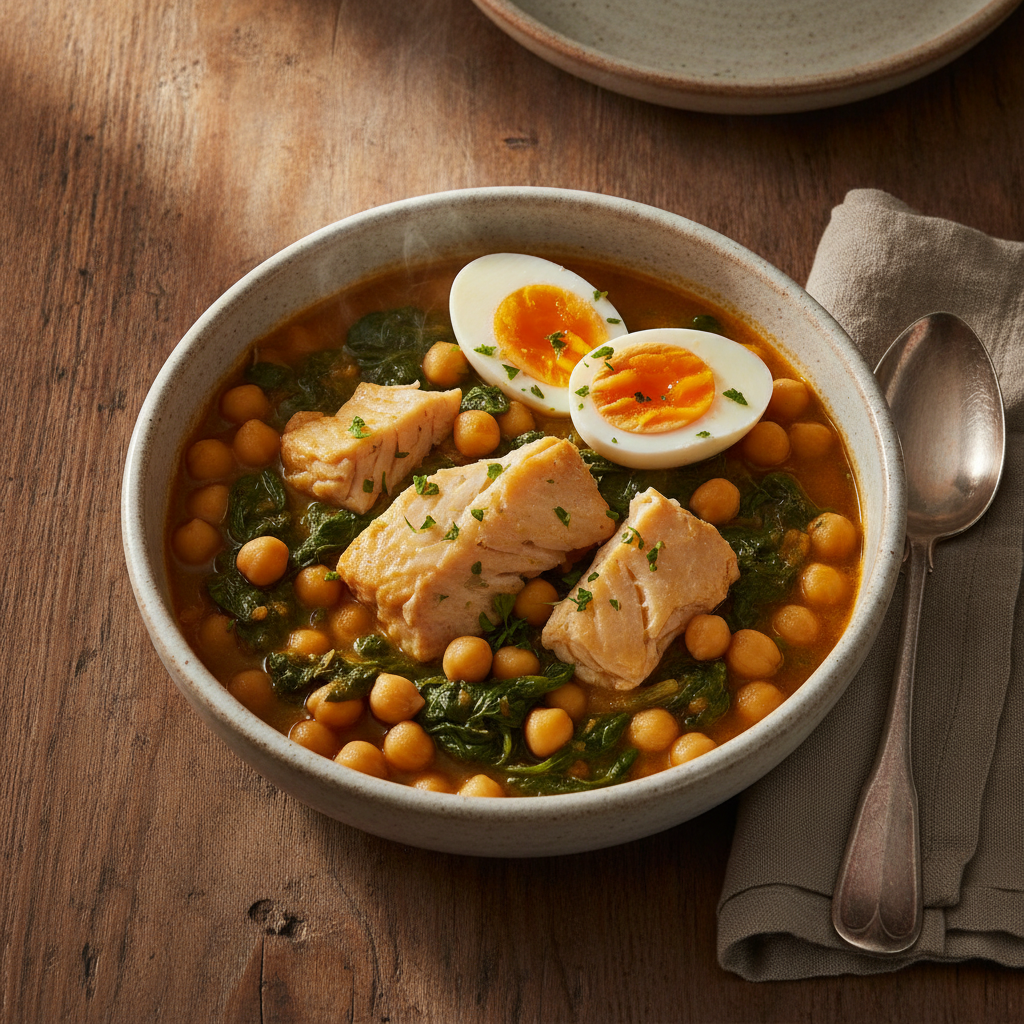
Every Good Friday in Seville, the same pot goes on the stove. Potaje de vigilia — vigil stew — has marked Catholic fasting days across Spain for centuries. The name comes from the Latin vigilia, the periods of abstinence from meat observed during Lent and Holy Week. What the cooks of Andalusia built to fill that gap was not a compromise dish but a genuinely great one: a thick golden stew of chickpeas, wilted spinach, and gently poached salt cod, bound together by a paste called the majado that transforms everything. The dish has two critical lead times you cannot shortcut. The dried chickpeas need to soak overnight in cold water — twelve hours minimum, more is better. The salt cod (bacalao desalado) needs even more advance planning: 36 to 48 hours of desalting in cold water, changing the water every 8 to 12 hours in the refrigerator. Undersalted cod in a chickpea pot is very difficult to rescue once it goes in. Take a small bite before adding it — it should taste pleasantly salty, not sharply briny. Once those two preparations are done, the stew itself is patient and forgiving. A sofrito of olive oil, onion, garlic, and sweet paprika. Long, unhurried chickpea cooking with a bay leaf and a pinch of saffron blooming in the broth. And then the majado: a fried slice of bread and a clove of garlic, pounded with cumin and a ladle of chickpea broth into a thick paste that gets stirred back in to bind and deepen the whole pot. The cod goes in last, poaching gently for just 10 to 12 minutes until it begins to flake. Hard-boiled eggs on top at the table — symbolic, golden, correct.
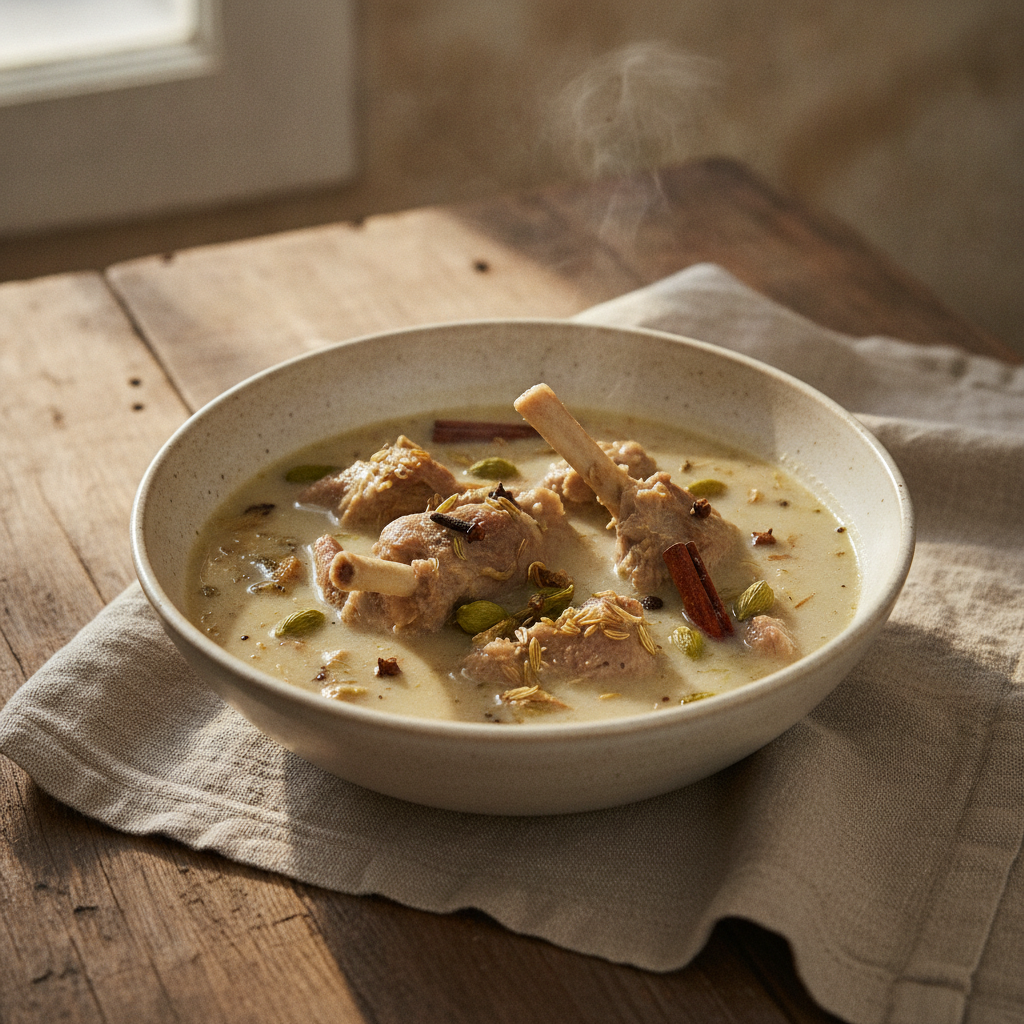
Yakhni is Kashmir's most quietly magnificent dish — a pale, silky broth built from lamb bones, whole spices, and carefully tempered yogurt, fragrant with fennel and dry ginger. No tomatoes. No onions. No red chili. In a country where curry often means deep ochre or fire-red, yakhni is a study in restraint — and in the kind of flavor that only patience can build. The word yakhni comes from the Persian yahni, referring to a covered-pot braising method that arrived in Kashmir with Mughal and Central Asian influence centuries ago. Today, two traditions keep it alive: the Muslim Wazwan banquet, where yakhni is one of the showpiece dishes served at weddings and celebrations, and the Kashmiri Pandit kitchen, where it is made without onions or garlic at all, using asafoetida (hing) to carry that savory depth instead. The Pandit version is the one we're making here — stripped to its most elemental form. What you get is something almost impossible to describe to someone who hasn't tasted it: rich and light at the same time, deeply aromatic without being pungent, warming without any heat. The yogurt does the work that tomatoes do elsewhere — it brightens and balances. The lamb bones give it body. The fennel seeds give it its soul.
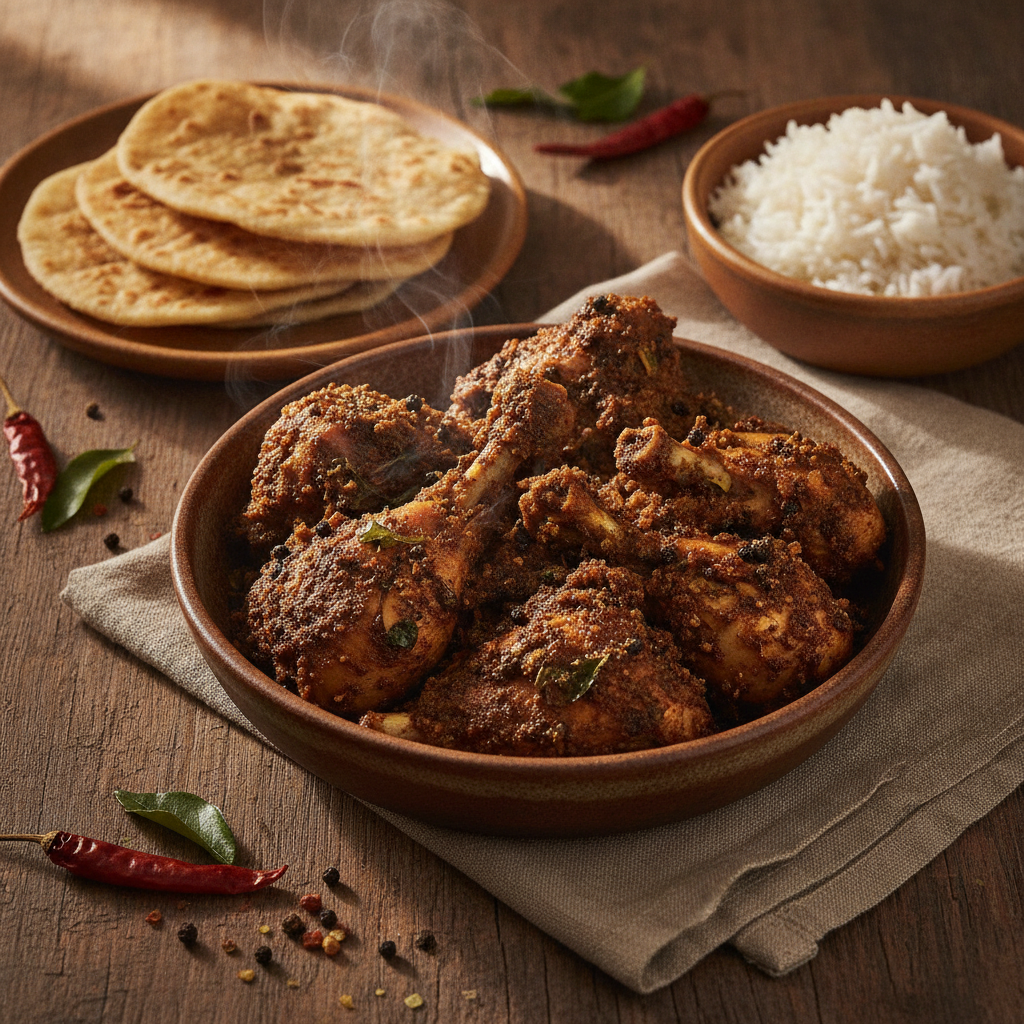
Chettinad cooking does not soften the blow. This is a cuisine from the Nagarathar merchant community of Tamil Nadu's Sivaganga district — traders whose maritime routes brought back spices that appear in no other Indian regional kitchen. Kalpasi (stone flower, a type of lichen with an earthy forest-floor depth), marathi mokku, and eye-watering quantities of black pepper are the signatures of a tradition that values complexity and heat in equal measure. Chettinad pepper chicken is the dish most people encounter first, and often remember longest. What sets it apart from generic 'Indian chicken' is not just the amount of pepper — though that is substantial — but the two-stage technique. The peppercorns go in twice: once into the marinade, where they slowly permeate the meat over hours, and once at the very end of cooking, cracked fresh over the pan so their volatile oils haven't had time to mellow. The result is pepper heat with two distinct registers: a warm, integrated depth from the marinade and a sharp, blooming finish that announces itself and then fades cleanly. The 'dry fry' (what the technique is named for) requires patience. There is no sauce to hide behind. The chicken cooks uncovered in oil over medium-high heat, moisture evaporating steadily until the masala thickens and begins to toast directly on the meat. Cover the pan and you've made a braise. The reward for patience is chicken coated in a dark, fragrant crust that you'll want to eat off the bone at the table. This dish is naturally gluten-free. Serve with parotta (the flaky, layered South Indian flatbread) for the full experience, or with plain rice — the latter soaks up any masala that escapes to the plate, which is its own reward.
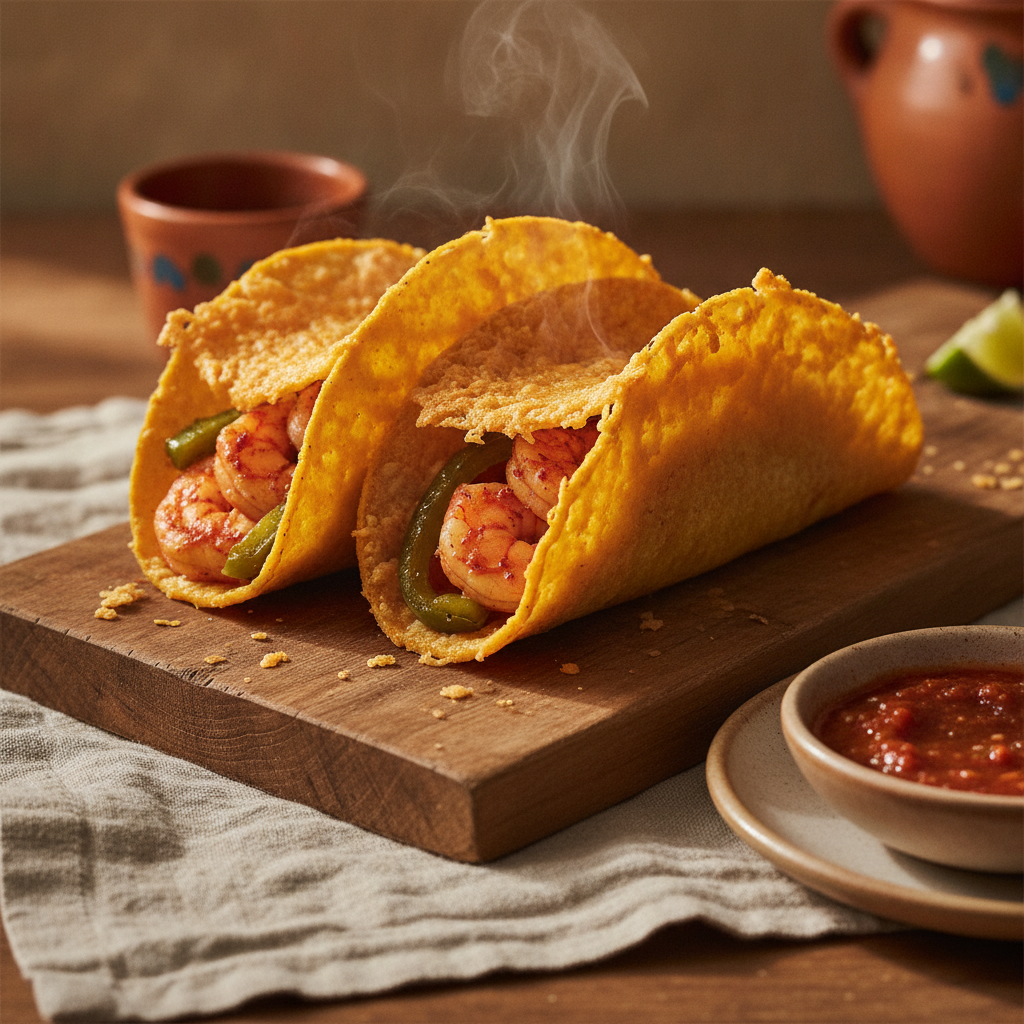
In the summer of 1987, the state governor of Sinaloa was coming to dinner. The chef at Los Arcos restaurant in Mazatlán, already celebrated for its Pacific coast seafood, had a problem: he knew the governor's wife made shrimp tacos at home, and a plain shrimp taco wouldn't do. So he layered chipotle-seasoned shrimp over roasted poblano strips, folded it inside Oaxacan cheese that melted and crisped against the griddle, and pressed the whole thing until it crackled. Governor Francisco Labastida Ochoa was impressed. The taco was named after him before he left the table. By morning, every diner was ordering it. The dish spread across Sinaloa within years, north through Baja California, then across the whole country until tacos gobernador appeared on menus from Tijuana to Mexico City. What travels that fast is usually both simple and remarkable, and this taco is both: crispy on the outside from the griddle-pressed cheese crust, smoky from chipotle, bright from roasted poblano, and tender from shrimp that haven't seen one second of excess heat. The key to all of it is the assembly method — and this is where most home recipes go wrong. Tacos gobernador are built like a quesadilla. Oaxacan cheese goes on the tortilla first. The shrimp filling lands on top of the cheese. The tortilla folds closed and presses onto a hot dry griddle until the cheese melts into the shell, turning the whole structure golden, lacy, and self-supporting. Treat this like a regular soft taco and you'll get a falling-apart mess. Treat it like a quesadilla and you'll get one of the great tacos in Mexican cooking.
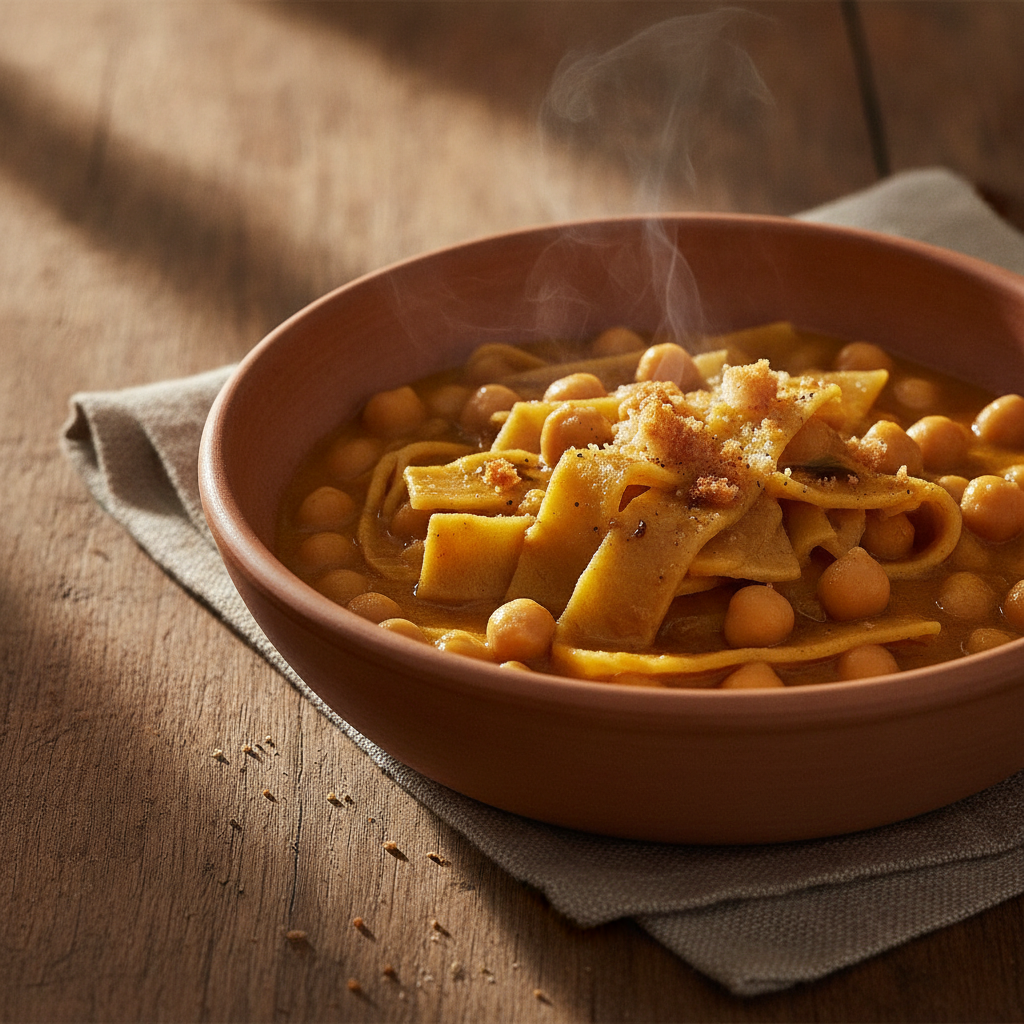
Horace wrote about eating lagane with chickpeas in his hometown of Venosa, Basilicata, around 35 BC — this is likely the oldest documented pasta dish in the world. Two-ingredient dough, hand-torn strips, chickpea broth that becomes its own sauce: it has not needed improving since.
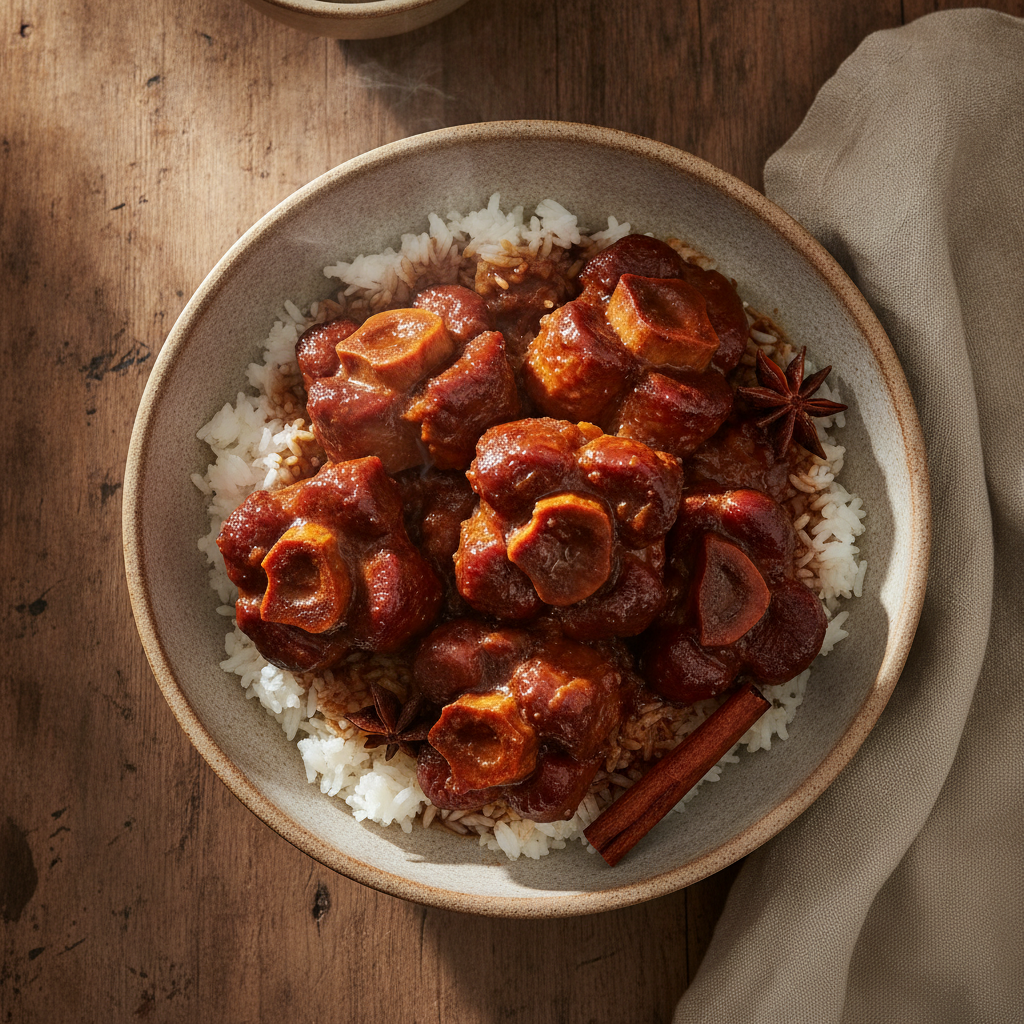
This is a weekend dish — not because it demands your constant attention, but because it cannot be rushed. Cantonese red-braising (hung siu) is a patient art: dark soy and rock sugar build a lacquered, mahogany sauce; five spice perfumes the kitchen long before the pot hits the table. Three hours of low, gentle heat transforms oxtail — one of the most collagen-dense cuts on the animal — into something fall-from-bone tender with a sauce so glossy it barely needs rice to justify its existence. But serve it over jasmine rice anyway. The sauce will pool and soak in, and you'll understand why this method has barely changed in a hundred years.
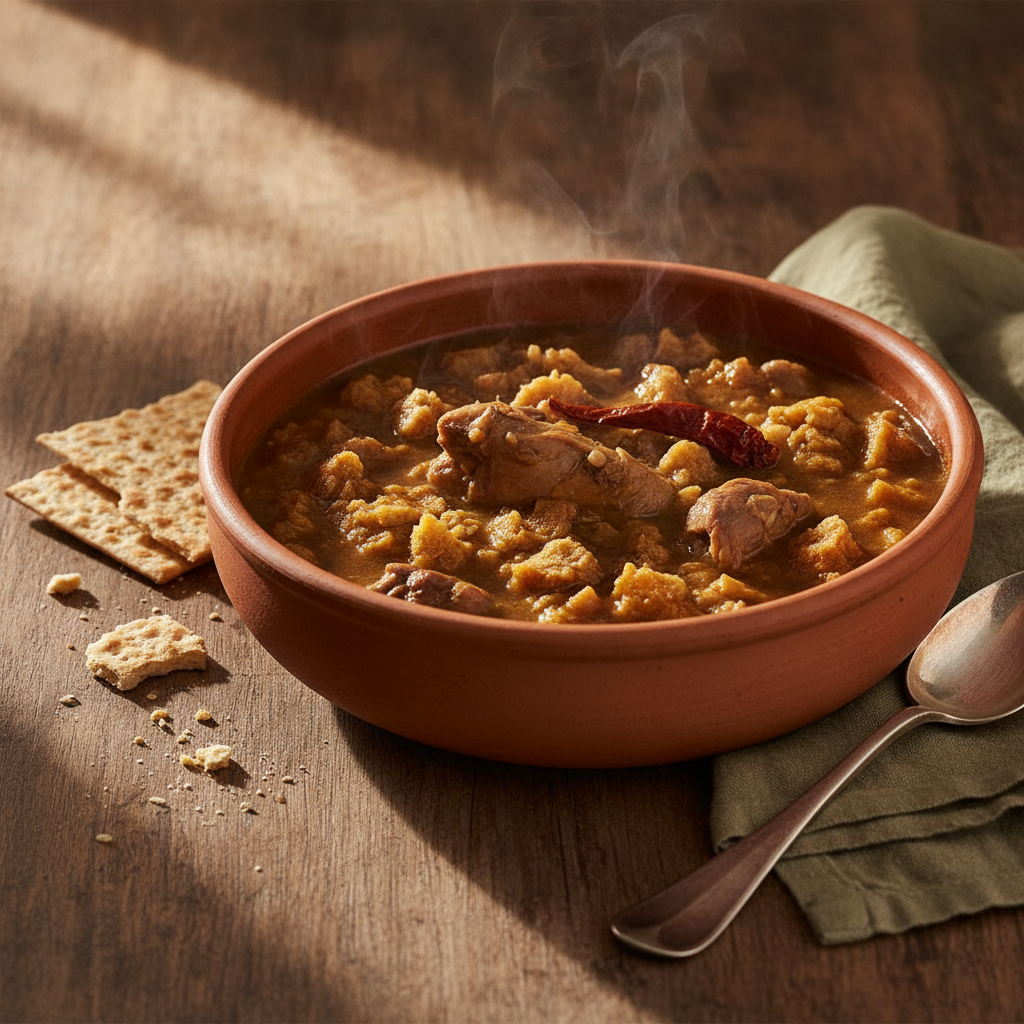
Before you close this tab assuming you've found a typo — this is not cold soup. Gazpacho manchego is a hot, deeply savory game stew from La Mancha, the windswept plateau of central Spain where Don Quixote tilted at windmills. It shares a name with the chilled Andalusian tomato soup only through historical accident: in Old Spanish, "gazpacho" referred broadly to a family of bread-and-ingredient dishes, not blended raw vegetables. The two dishes have nothing in common except four letters. This is the older gazpacho — the one hunters and shepherds made in clay pots over open fires in the Manchegan countryside, throwing in whatever game they caught: rabbit, partridge, pigeon. The defining ingredient isn't the game, though. It's the torta cenceña: a dry, thin unleavened flatbread broken into rough pieces and simmered into the stew only at the end, where it absorbs the rich game broth and softens to a thick, chewy tenderness. No flour. No cream. The bread does the thickening from within. The final texture is closer to a risotto than a soup — dense, fortifying, deeply aromatic. The torta may also carry a piece of history. Food historians believe the unleavened bread in this dish reflects Sephardic Jewish culinary influence in La Mancha before the 1492 Inquisition-era expulsions. That the most widely accepted modern substitute is matzo cracker — historically appropriate, and widely available — lends the theory some weight. There's a story in this stew, if you're paying attention.
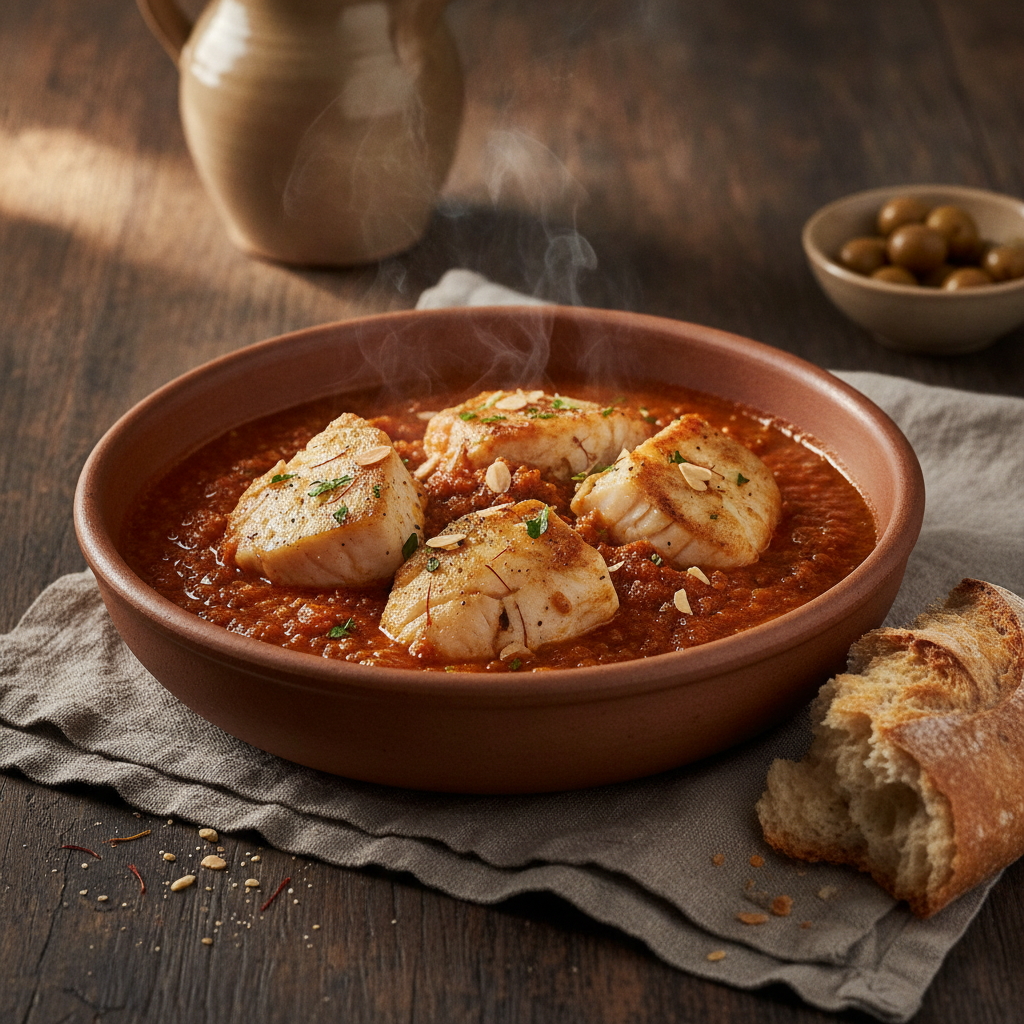
A note on the name: *rape* (pronounced RA-peh) is the Spanish word for monkfish — the same fish North Americans call anglerfish or goosefish. It is an odd-looking creature with magnificent, lobster-sweet flesh that holds together through a long braise without falling apart. In Mallorca, they cook it this way: in a rich tomato sofrito built slowly in olive oil, enriched at the end with picada — a Catalan invention of ground toasted almonds, raw garlic, and fresh parsley that dates back to medieval times. The picada goes in last. Every book tells you this, and most cooks ignore it anyway. Do not. Add it in the final five minutes and the almonds thicken the sauce while keeping a subtle, pleasant graininess; add it earlier and you get almond mush. The sofrito deserves equal attention. Onion cooked for a full fifteen to twenty minutes in good olive oil becomes something entirely different from onion cooked for five: sweeter, darker, truly caramelized. This is the flavor backbone of the whole dish, and shortcuts produce a noticeably thinner result. The rest is comparatively fast — a brief sear on the fish, a splash of white wine, fish stock, a few saffron threads, and then patience while everything comes together. Serve with crusty bread for mopping the sauce. It would be a crime not to. The dish is naturally gluten-free provided you skip bread in the picada and use only almonds.
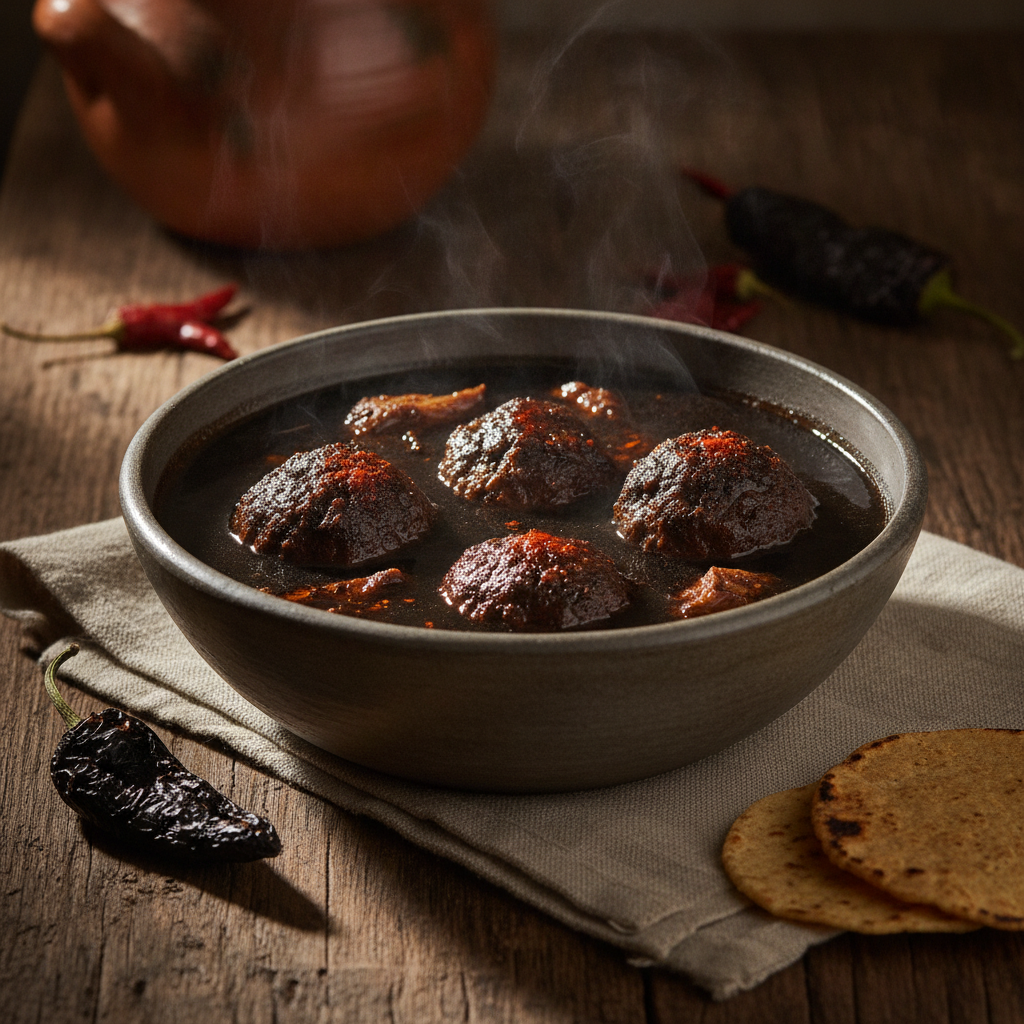
Relleno negro is one of the siete potencias — the seven great dishes that define Yucatecan cuisine — and it earns that designation through pure, uncompromising ambition. This is a dark, smoky, faintly bitter stew of turkey and pork meatballs braised low and slow in chilmole, a sauce built from chiles deliberately torched to the edge of ash. It is the dish Yucatecan families prepare for Hanal Pixán, the regional Day of the Dead celebration, setting aside a full day (often two) to char chiles, season turkey, shape meatballs, and let the braise deepen into something that smells like smoke and tastes like ceremony. If you have never burned a chile on purpose, this recipe will ask you to do exactly that. The instruction 'toast the chiles until they are nearly black' is not a warning — it is the technique. Charcoal flakes are correct. A faint acrid smell from the comal is correct. Undertorching the chiles produces a different dish, a lesser dish, one that lacks the signature bitterness and depth that makes relleno negro irreplaceable among the stews of southern Mexico. Plan for this as a special-occasion project: 90 minutes of active work, three hours of braising, and ideally a night of advance prep. Yucatecan home cooks start the day before. You should too.
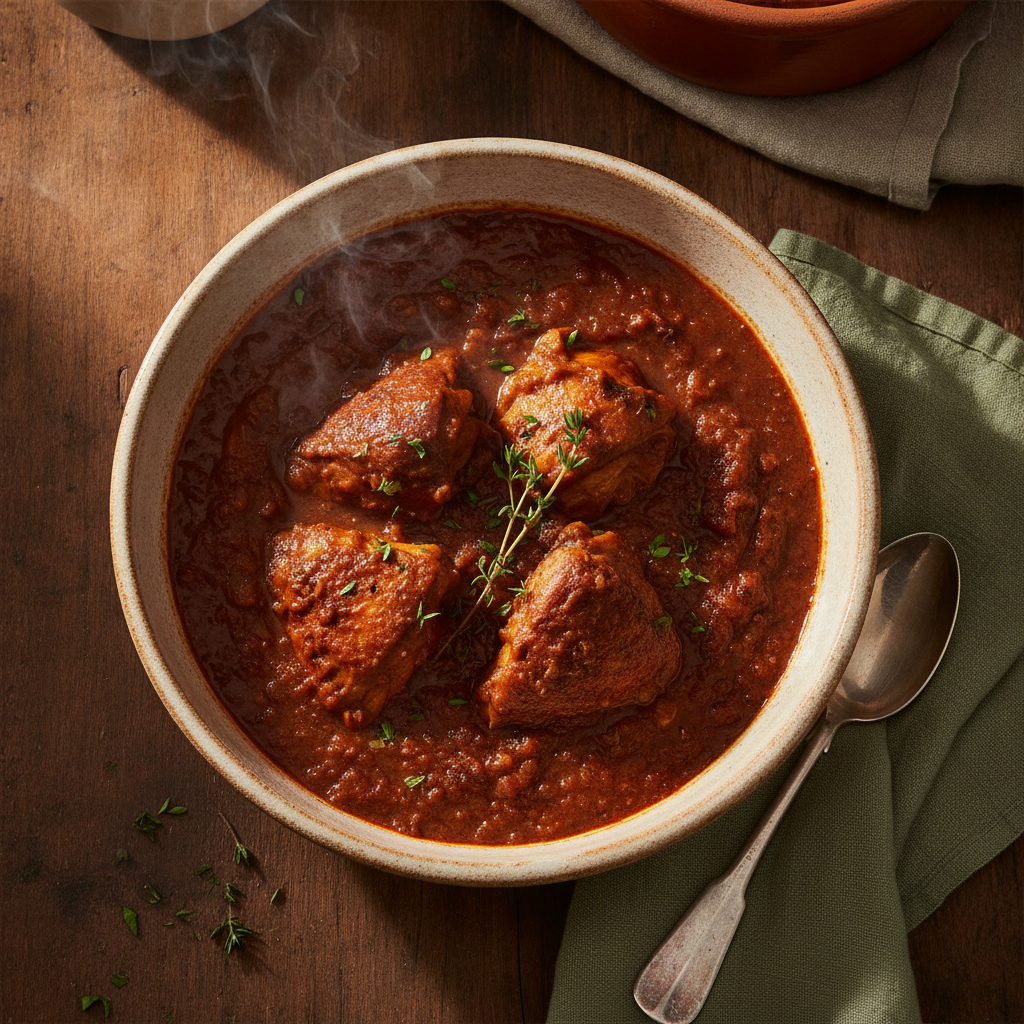
There is a version of this dish that arrives in 30 minutes, with identifiable vegetable chunks and pale, sad chicken. That is not this recipe. Pollastre amb samfaina — Catalan chicken braised in its namesake vegetable sauce — is a dish built entirely on patience. The onion must cook until it is almost jammy and dark, what Catalan cooks describe as *sofregir fins que quedi negre*: fry it until nearly black. The eggplant must collapse. The tomato must reduce. By the time the lid comes off, you will have a rust-red, deeply savory sauce that looks nothing like the Instagram-friendly vegetable stews of the internet — and tastes incomparably better. Samfaina is Catalonias answer to ratatouille and Valencian pisto, but with a key difference in philosophy: the vegetables cook down into a near-purée that coats and enriches rather than staying as distinct pieces. Dont be alarmed by the sauces rustic, brown-red appearance. That color is the flavor. A note on what this dish looks like: samfaina is a brown-red, rustic sauce. The vegetables will have melted into it. This is correct. If you want identifiable vegetable chunks, this is the wrong recipe. If you want deep, layered flavor, you are in exactly the right place.
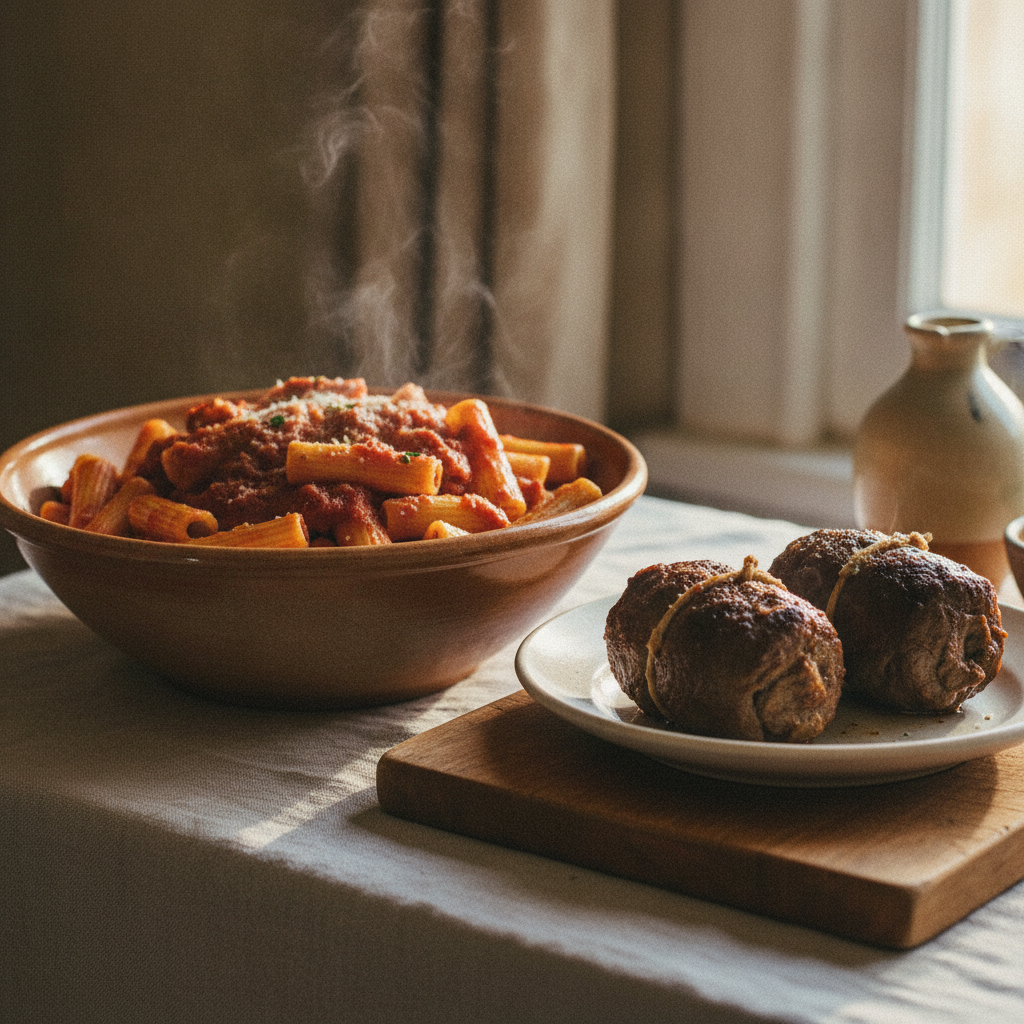
In Naples, the braciole go into the pot before 9am on Sunday, and the whole building knows something's cooking by the time church lets out. These beef rolls pull double duty — they flavor the tomato sauce for three hours while braising, then arrive at the table as a separate meat course after you've already eaten a bowl of rigatoni.
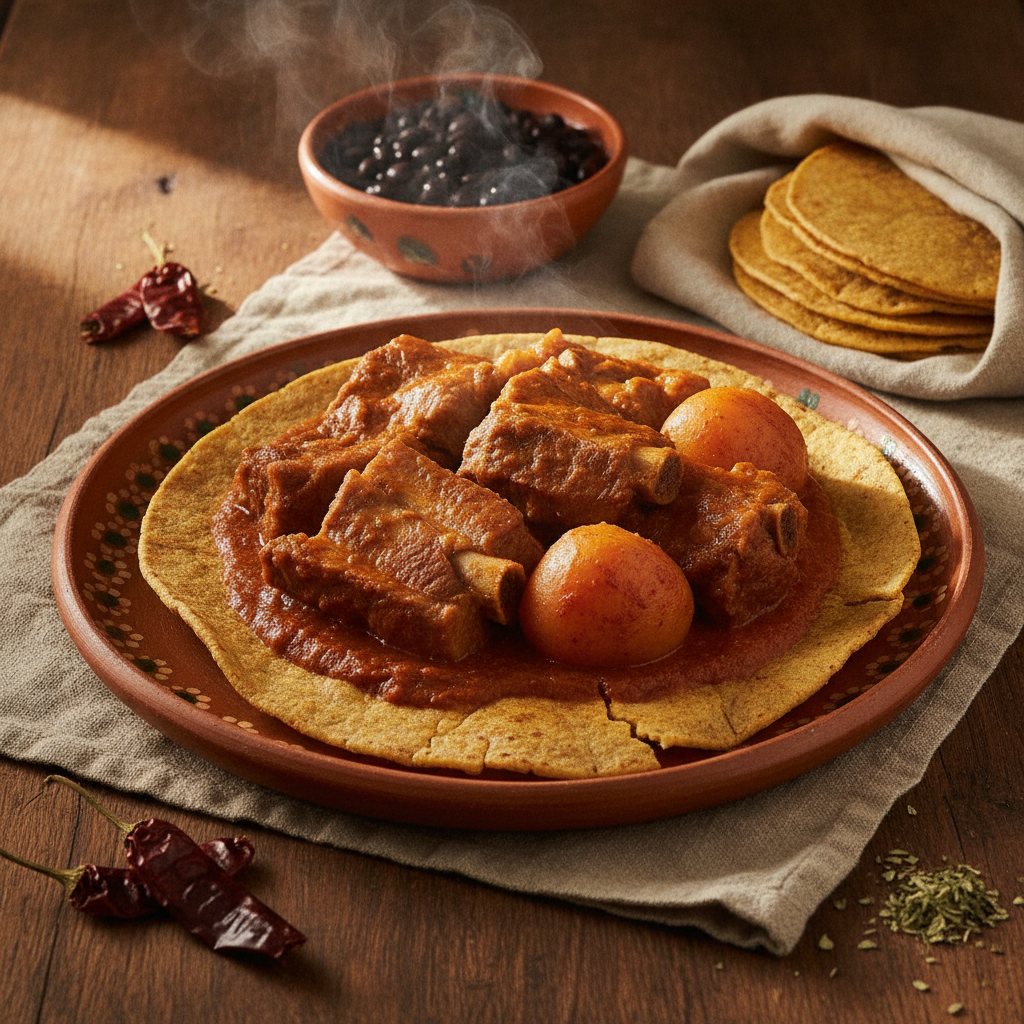
Chileajo is a traditional dish from the Mixtec region of Oaxaca — its name is a portmanteau of chile and ajo (garlic), naming its two defining pillars. This is not a generic Mexican chile stew: it's a deeply savory, brick-red braise built on a toasted-dried-chile paste that Oaxacan cooks fry in lard before anything else touches the pot. Guajillo provides the fruity backbone and the color; ancho adds dark chocolate-raisin depth; a full head's worth of dry-toasted, charred garlic rounds everything into sweetness rather than sharpness. Bone-in pork ribs and leg pieces are par-cooked first so their collagen melts into the broth, then they finish in the chile sauce alongside waxy potatoes that stain deep red and absorb every bit of flavor. The result is rich, warming, and bracingly aromatic — completely at home on a weeknight table with warm corn tortillas and black beans. A note on sourcing: dried guajillo and ancho chiles are the non-negotiables here. Both are widely available at Latin grocery stores and online. Mexican oregano — more citrusy and anise-forward than Mediterranean — is worth seeking out. Bricia Lopez's Oaxaca cookbook (Ten Speed Press, 2019) is an excellent companion if you want to explore this cuisine further. For an Oaxacan street-food presentation, serve the pork and sauce over a toasted tlayuda (a large, semi-crispy tortilla) instead of rice. The broth soaks into the crispy surface beautifully.
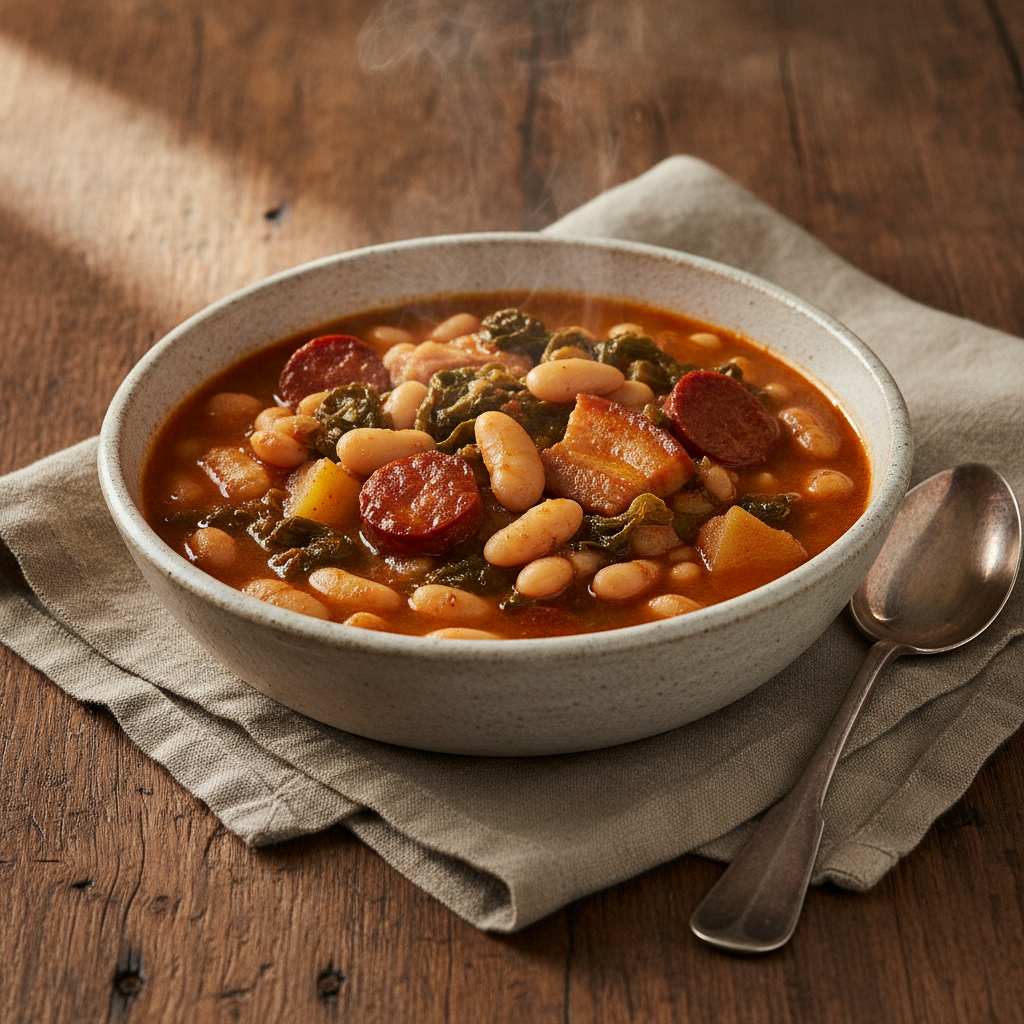
Pote asturiano is the elder cousin of fabada — older, humbler, and arguably more satisfying. Where fabada is all beans and cured meat, pote adds turnip greens and potatoes, making it a complete one-pot meal that has fed Asturian families through mountain winters for centuries. The name comes from the pot itself (pote), which tells you everything: this is peasant cooking at its most honest. Cured chorizo and pork belly release their paprika-stained fat slowly into the water over two hours; the beans drink all of it; the potatoes absorb what's left; and the greens, added only at the end, give a gentle bitterness that cuts through the richness of the compango. Make it the day before you plan to serve it. This is non-negotiable. Reheated gently the next day, pote is a categorically better dish — the beans deepen, the broth thickens, and everything comes together in a way that simply does not happen straight off the stove. Like many great peasant pots, it was designed to be eaten twice.
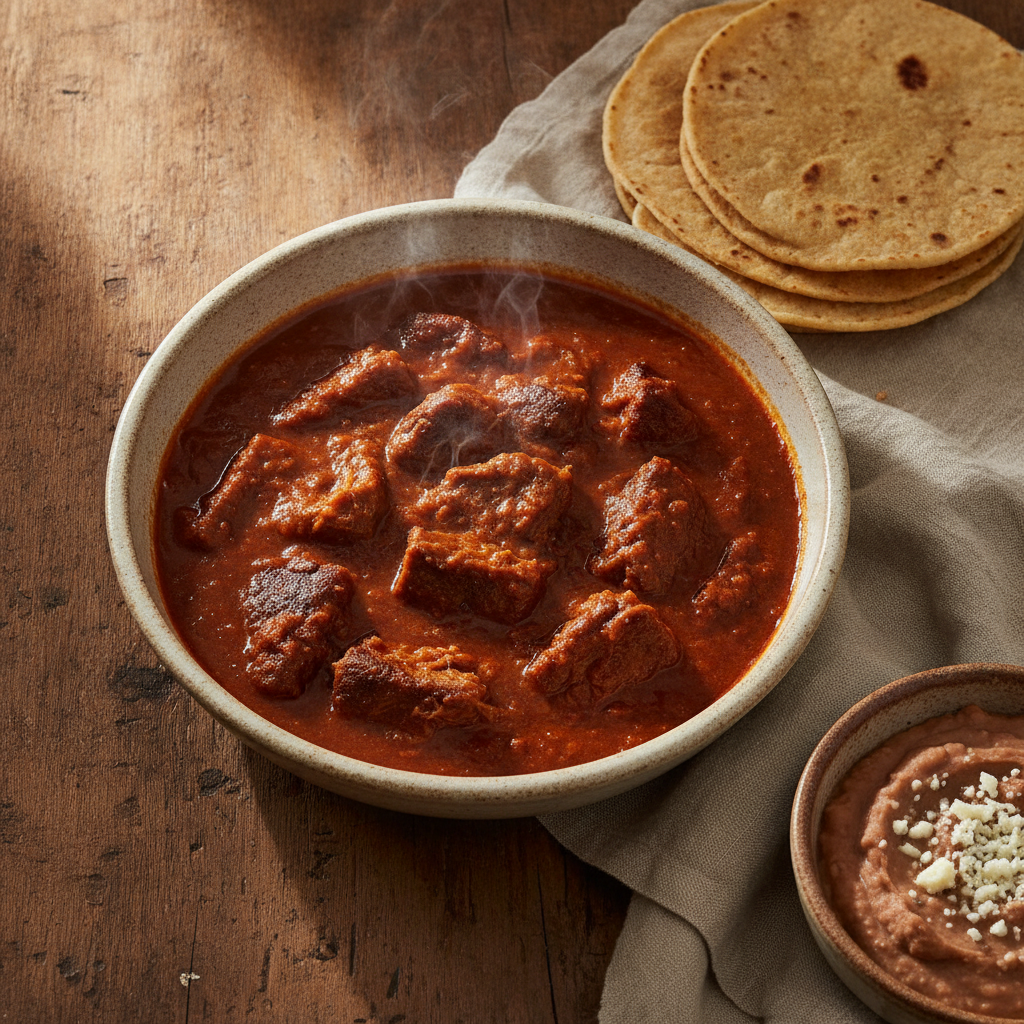
Chile colorado is one of northern Mexico's great gifts to the table — a slow-braised beef stew that gets every drop of its brick-red color, its earthy depth, and its gentle heat from nothing but dried chiles. No tomatoes. No shortcuts. Just ancho and guajillo reconstituted from their shriveled dried state into a glossy, rust-colored sauce that coats slow-braised beef chuck until the collagen in the meat dissolves and the whole pot becomes something much larger than the sum of its parts. The name causes confusion at the border and beyond: 'colorado' is not a reference to the American state. It is old Spanish for red — colorado simply means 'red chile,' which is exactly what this is. The dish is rooted in the cattle ranching culture of Chihuahua, Sonora, and the broader northern Mexican borderlands, where dried chiles were the pantry staple that made it through the dry season, and a long-simmered beef stew was practical sustenance for vaqueros working long hours in the high desert. Three moves separate a transcendent chile colorado from a flat one. First: toast those dried chiles in a hot dry skillet for 15 to 20 seconds per side until they smell like dark chocolate and toasted raisins — not burned, just awake. Second: don't skip the hard sear on the beef. Every cube of chuck needs a dark, crackling Maillard crust on at least two sides before it ever touches liquid, or the finished stew will taste braised rather than roasted. Third: use the chile soaking liquid. It carries color and flavor you paid for when you bought the chiles; pouring it down the drain is a waste. The braise does the rest over two unhurried hours, and what you get is beef that shreds at a fork touch wrapped in a sauce that is fruity, earthy, mildly smoky, and clean. Serve it with flour tortillas — the northern Mexican choice, not corn — and refried beans.
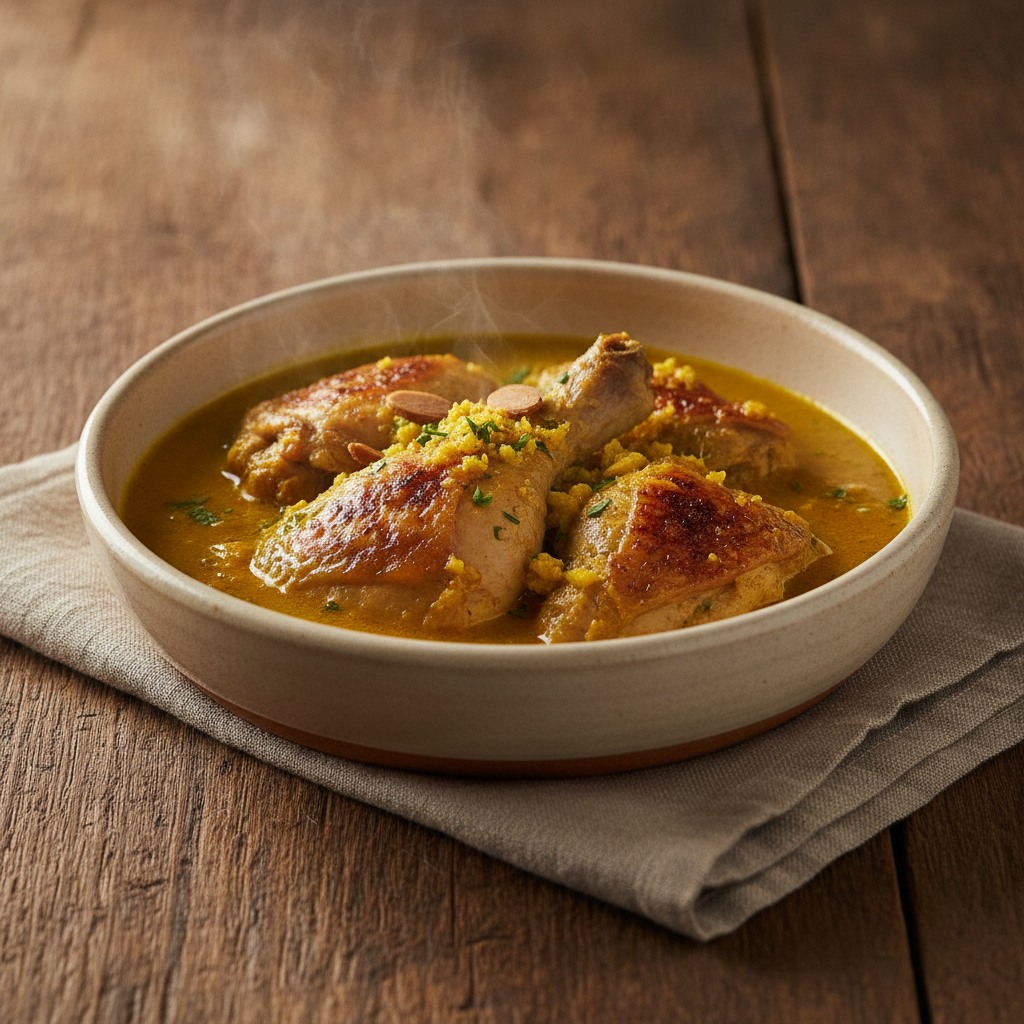
Pollo en pepitoria is one of Spain's oldest surviving recipes — versions appear in 15th and 16th-century cookbooks, and Francisco Martínez Montiño included it in his landmark Arte de cocina in 1611. The almond-saffron DNA reveals clear Moorish influence, and legend holds it was a favourite of Queen Isabella II. Yet for all its medieval credentials, this braise tastes startlingly modern: deeply savoury, golden-hued, velvety without being heavy.\n\nThe secret is the picada — a paste pounded from fried almonds, fried bread, garlic, and hard-boiled egg yolk that gets stirred into the braising liquid for the final minutes of cooking. It thickens the sauce, packs it with toasted-nut depth, and gives it a body no flour-based roux can match. Saffron, bloomed in warm sherry, does the rest. The result is a Sunday dish from Castile and Aragón that earns its reputation.
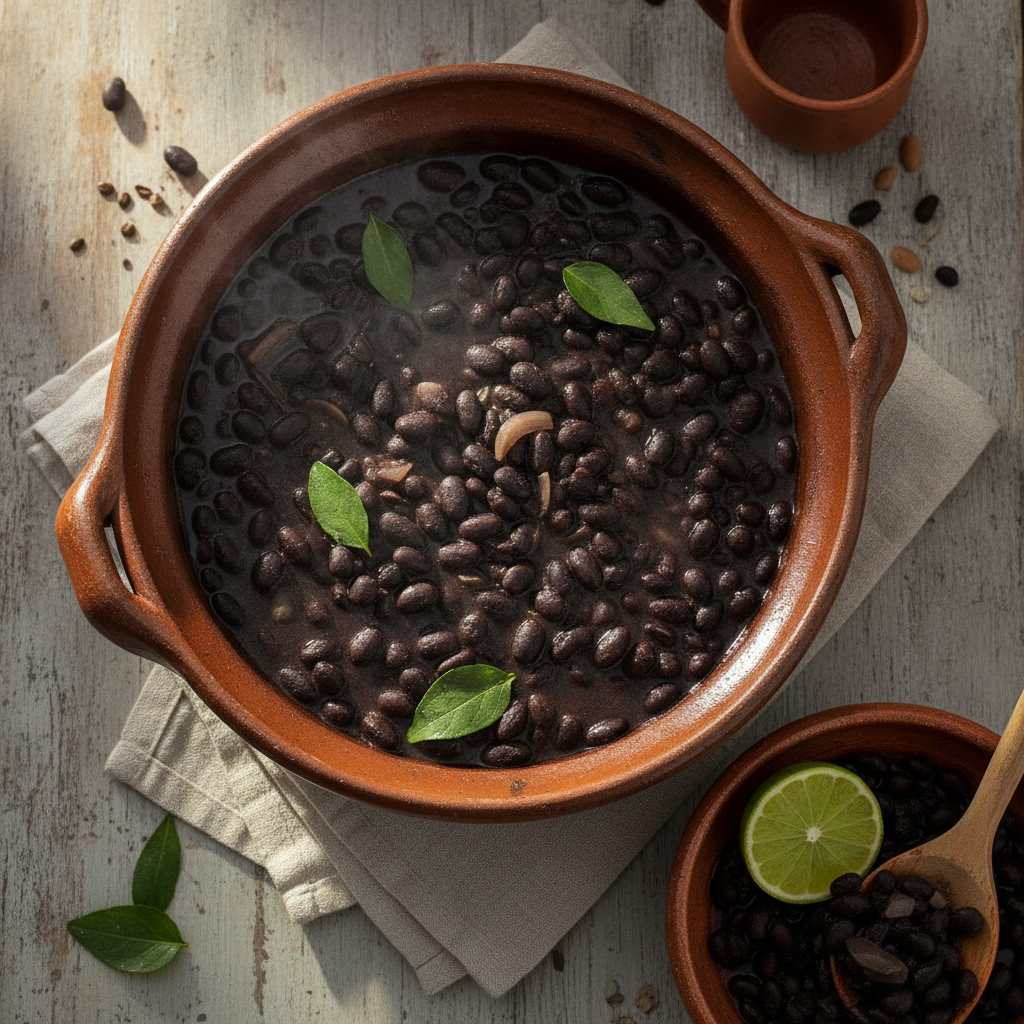
Frijoles negros de olla is the foundation of the Mexican table — black beans cooked low and slow in a clay pot with white onion, garlic, and epazote until they are soft, intact, and suspended in a dark, silky pot liquor that is as valuable as the beans themselves. This is a patience dish. Time is the technique. Black beans have been cultivated in Mesoamerica for over 7,000 years, and the olla de barro is one of the oldest cooking vessels in Mexican material culture, still used daily in Oaxaca, Chiapas, Yucatán, and across the south of Mexico. The result is a pot of beans so deeply flavoured you can eat them straight from the clay with a squeeze of lime, or use them as the base for enfrijoladas, tlayudas, rice and beans, or a simple, restorative broth. The pot liquor — caldo de frijol — is itself a dish: often drunk straight from a cup with lime and a pinch of dried chili. Do not discard it.
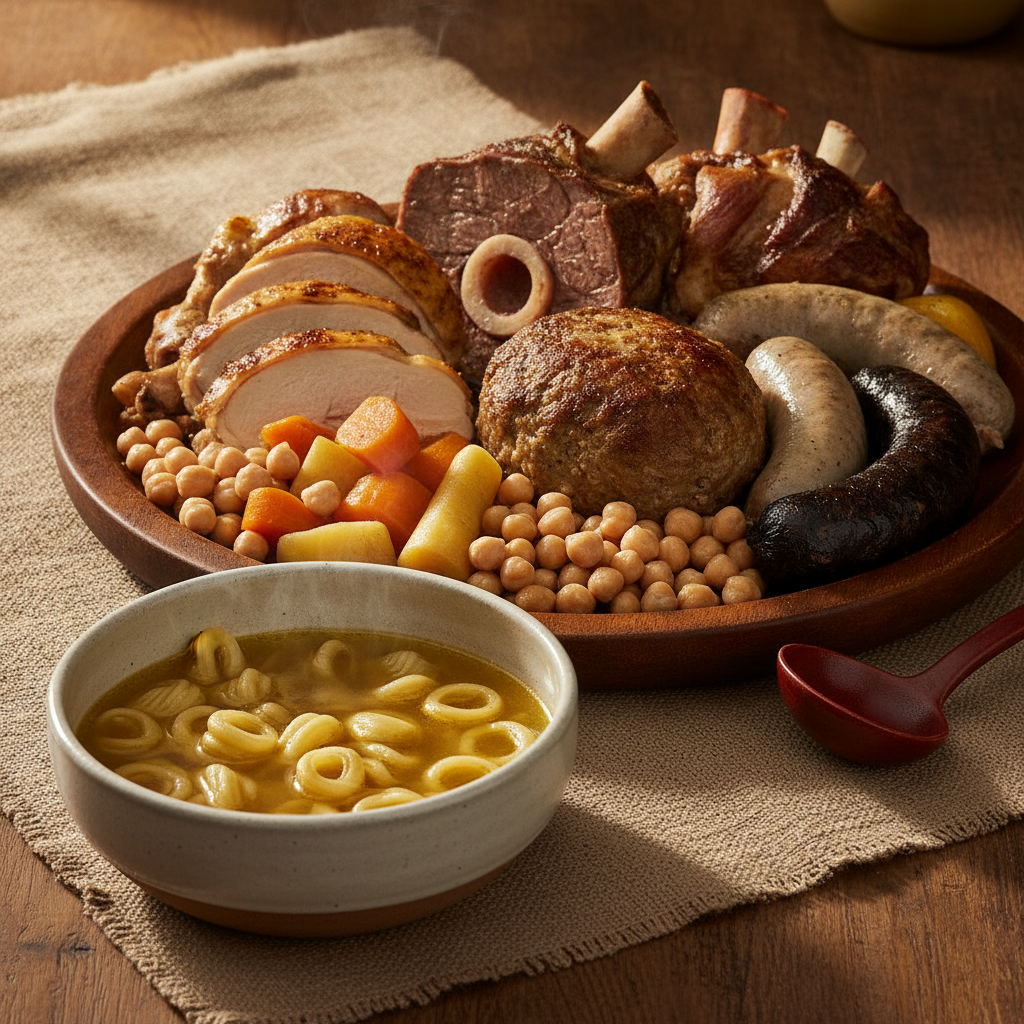
Escudella i carn d'olla is one of Europe's oldest recorded dishes — a magnificent Catalan Christmas pot stew referenced by the writer Francesc Eiximenis as far back as the 14th century. The name tells the story: escudella means 'bowl', carn d'olla means 'meat in the pot.' Everything cooks together in one great vessel — chicken, beef shank, pork ribs, the essential Catalan sausages (botifarra blanca and negra), chickpeas, root vegetables, and the centerpiece: the pilota, a large fist-sized meatball of seasoned ground pork that poaches in the broth for almost an hour and becomes the concentrated expression of the whole pot in a single bite. Served in two courses — first the golden broth ladled over galets (giant Catalan pasta shells), then the meats and vegetables on platters — this is the dish around which Catalan Christmas revolves.
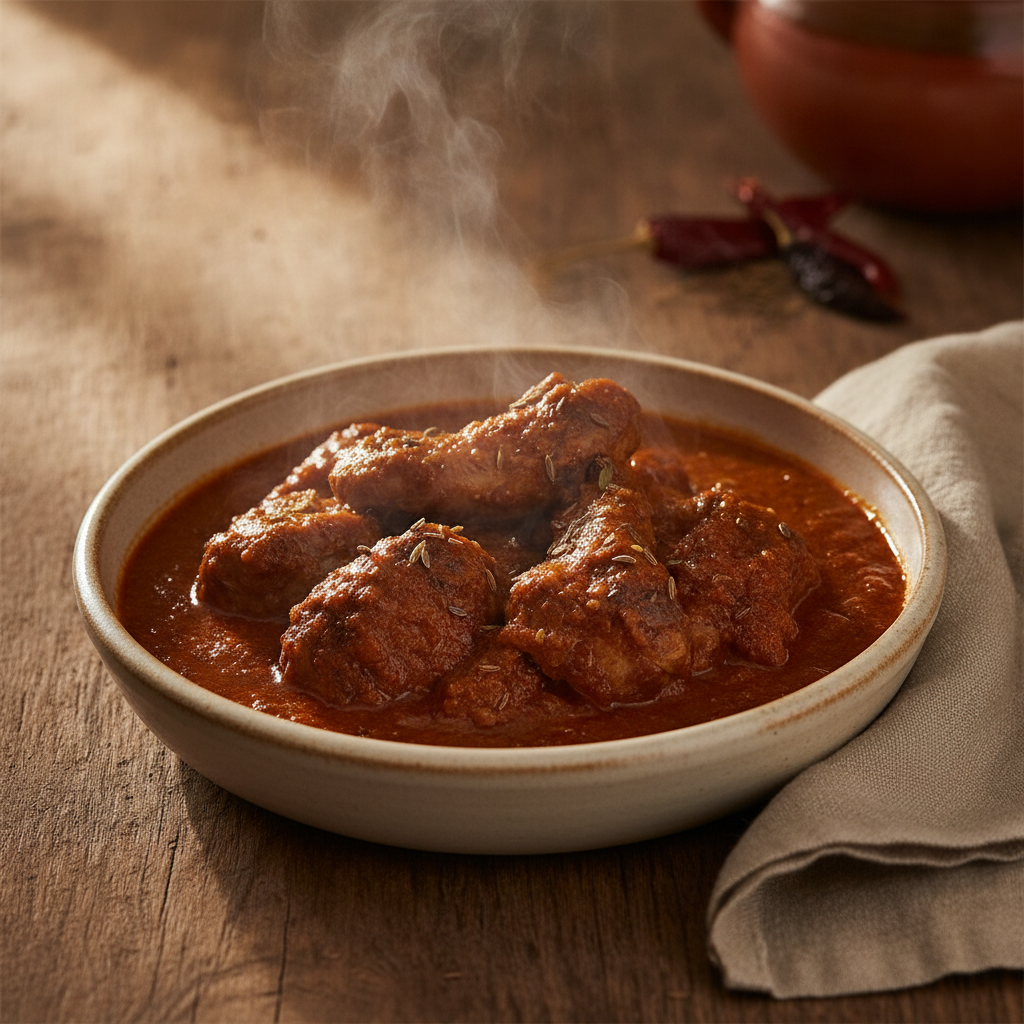
Before the Spanish arrived with cattle and pigs, before lard and wheat flour changed the Mexican kitchen, there was this: dried chile paste, toasted spices, and rabbit. Conejo en adobo is one of the oldest surviving dish structures in Mexican cooking — the technique of grinding dried chiles into a thick paste for braising predates the Conquest by centuries. The Aztecs counted rabbit among their prized animal proteins alongside turkey and duck; marketplace records from Tenochtitlán show a rabbit worth 10 cacao beans, and the rabbit-headed deity Ometochtli presided over the entire cosmos of fermentation and excess. What separates this recipe from chile-flavored broth is a step called *freír el adobo* — frying the strained chile paste in hot fat until it reduces to a dark, sticky mass. It splatters. It fills the kitchen with dense, fragrant smoke. And it is non-negotiable: without it, you have chile-flavored water; with it, you have adobo. This formulation — guajillo and ancho together, charred tomatoes and onion, cumin and Mexican oregano — is canonical to the northern state of Tamaulipas, though variations appear across Mexico wherever dried chiles and game have long coexisted. Rabbit is worth tracking down (any good butcher can order it; heritage farms sell it online). But if availability is the barrier: bone-in, skin-on chicken thighs work beautifully with identical technique and identical timing. The adobo is the point. The protein is flexible.
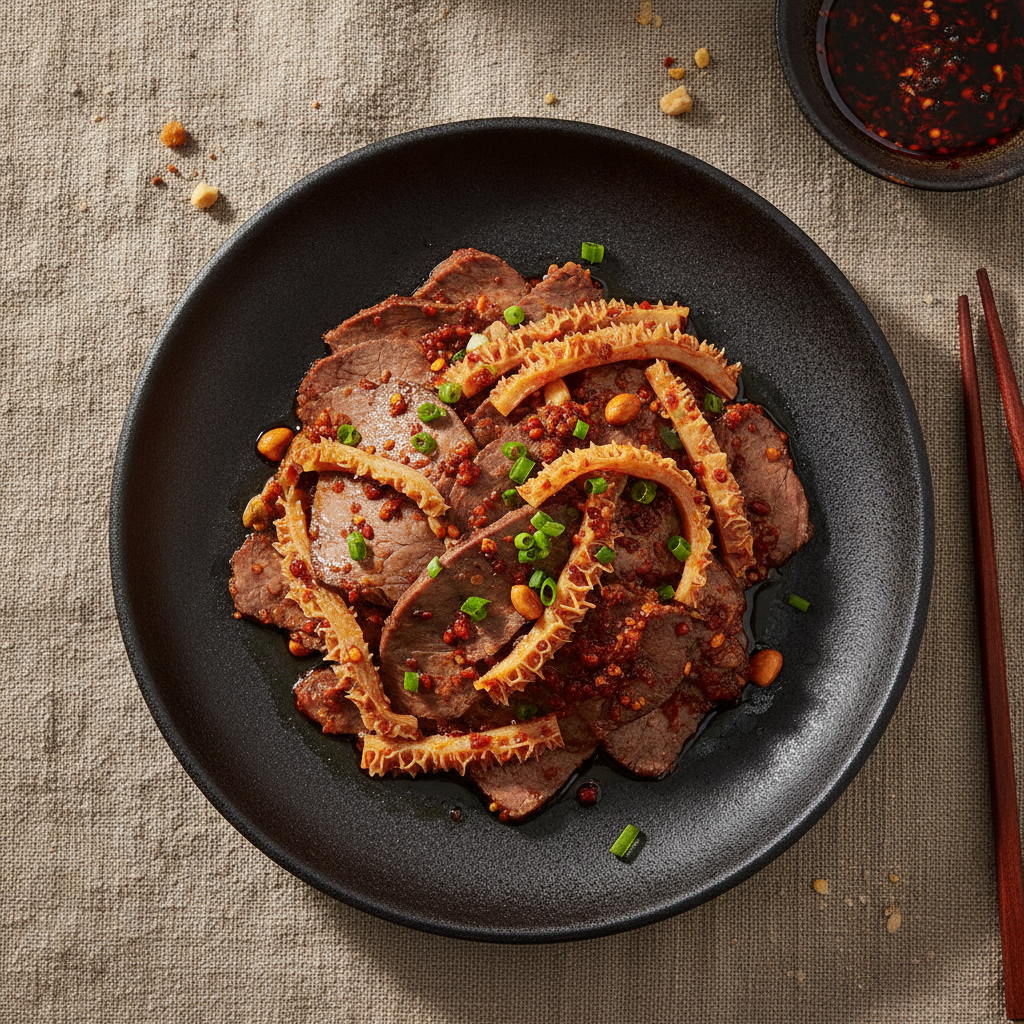
In 1930s Chengdu, a couple named Guo Zhaohua and his wife Zhang Tianzheng sold spiced cold beef offal from baskets carried on their shoulders. They hawked it through the lanes of the city for a few coins a portion, and the dish became famous enough that locals named it after them — "husband and wife offal slices." The word fei (肺) in the name means "lung," which was indeed one of the cheaper offal cuts they used at the time. Modern versions rarely include lung — texture and availability have long since phased it out — but the name is preserved as a cultural artefact. You are not eating lung. You are eating braised beef shank and honeycomb tripe, cold-sliced thin and dressed in a chili oil sauce with enough numbing Sichuan peppercorn to make your lips tingle pleasantly for several minutes after you finish. Fu qi fei pian is a cornerstone of Sichuan leng cai (cold dishes), and it exemplifies the mala (麻辣) flavour profile that defines Chengdu cooking at its most characteristic: the má (numbing) sensation from hua jiao peppercorns fused with the là (spicy) heat of chili oil and Pixian doubanjiang. Neither the numbness nor the heat is overwhelming on its own — together they create something simultaneously exciting and addictive in a way that straightforward chili heat alone never quite achieves. The dish requires patience: the meats braise at a low simmer, cool overnight, and are sliced paper-thin the following day. Very little of that time is active work. The reward is a cold dish that punches far above its ingredient cost and works beautifully as part of a larger Sichuan spread or as a standalone appetiser with drinks. One ingredient is non-negotiable: Pixian doubanjiang — the aged, brick-red broad-bean chili paste from Pixian county in Chengdu. Buy it from an Asian grocery store or online. The generic chili bean paste sold in some supermarkets is a different product. Similarly, the quality of your chili oil matters enormously. A good chili oil carries layers of flavour from whole spices — star anise, cinnamon, cardamom — steeped in the oil during cooking. A cheap oil is just neutral oil with chili flakes floating in it, and the difference shows on the plate.
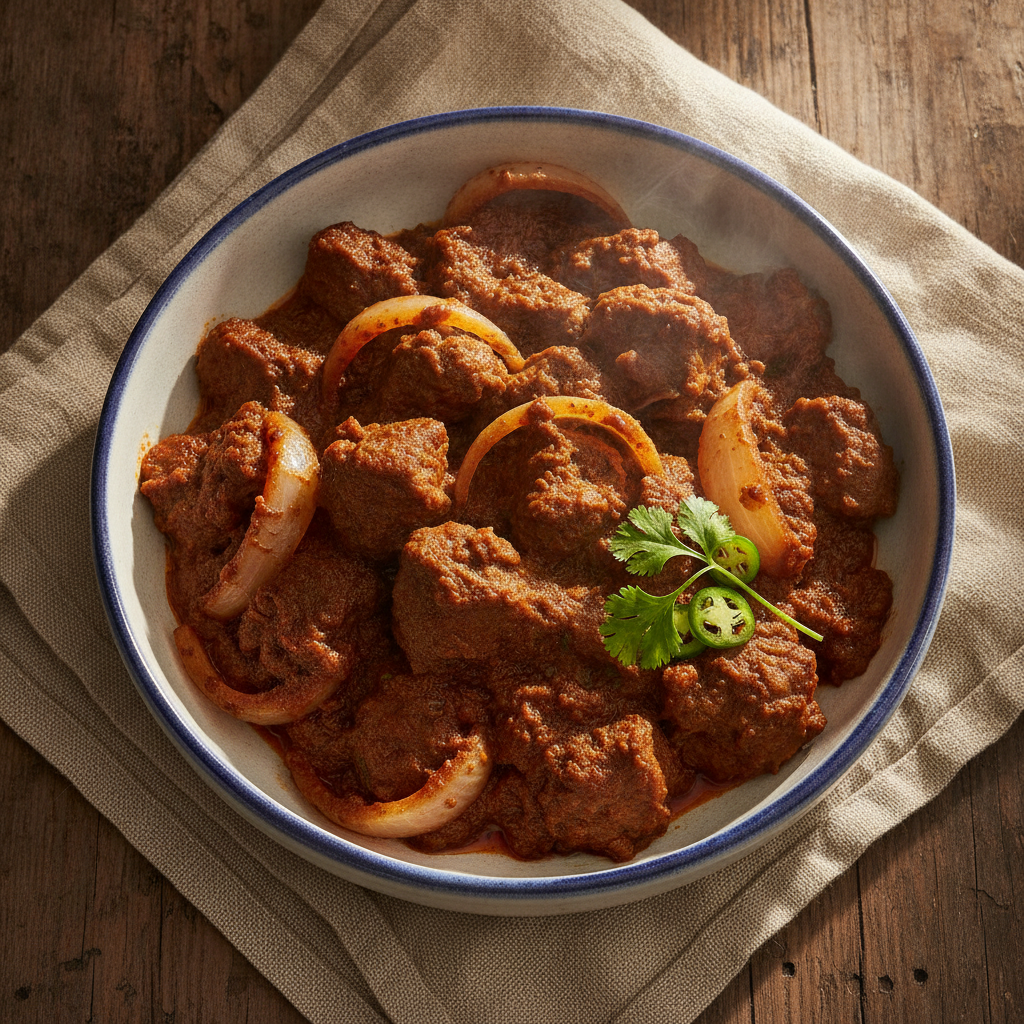
Legend has it that gosht do pyaza was born by accident. Mullah Do Pyaza, a beloved jester in Emperor Akbar's 16th-century court, allegedly doubled the onions in a lamb recipe — whether through carelessness or mischief, no one agrees — and produced something so much better than the original that it was named after him. Food historians treat the story as charming apocrypha, but the dish it describes is very real, and the name is literally descriptive: gosht means meat, do pyaza means double onion. The double-onion technique is everything here. The first batch — thinly sliced and cooked patiently over medium heat until a deep, uniform mahogany — collapses into a thick, jammy base that functions like a concentrated stock, a sauce, and a tenderizer all at once. The lamb braises in this dark, glossy paste rather than in liquid, which is why gosht do pyaza tastes so different from an ordinary curry. With fifteen to twenty minutes left on the clock, the second batch goes in: thick onion wedges that hold their shape and introduce a fresh, slightly sweet crunch against the yielding meat. That second addition is also what makes this dish counterintuitive for cooks used to saucy gravies. Do pyaza is intentionally dry. The finished masala should coat the lamb rather than pool at the bottom of the pot — if it looks saucy at the end, cook it down further. That thick, clingy texture is the goal, not a mistake. Note: prep time does not include the optional 30-minute yogurt marinade. If time allows, toss the lamb with the yogurt and half a teaspoon of salt and rest it in the refrigerator before starting — the dairy acids will begin tenderizing the meat and you'll get a slightly more yielding result. It is not required, but it does not hurt. Pressure cooker note: Build the full masala as directed through step 5, then transfer to a pressure cooker and cook on high for 8–10 minutes. Release all steam naturally before opening. Return the pot to an open flame and cook uncovered for 5–10 minutes to reduce excess moisture before adding the second batch of onions.
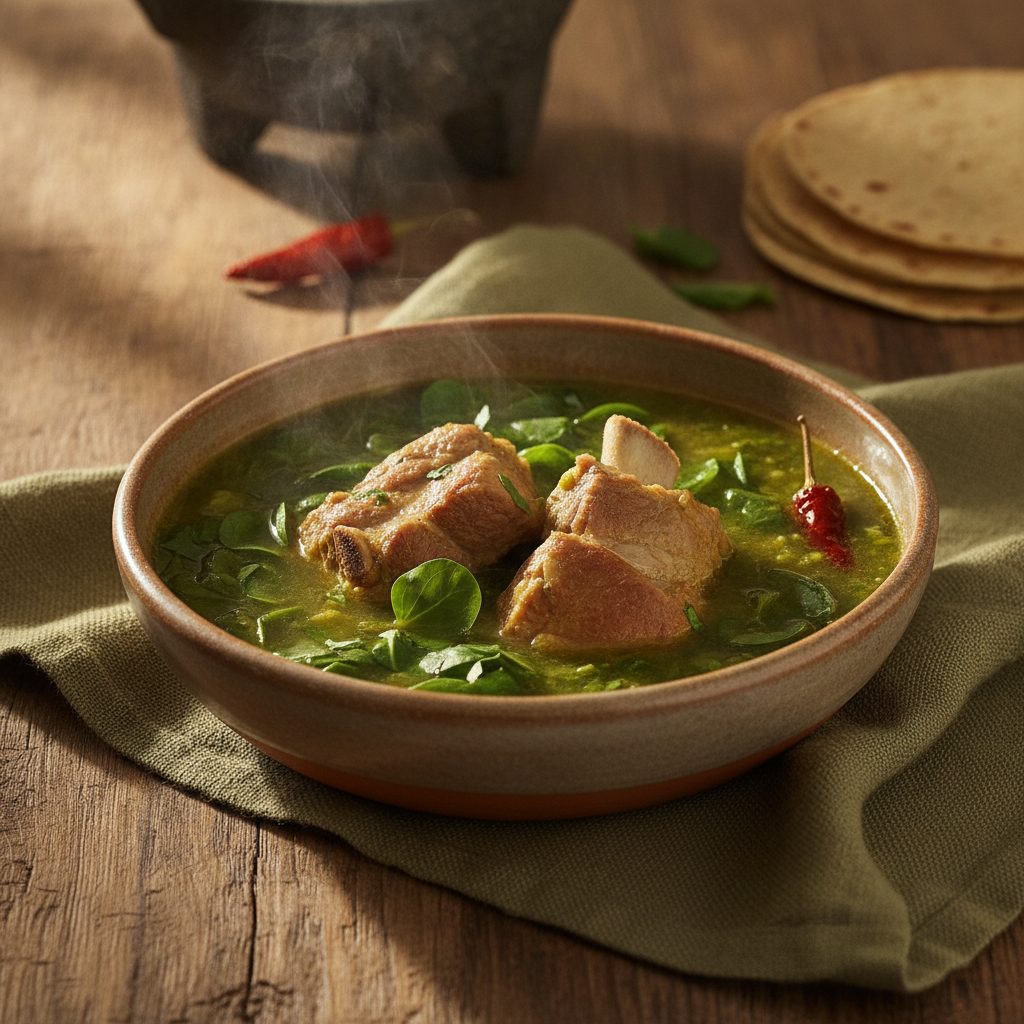
Purslane looks like a succulent — glossy, thick-leaved, growing low to the ground — and in much of North America it is treated as a weed. In central Mexico, it is dinner. Verdolagas (Portulaca oleracea) belong to the quelites, the family of wild edible greens central to Mexican cooking since pre-Columbian times. Fray Bernardino de Sahagún documented them in Nahua foodways as early as 1577. They have a mild citrus tang, a slight succulent texture, and they wilt just enough in hot broth to become silky without disappearing. Sopa de verdolagas is not a restaurant dish. It is not a festive occasion meal. It is Tuesday dinner in Mexico City and across the central highlands — the kind of food a grandmother makes without a recipe. Pork ribs braised low and slow until the collagen melts into the broth. A salsa verde fried in lard until it rounds from sharp and acidic to deep and herbal. Purslane added at the very end, just long enough to wilt and absorb the flavors without overcooking. Start the pork and walk away. By the time you make the salsa and fry it off, the meat is done. The whole dish takes 15 minutes of actual work.
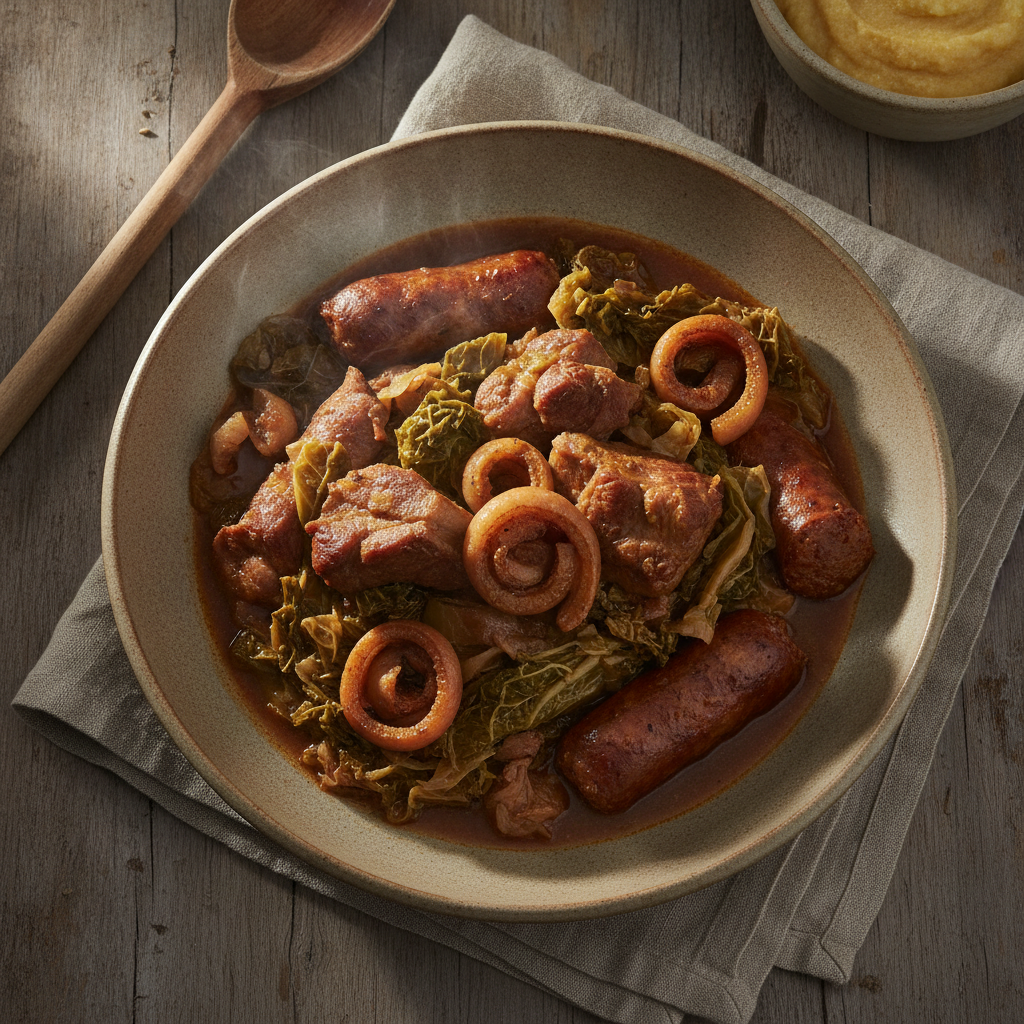
Cassoeula is Milan's cold-weather standard — a long braise of pork ribs, sausage, and pork rind with savoy cabbage that comes into its own after the first frosts of January. Lombard families traditionally made it on Sant'Antonio Abate, the feast day that marked the end of the winter pig slaughter, using the collagen-rich cuts that braising handles best.
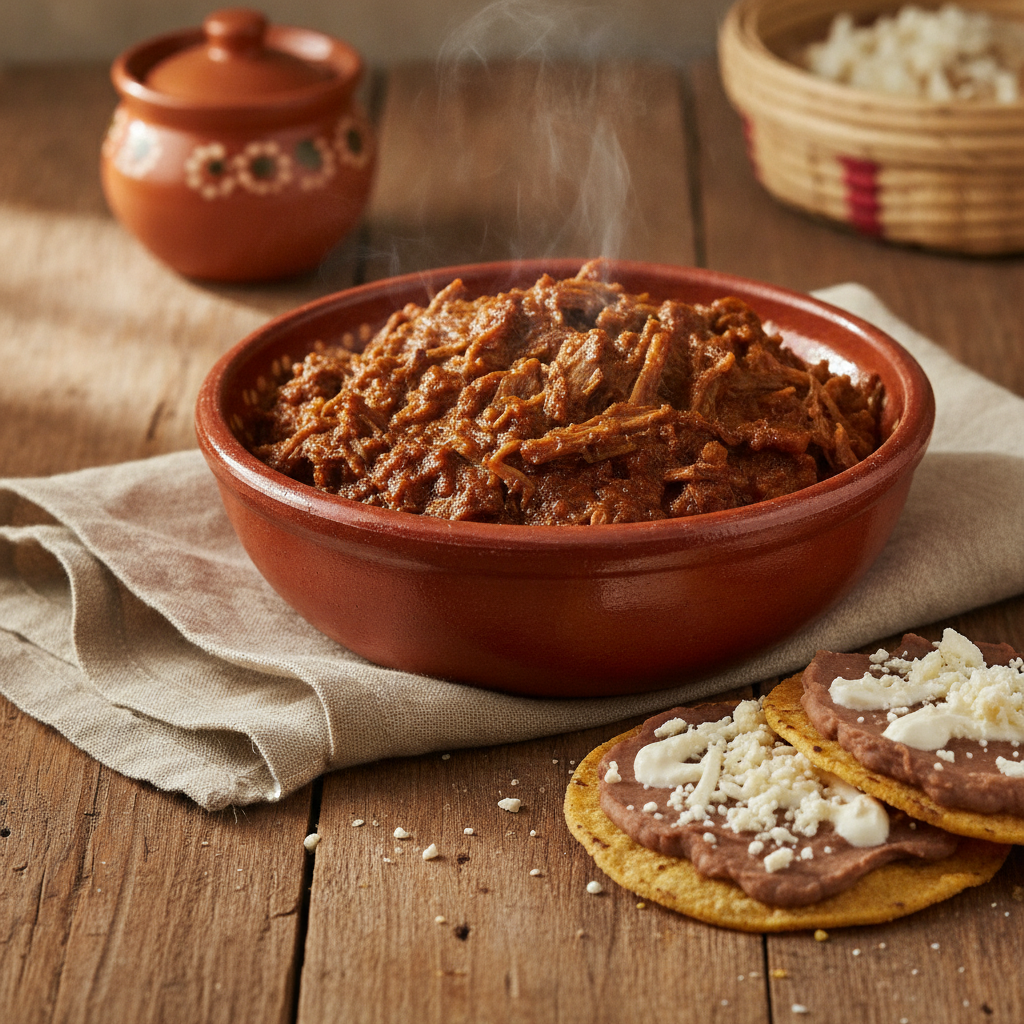
Tinga de res is the beef sibling of the more widely known tinga de pollo — and in many ways, it is the richer, more satisfying version. Brisket or chuck roast braises low and slow until pull-apart tender, then gets reunited with a smoky, reduced chipotle-tomato sauce until the edges caramelise and the whole dish smells like it came off an open fire. This is Pueblan cooking at its weekend best: unpretentious, deeply flavoured, and made for piling onto crispy tostadas with a smear of refried beans, a drizzle of crema, and a scatter of queso fresco. The recipe is not complicated, but it has one non-negotiable step that most home cooks skip: reducing the blended chipotle-tomato sauce until it is thick and dark before adding the beef back in. Skip this and you get watery tinga. Do it right and you get something that clings to every shred of beef, stains your fingers, and disappears from the platter faster than you expect.
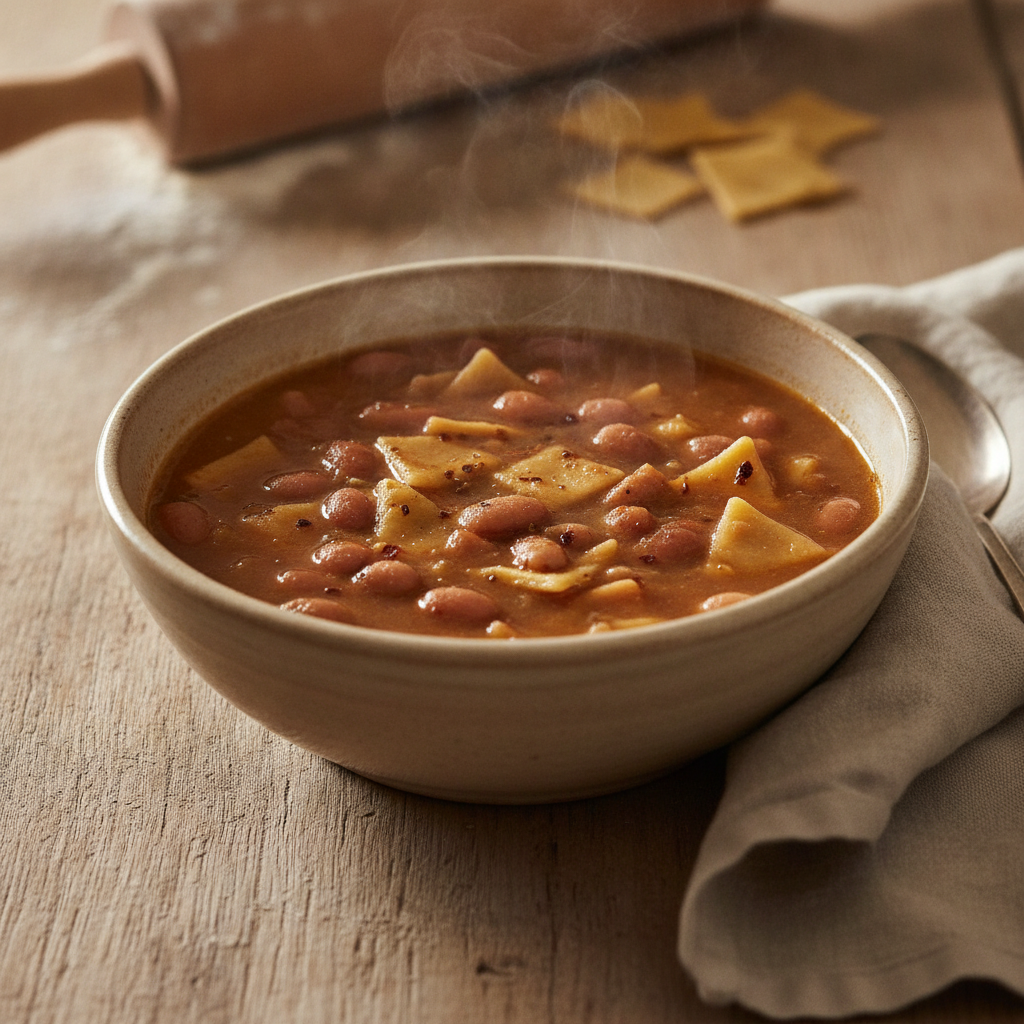
Maltagliati — 'badly cut' — are Emilia-Romagna's pasta of necessity: the scraps trimmed from tagliatelle dough that were too good to waste. Cooked with borlotti beans in a thick, pork-fat-rich broth, they produce something better than the sum of their parts.
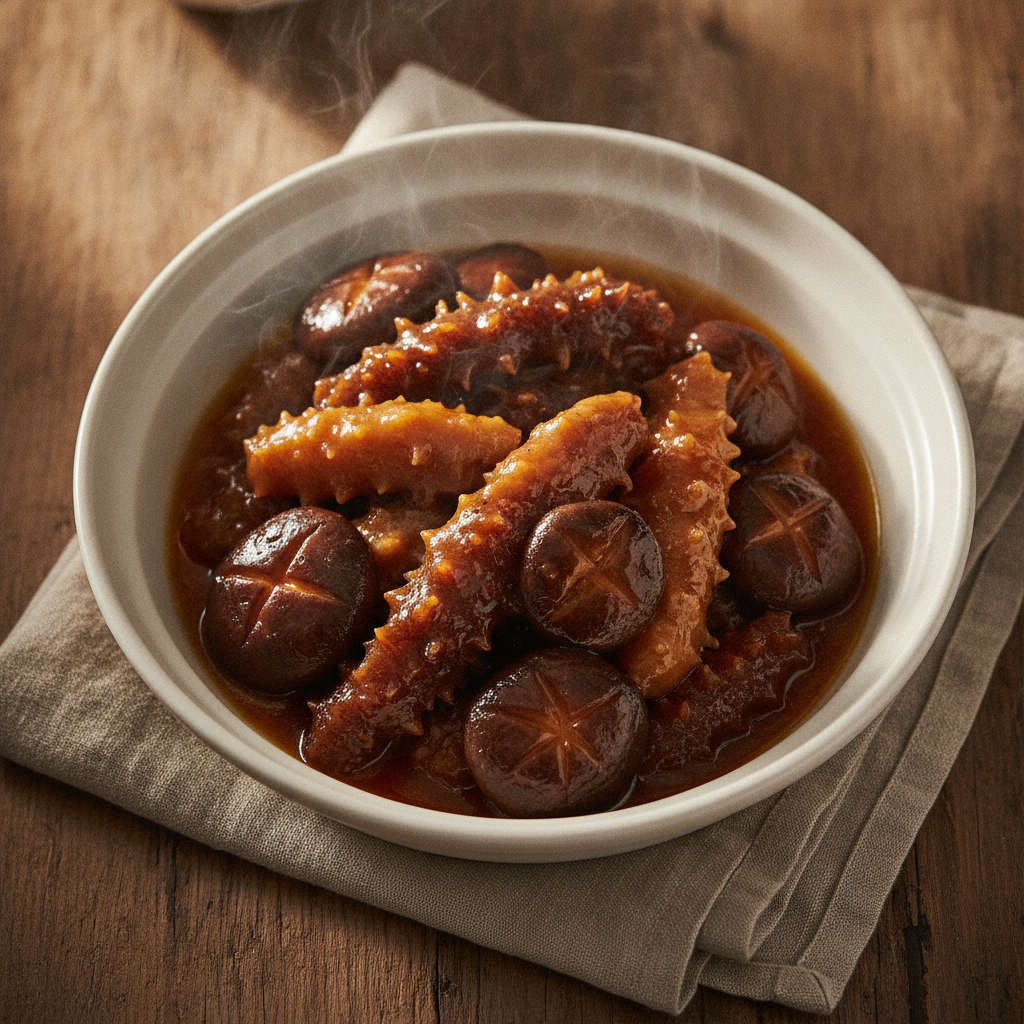
A Chinese banquet centrepiece that takes patience and skill, but rewards both in full. Braised sea cucumber with shiitake mushrooms in a glossy oyster sauce glaze is one of the great Cantonese luxury preparations — and the multi-day rehydration required is not an obstacle but a signal of care for your guests. Budget 3–7 days before you cook; the active work is about an hour. Sea cucumber (海参, hǎi shēn) is one of the Four Sea Delicacies of Chinese banquet cuisine alongside abalone, shark fin, and fish maw. Its name phonetically echoes 'newborn,' making it auspicious at Chinese New Year, weddings, and important family occasions. The ingredient is essentially a flavour sponge — tasteless on its own, completely transformed by the deeply layered braising liquid it absorbs. The craft here is building that liquid: chicken stock, shiitake soaking water, Shaoxing wine, and oyster sauce create a compound umami that saturates every piece. The final cornstarch-thickened glaze, finished with sesame oil, is unmistakably Cantonese.
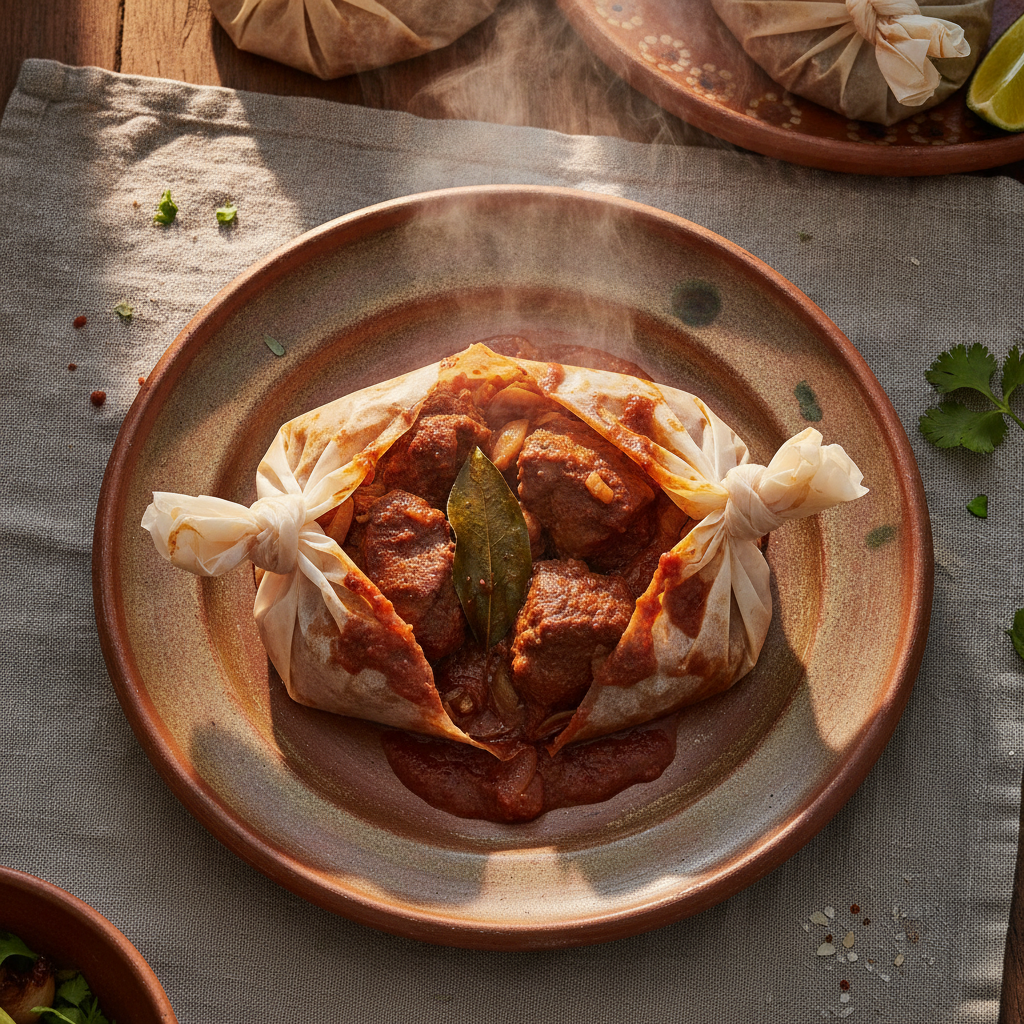
The moment the paper splits open and a cloud of guajillo-anise steam rises from the table, you understand why mixiotes have survived seven centuries of Mexican cooking unchanged in spirit. This is a dish that rewards patience and punishes shortcuts. Mixiotes (from Nahuatl: metl = maguey, xiotl = membrane) are tightly sealed steam packets of marinated meat — traditionally lamb wrapped in the dried epidermis of agave leaves — that have been cooking in the Mezquital Valley of Hidalgo since before the Spanish arrived. The Otomí people of that semi-arid region are considered the master practitioners: lamb grazes on wild aromatic herbs, maguey grows from the same earth, and the adobo built from dried guajillo and ancho chiles ties the whole landscape into a single packet. Today, real maguey paper (papel de mixiote) is hard to find outside Mexico and its harvest is legally restricted in many states to protect endemic agave species. Parchment paper is the accepted substitute and works beautifully — you lose the faint herbal note the real membrane imparts, but the technique is unchanged. What you don't substitute: the overnight marinade, the charred onion and garlic on a dry comal, and the avocado leaf tucked inside each packet before you tie it shut. That last ingredient is the detail that separates authentic mixiotes from the generic — it contributes a slow, anise-like note that builds throughout the steam, and it's worth hunting down at a Mexican grocery. This is a weekend dish. Plan for it.
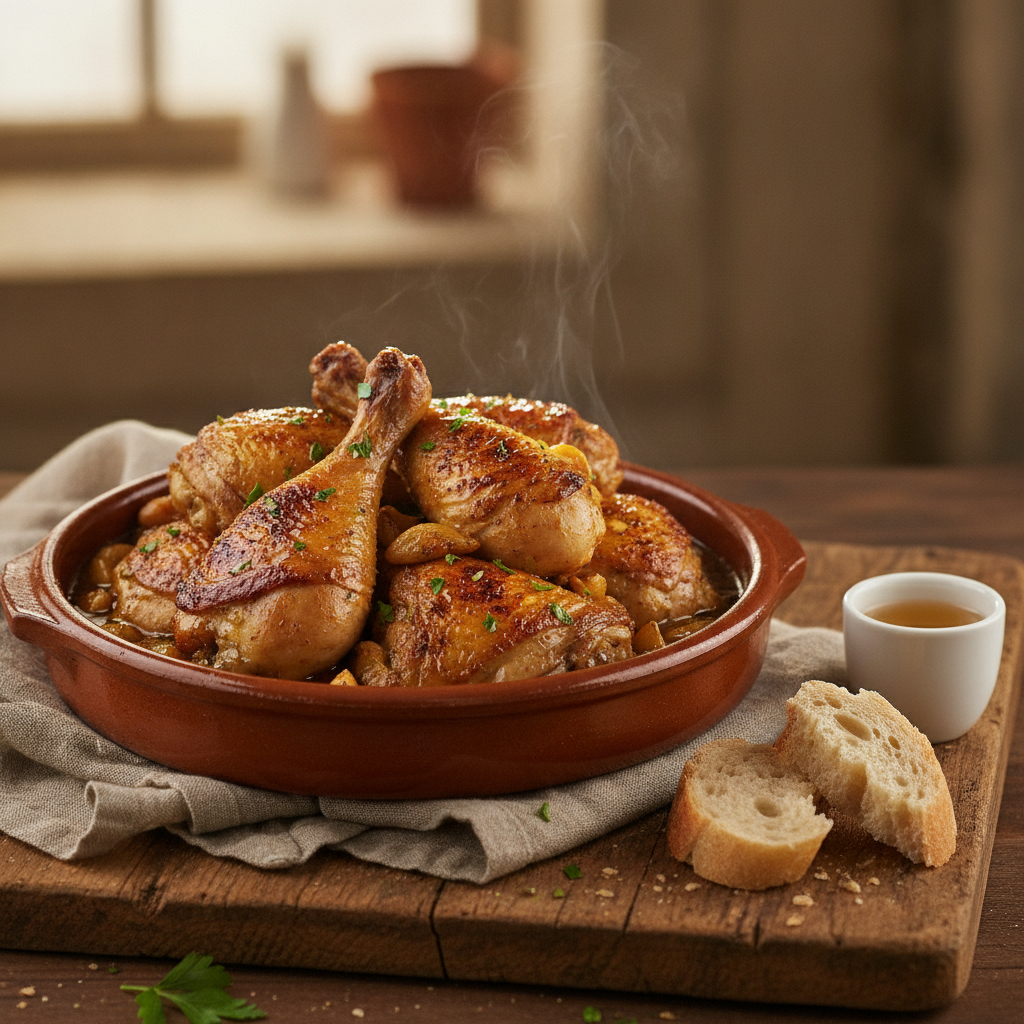
There are three moments in this recipe that matter: the hard sear that crisps the chicken skin and builds flavour fond on the pan; the garlic sweetening in the hot oil until fragrant and just beginning to colour; and the sherry deglaze that lifts every bit of that fond into a wine sauce that couldn't exist without a Spanish pantry. Pollo al ajillo translates simply as 'chicken with garlic' — a template Andalusians apply to prawns, mushrooms, veal, almost any protein. But the chicken-and-sherry version is the one that makes you want to mop the pan clean with bread. It is traditional tapas food, meant to be eaten from the cazuela with a cold glass of fino on the side. The sherry is the soul of this dish. Buy manzanilla or fino — dry and saline with a nutty edge — not sweet cream sherry. And use bone-in, skin-on thighs and drumsticks: they release collagen as they braise, giving the pan sauce its body. Breasts dry out before the sauce has time to build.
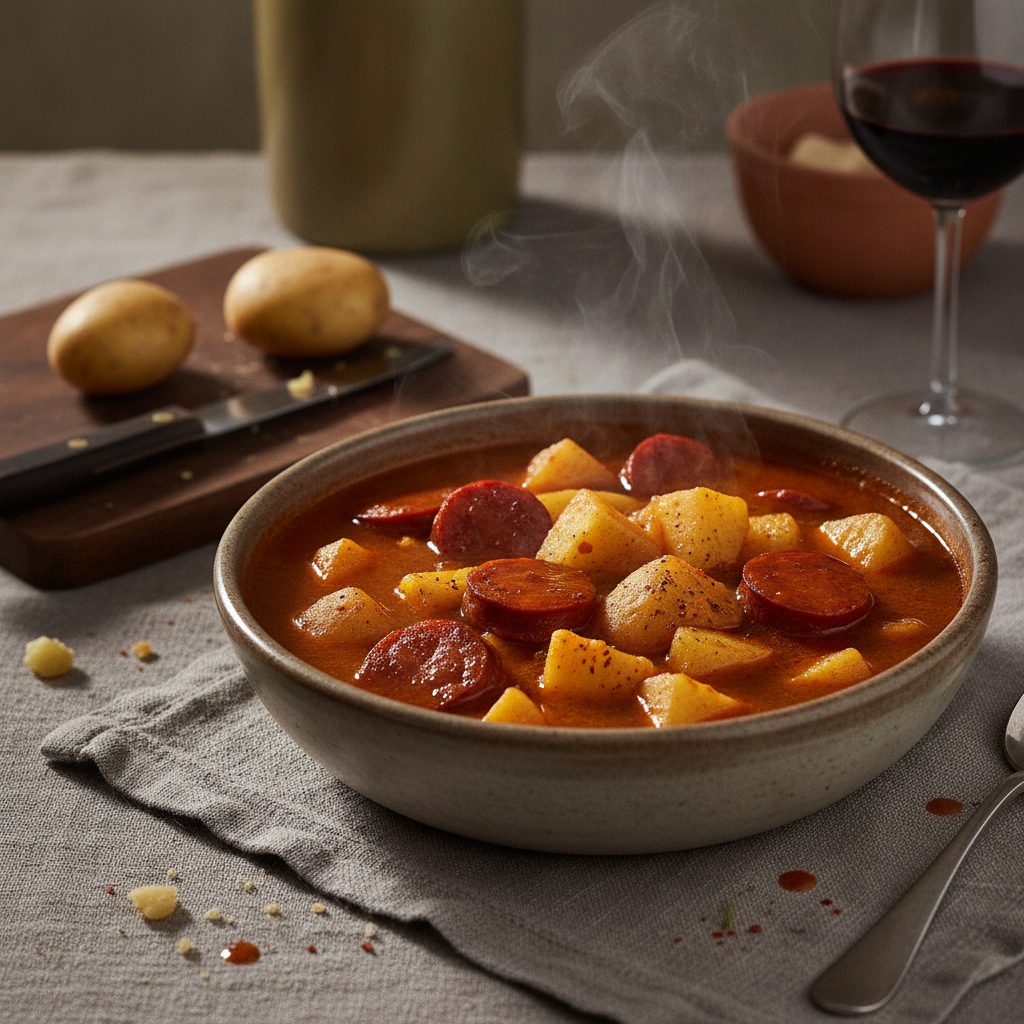
The first thing people notice about patatas a la riojana is the colour — that deep rust-orange broth that stains the bowl and coats every potato. That colour comes from chorizo fat rendering slowly into the liquid, carrying the pimentón with it, and together they turn a pot of water and humble vegetables into something that looks and tastes like it has been simmering for hours. It hasn't. This is La Rioja's everyday dish. Not the wine (though a glass alongside is not a bad idea), not the lamb — the potatoes. Patatas a la riojana appears at family tables and modest restaurants throughout the region, unchanged in its essentials: potato, chorizo, pimentón, one pot. The dish crystallised in the 16th century when the potato and the pimentón arrived from the Americas, and it has been staying for dinner ever since. There are two techniques worth understanding before you start. The first is the cascado (or chascarlas) cut: you insert the knife into the potato and twist to break off each piece rather than cutting cleanly through. The rough, torn surface releases far more starch into the broth than a clean knife cut would, and this is how the broth thickens itself without a spoonful of flour. The second technique is the pimentón moment: the spice goes into hot oil before any liquid, and it must fry for 30 to 60 seconds. Crucially, do it at lowered heat or briefly off the burner — pimentón scorches in seconds and turns bitter. These two decisions separate a good version from a great one.
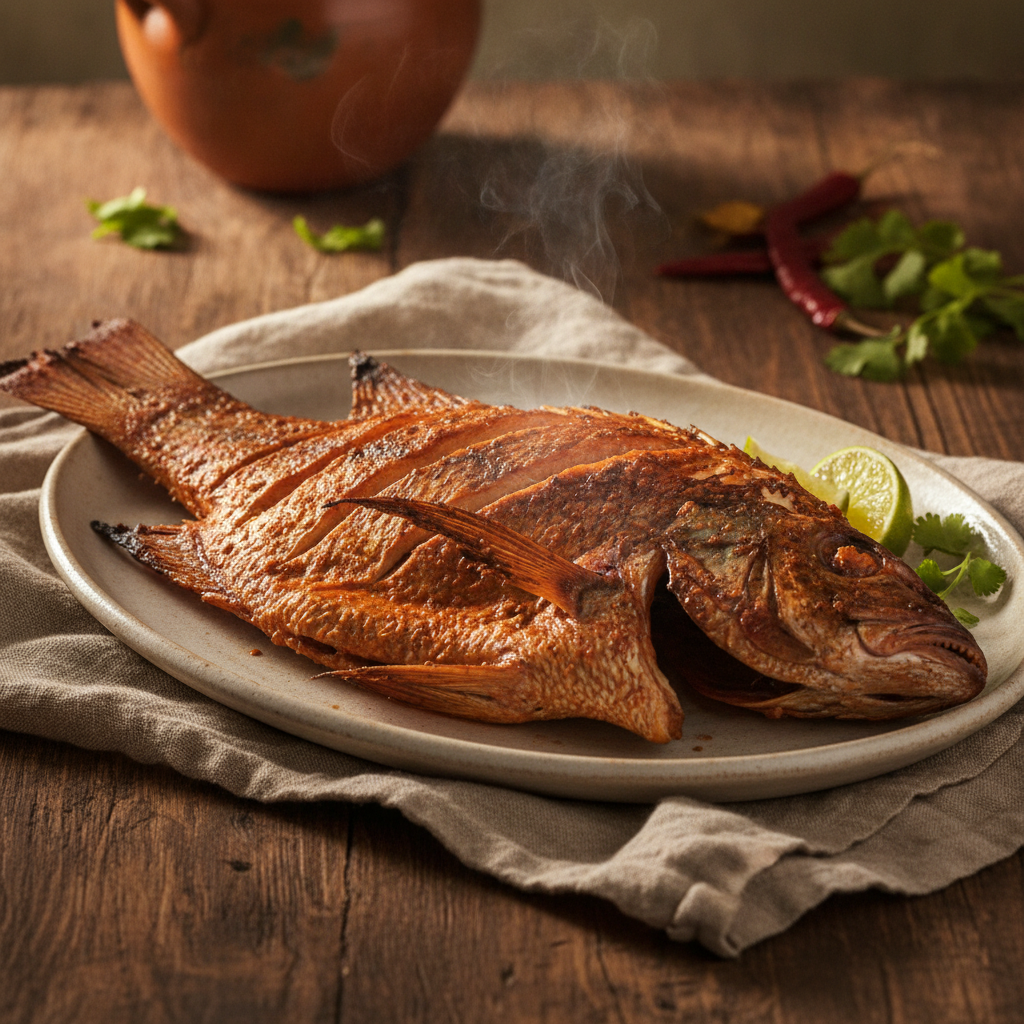
Pescado zarandeado is the soul of the Sinaloan Pacific coast — a whole fish butterflied open, scored deeply, slathered in a rust-red achiote adobo with sour orange, chiles, and a whisper of Maggi, then grilled over mesquite charcoal in a wire basket that is rocked and repositioned over the coals. The name comes from zarandear: to shake or swing. The result is fish with a deeply caramelised, almost lacquered exterior and a barely-cooked, flaking interior saturated with adobo all the way through. This recipe brings that experience home with honest instructions for gas grill and charcoal alike. The two moves that define this dish: butterfly the fish correctly and open it flat like a book (score it deeply — this is not optional), and grill it at medium heat, not high. The achiote adobo contains natural sugars that burn before the fish cooks through if your heat is too aggressive. Keep the fish moving, baste during cooking, and resist the urge to rush it. If you cannot find sour orange (naranja agria), substitute three parts lime juice to one part fresh orange juice — the profile is close enough that you will not notice the difference. Ask your fishmonger to butterfly the fish for you if you are not comfortable doing it yourself: split from head to tail along the spine, opening flat with the spine intact, the two fillets connected through the belly.
08 / FAQ
Yes, but the oven gives more even heat. On the stovetop, use the lowest possible flame and keep the lid mostly on. A heat diffuser helps.
Absolutely. Whole fennel, leeks, cabbage wedges, romaine hearts — sear, add stock and aromatics, cover and cook 30–60 minutes. The vegetable version is faster but the same idea.
Stewing is braising with smaller pieces of meat fully submerged in liquid. Braise = large piece, half-submerged. Stew = small pieces, fully covered. Both convert tough to tender.
Optional. A 12-hour marinade in wine and herbs adds depth but isn't strictly necessary — a long enough braise builds flavor on its own.