Souschef AI

Global Kitchen

AI

Spanish · dinner

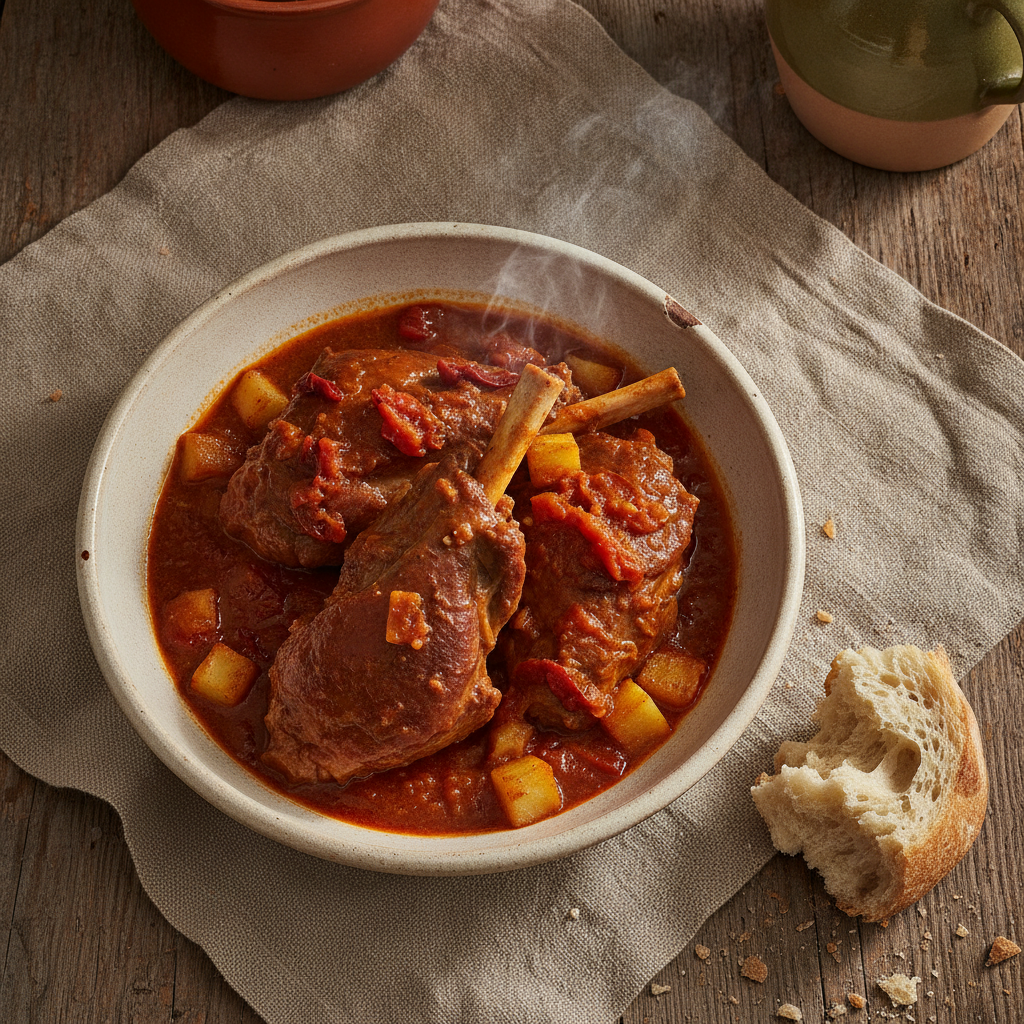
Carrilleras de Cerdo: Slow-Braised Pork Cheeks with Fino Sherry and Red Wine

#spanish#pork#braised#dinner#andalusian

170m

Total time

4

Servings

kcal

medium

Difficulty

Jul 4, 2026

INGREDIENTS.

4
Meat
  • 1.2 kg pork cheeks (carrilleras de cerdo)
Pantry
  • 3 tbsp plain flour
  • 3 tbsp extra-virgin olive oil
  • 400 ml chicken or beef stock
Alcohol
  • 200 ml fino sherry or Manzanilla
  • 300 ml full-bodied dry red wine (Rioja or Ribera del Duero)
Produce
  • 2 medium onions
  • 2 medium carrots
  • 2 celery stalks
  • 6 garlic cloves, unpeeled and lightly crushed
  • 4 fresh thyme sprigs
  • flat-leaf parsley, finely chopped (to serve)
Spice
  • 2 bay leaves
  • 6 black peppercorns, lightly crushed
  • 1.5 tsp fine sea salt

THE METHOD.

tap to check off

0/6 done

FAQ · Things people ask

About this recipe.

Can I use oloroso or amontillado sherry instead of fino?

Yes — oloroso gives a richer, more oxidised, nuttier flavour; amontillado is a middle ground between fino and oloroso. All work well and keep the dish within the right Andalusian family. Fino and Manzanilla are the lightest and most delicate, which is why they are the first choice here. Avoid cream sherry — it is too sweet and will throw off the balance of the sauce.
Where do I buy pork cheeks?

Ask your butcher directly — they are not always on display but most whole-animal butchers carry them. Spanish delis often stock them frozen. Online meat suppliers are another good source. Beef cheeks are a solid substitute with a slightly richer, beefier flavour and a slightly longer braise time (add 30–45 minutes).

Can I make this a day ahead?

Absolutely — this dish is genuinely better the next day. The cheeks absorb more sauce overnight and the flavours meld and deepen. Refrigerate the cheeks and strained sauce separately. The sauce will set to a firm jelly (all that gelatin), which is a good sign. Reheat both gently together over low heat — do not boil.

What should I serve with carrilleras?

Creamy mashed potato is the classic pairing — the starch absorbs the sauce beautifully. White bean puree is a Spanish alternative with more body. Polenta, papas arrugadas (Canarian wrinkled potatoes), or crusty bread for mopping all work well. A simple dressed green salad or braised greens like spinach with garlic balance the richness.

My sauce is not thickening — what went wrong?

Keep reducing. The natural gelatin in the braising liquid does the work, but it needs time and a brisk simmer. Do not add cornstarch or flour at this stage. If after 20 minutes of steady simmering it is still very thin, your pork cheeks may have been lean. A small knob of cold butter whisked in at the end will give you gloss and body.

Related · You might also cook

Keep going.

Croquetas de Sepia con Tinta: Spain's Jet-Black Squid Ink Croquettes
spanishhard

Croquetas de Sepia con Tinta: Spain's Jet-Black Squid Ink Croquettes

These are the croquetas that stop the table. The moment you set down a plate of jet-black croquetas — no other colour, just coal — conversation pauses. The first bite does the rest: a crust that shatters cleanly, then warm, silk-smooth béchamel loaded with the taste of the deep sea. This is croquetas de sepia con tinta, and they belong to the Cantabrian coast, where cuttlefish (sepia) has always been celebrated in its own ink. The recipe has three distinct stages and patience requirements that are genuinely non-negotiable. First, a slow sofrito — onion cooked until almost melting, a full 20 minutes, sweetening from the inside out. Then the stiff ink béchamel, which is nothing like the sauce you pour over pasta. This is thick, glossy, and stiff enough to hold a shape cold. Then the chill: four hours minimum, overnight if at all possible. No shortcuts here. Warm filling means burst croquetas, and burst croquetas mean a sad fryer and a sadder cook. If you do all of this — and you will — the reward is extraordinary. A plate of dramatically black croquetas against white china, with a small bowl of saffron aioli alongside, is one of the great moments of Spanish bar food. Make these and people will ask for the recipe.

90 min 4
Read
Ensalada Rusa Española: Spain's Essential Tuna Potato Salad
spanisheasy

Ensalada Rusa Española: Spain's Essential Tuna Potato Salad

Walk into any tapas bar in Spain — Madrid, Seville, Barcelona — and you will almost certainly find a small earthenware dish of ensaladilla rusa waiting on the counter. Creamy, set, scoopable, and deeply savory, it is one of those dishes that looks deceptively simple and rewards anyone who makes it properly at home. The name means 'little Russian salad,' a nod to the Olivier salad created in 1860s Moscow that eventually reached Spain and was quietly transformed. The extravagant game meats and seafood of the Russian original gave way to pantry staples, and canned tuna — one of Spain's most beloved ingredients — became the defining feature. What emerged is a dish distinctly Spanish in character: generous with mayonnaise, deeply flavored with good olive oil tuna, and built for the table, not the fridge door. The keys to getting it right: cook the vegetables separately so nothing is over- or underdone, let everything go fully cold before the mayo goes in, cut everything to a uniform small dice so each forkful carries all the flavors, and — critically — give it time. A few hours minimum, overnight if you can. The patience pays off in a salad that tastes like it came from a real tapas kitchen.

45 min 6
Read
Boquerones en Aceite con Olivas — Acid-Cured Anchovies the Right Way
spanisheasy

Boquerones en Aceite con Olivas — Acid-Cured Anchovies the Right Way

Boquerones en aceite con olivas is one of the great simplest things in Spanish food — fresh anchovies acid-cured in vinegar, then drained, dried, and dressed in good olive oil with raw garlic, flat-leaf parsley, and green olives alongside. It is quintessentially Andalusian, rooted in the coastal markets of Málaga where European anchovies are caught fresh in spring and summer and have been cured this way long before refrigeration existed. A word on what you are making: this is not raw fish. The vinegar denatures the proteins completely — turning the flesh white and opaque, just as heat would — through a process called acid denaturation. The result occupies its own sensory space: firmer than sashimi, softer than heat-cooked fish, clean and briny and bright rather than fishy. It has absolutely nothing to do with the brown, salt-cured anchovies in a tin. Two things make or break this dish. First, food safety: fresh anchovies must be frozen at −20°C / −4°F for at least 24 hours before you cure them. This eliminates anisakis, a parasitic worm found in wild anchovies that survives acid-curing. This is not optional, and it is not covered by refrigerating the fish overnight. Commercially frozen anchovies (most of what you will find outside coastal Spain) are already frozen to the required temperature; confirm with your fishmonger if buying something labeled 'fresh.' Second, the olive oil: after the vinegar is washed away, the fillets absorb the dressing directly. A mediocre oil will dominate the delicate fish. Use the best Spanish extra virgin olive oil you can find. Active prep is about 30 minutes. Then the fillets cure unattended in the refrigerator for 2 to 4 hours. The dish can be made the morning of and held in its olive oil dressing, covered, in the refrigerator until you are ready to serve.

30 min 4
Read
Mojo Picón Canario — The Canary Islands' Fiery Red Sauce
spanisheasy

Mojo Picón Canario — The Canary Islands' Fiery Red Sauce

Mojo picón is the sauce that defines the Canary Islands — a table condiment so essential that no plate of papas arrugadas (wrinkly brine-boiled potatoes) appears without it, and no Canarian cook would let a guest leave without a jar. It's smoky, garlicky, bracingly acidic, and built from a handful of pantry staples that collide in a blender and emerge tasting like something far more complex than their combined ingredients suggest. The Canary Islands sit off the northwest coast of Africa, closer geographically to Morocco than to Madrid, and their cuisine reflects centuries of Portuguese, African, and pre-colonial Guanche influence alongside Spanish culinary traditions. The word 'mojo' itself derives from the Portuguese 'molho' (sauce), a reminder that these islands served as a crucial waystation between Europe, Africa, and the Americas during the Age of Exploration. Two classic mojos rule every Canarian table: mojo rojo (red, this one) and mojo verde (green, made with cilantro or parsley). Picón specifically indicates the spicier, more fire-forward red variety. What makes this recipe special — and what often surprises first-time makers — is the piece of stale bread blended into the sauce. This is not a filler trick: the bread, briefly soaked and squeezed, acts as an emulsifier that gives mojo picón its signature thick, spreadable body. Without it, you get a thin vinaigrette; with it, you get a sauce that clings to a potato, coats a piece of grilled fish, or holds its shape on a slice of goat cheese. If you can find dried ñora peppers or the near-mythical pimienta palmera from La Palma island, use them. Dried ancho or guajillo are solid substitutes. Do not reach for bell peppers — they lack the depth.

15 min 6
Read