Can I use different vegetables?
Absolutely! You can substitute Napa cabbage with bok choy, spinach, or even add mushrooms or carrots for extra flavor and nutrition.
Chinese · dinner
30m
Total time
2
Servings
420
kcal
medium
Difficulty
tap to check off
FAQ · Things people ask
Absolutely! You can substitute Napa cabbage with bok choy, spinach, or even add mushrooms or carrots for extra flavor and nutrition.
Ensure you boil them until they are just tender before stir-frying, and separate them gently with chopsticks. A little oil in the stir-fry also helps prevent sticking.
Related · You might also cook
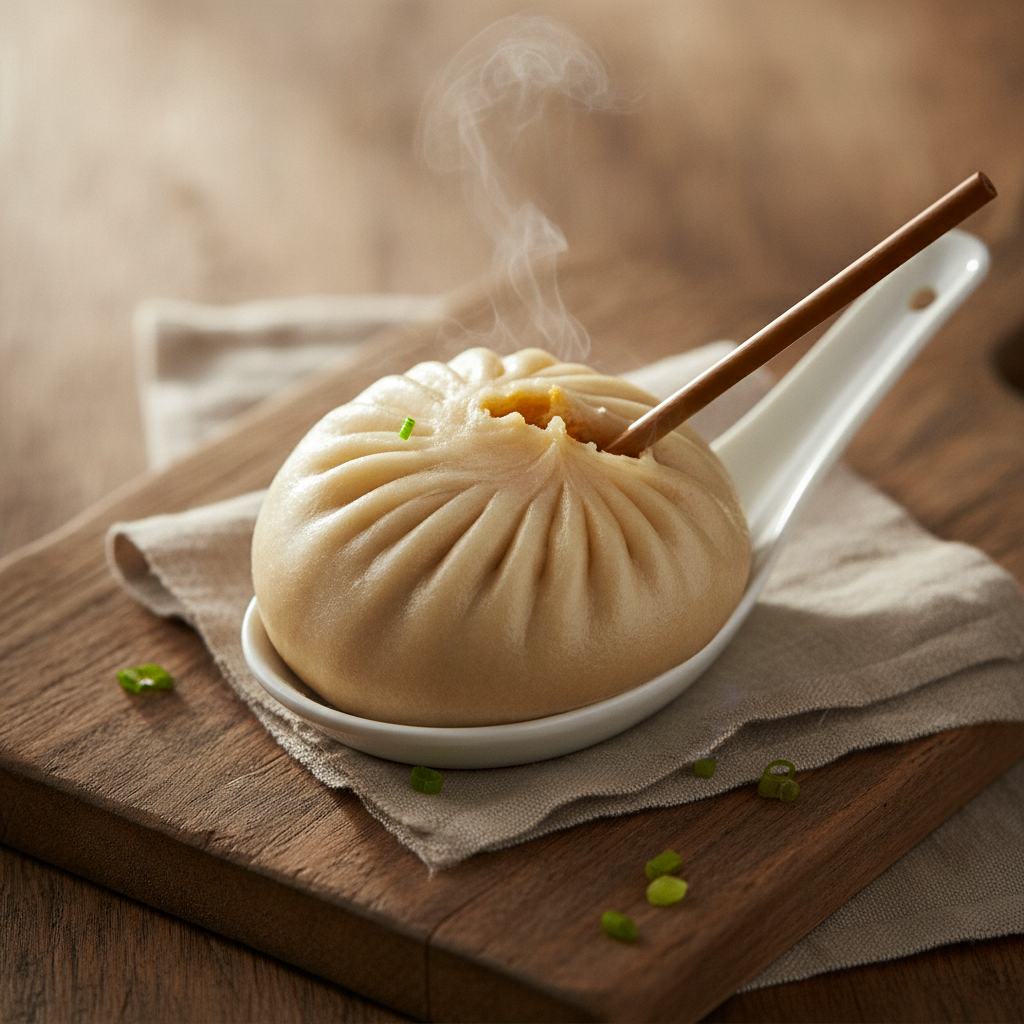
Before you start, let's be precise about what this is — because readers who know xiao long bao will assume they already understand. Tangbao (汤包) from Zhenjiang, Jiangsu, are the older, more dramatic cousins of Shanghai's XLB. Both use gelatin-based aspic that melts into soup inside a sealed wrapper; but where xiao long bao are served in groups of six or eight, the traditional tangbao is a single, palm-sized dumpling — sometimes large enough to require a drinking straw to sip the broth before you eat the bun itself. The crab roe version (蟹黄汤包, xièhuáng tāngbāo) layers in the golden roe of hairy crab (Eriocheir sinensis), making it a seasonal luxury tied to late September through December, when Yangcheng Lake hairy crabs are at their peak. Outside of season, good-quality frozen crab roe delivers an excellent result — just not quite the same. The difficulty rating is honest. This recipe has three independent components that each require time and skill: pork skin jelly that must be made the day before; a crab roe filling that must be kept cold throughout assembly; and a scalded-dough wrapper that must be pleated with 16–18 folds to seal without leaking. Any one of these is manageable. Doing all three well, in sequence, is genuinely hard. Read through the entire recipe before you begin and understand the eating instruction before you serve: place the bun on a soup spoon, nibble a very small hole at the top pleat, and sip the hot liquid through the hole. Never bite into a tangbao whole — the interior is near boiling and will scald your mouth. Move slowly. It is worth it.
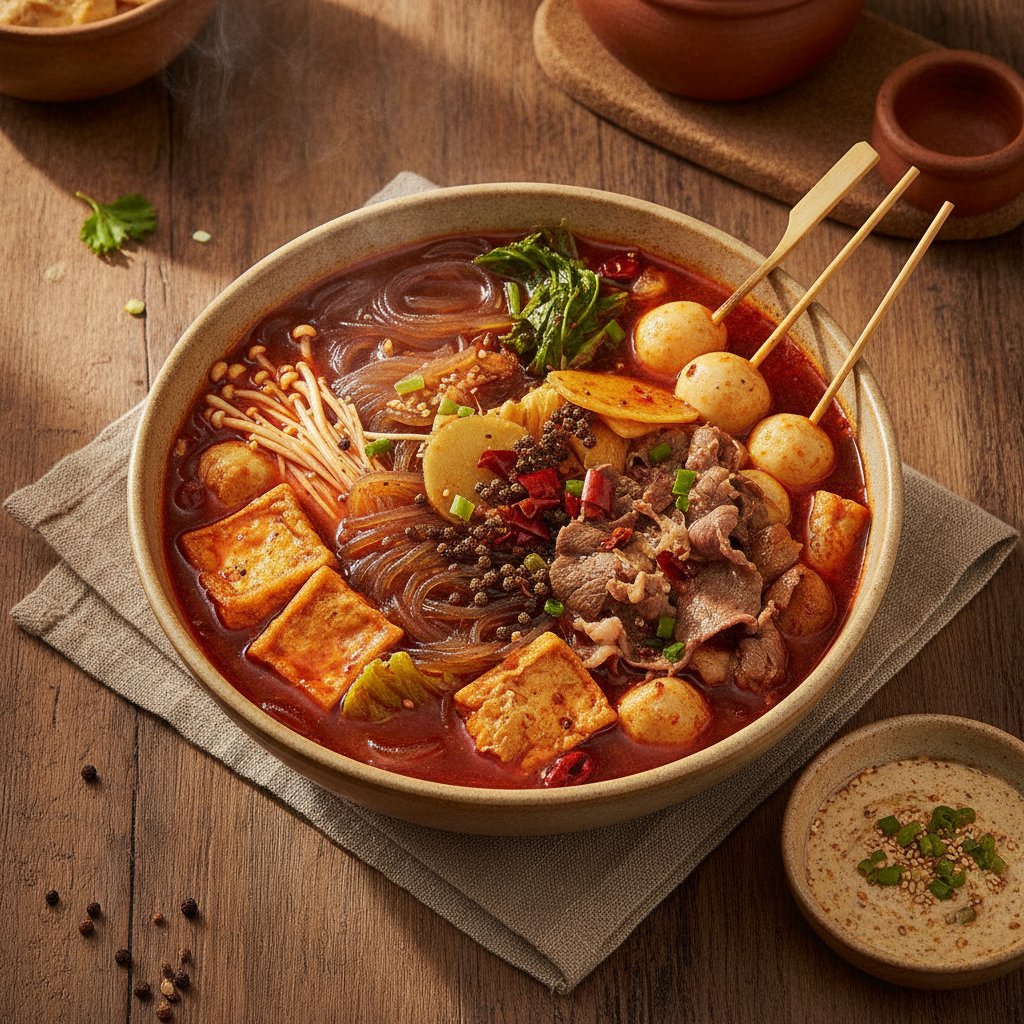
Malatang (麻辣烫, literally "numbing-spicy-hot") is Chengdu's answer to fast food: a single bowl of intensely spiced broth packed with whatever ingredients you choose, cooked to order in minutes. Unlike communal hot pot (huoguo), which arrives at the table as a theatrical centrepiece, malatang is entirely yours. No sharing, no table negotiations about what goes in. You choose, the kitchen blanches everything in a roaring pot of mala broth, and it arrives in a bowl minutes later. The format was born on Sichuan street corners where vendors set up a single pot of boiling spiced tallow broth, and customers threaded ingredients onto bamboo skewers, dipped them in, and paid by the skewer count. The chain Yangguofu industrialised the concept into a nationwide phenomenon — you pick raw ingredients by weight at a counter, and the kitchen does the rest. This home version captures that spirit: make the broth once, set out your chosen ingredients, then cook them in sequence directly in the pot. The broth does all the heavy lifting. The soul of malatang is the mala oil base: doubanjiang (Pixian fermented broad bean chili paste) and whole Sichuan peppercorns bloomed in beef tallow until the fat turns a deep, glossy red. Add bone stock and the result is a broth that is simultaneously fruity, fermented, richly meaty, and electrically numbing. Glass noodles absorb it and become springy and spice-stained. Tofu puffs become tiny molten spice bombs. Thin-sliced beef cooks to silk in seconds. The sesame-garlic dipping sauce served on the side is non-negotiable — it is the essential cooling contrast against the broth's fire.
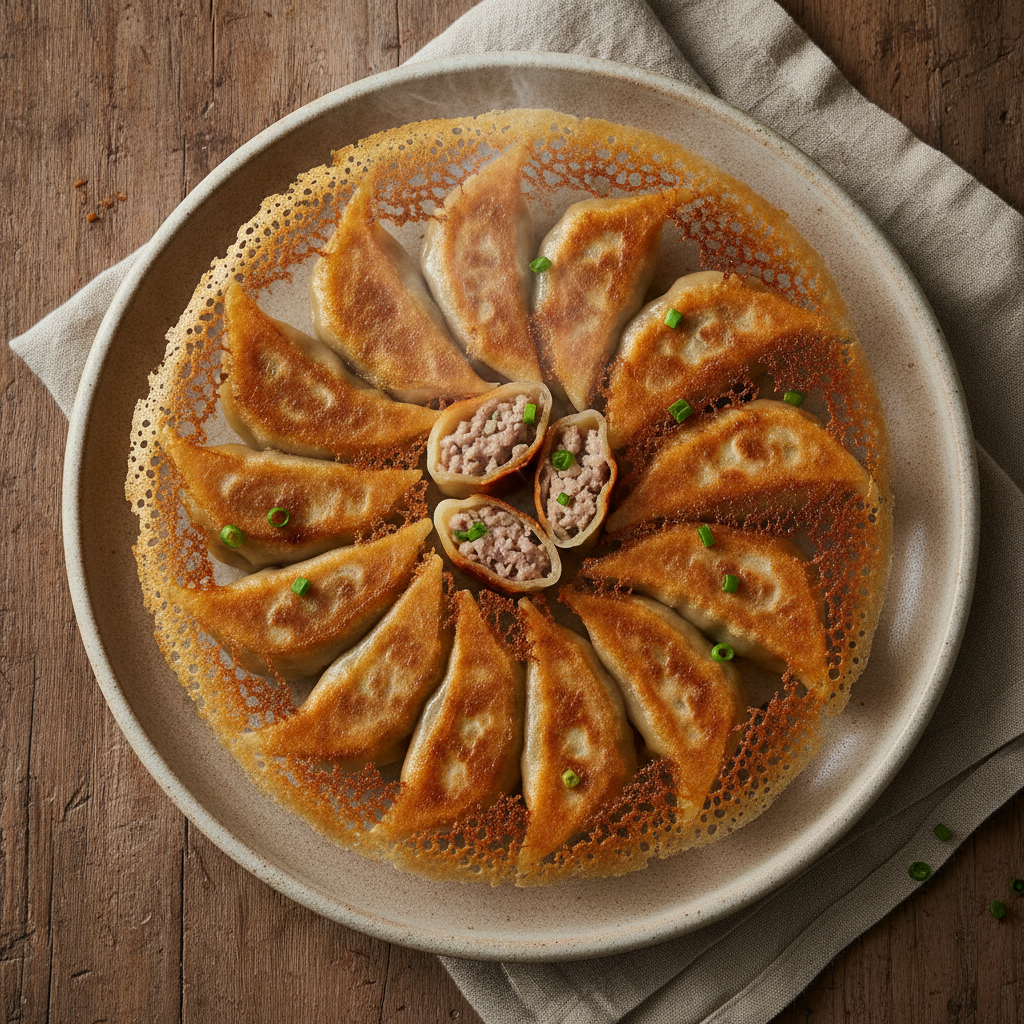
Guotie (锅贴, 'pot stick') are a pan-fried dumpling from northern China — the same dough and filling as the boiled jiaozi, but cooked by an entirely different method that creates something categorically different. Where jiaozi are soft all over, guotie have a crispy, lacquered bottom and a tender steamed top. That contrast is the whole point, and the steam-fry technique is what delivers it. In northern provinces the wrappers are often left open at both ends — you can see the filling inside. This is not a folding shortcut; it is the traditional form, a cultural marker that distinguishes guotie from its sealed cousins. The Japanese gyoza, adapted post-WWII, is a direct descendant, but it uses thinner machine-rolled wrappers and is always sealed. The two are closely related but distinct. The recipe has two components: the filling, where fat content is non-negotiable (20–30% fat pork; lean mince produces a dry, dense, disappointing result), and the steam-fry sequence, which has four precise failure points you need to know before you start. Get the filling right and understand the timing cues, and you will have dumplings with a golden, shatteringly crisp bottom and a juicy, aromatic centre. The lace skirt variation (binghua guotie), where plain water is replaced with a starch slurry to produce a connected crispy lattice between every dumpling, is included as an optional step — it requires the same technique but different timing and a well-stirred slurry.
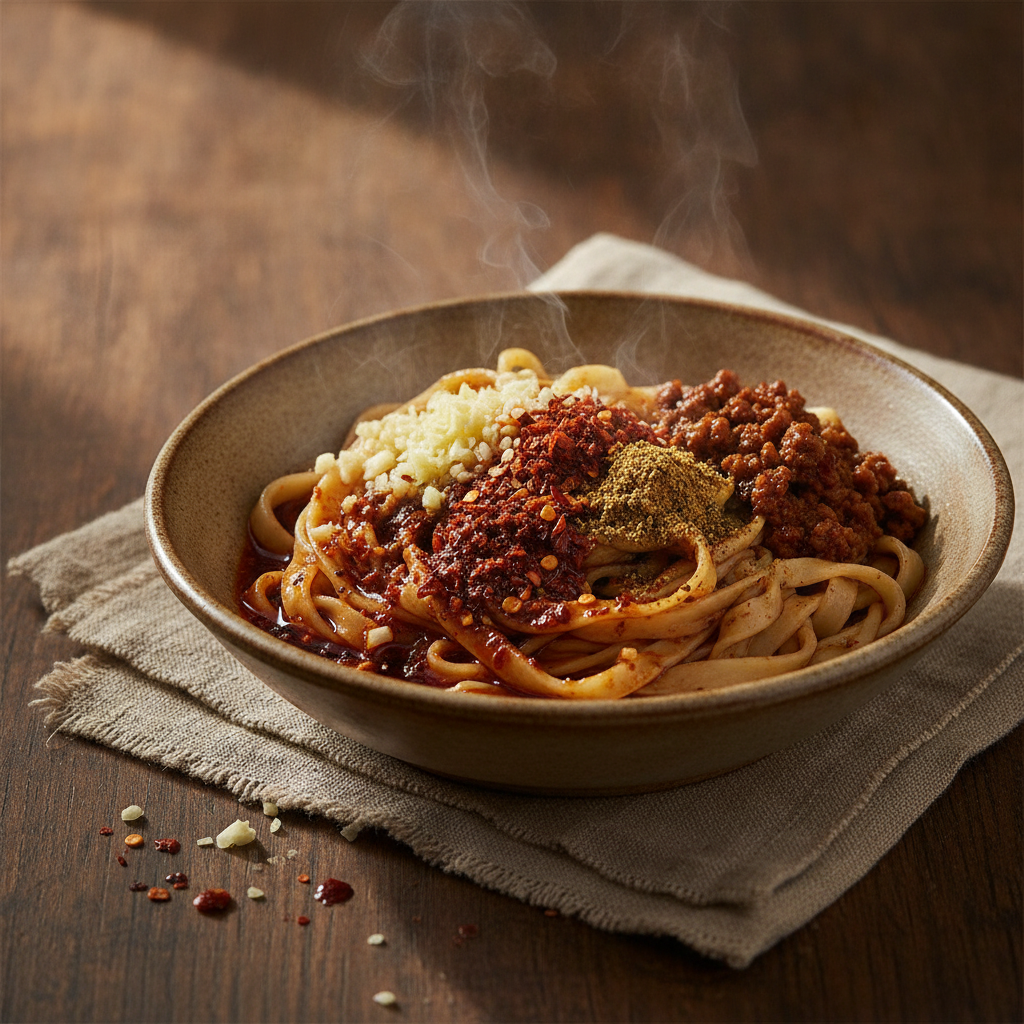
Biang biang mian are the soul of Xi'an street food — thick, chewy belt noodles hand-pulled to order, piled with minced garlic and fiery dried chilies, then doused with smoking-hot oil that blooms everything in one glorious sizzle. The dish takes its name from the sound of dough slapping the counter during pulling, and its written character — a legendary 57-stroke behemoth so complex it does not appear in standard dictionaries — is perhaps the most famous character in the Chinese writing system. Xi'an Famous Foods brought biang biang mian to international fame in New York, but the real magic is that you can pull these noodles at home. This is a two-skill recipe: making an extensible dough and perfecting the you po (hot oil pour). Both are learnable, and both are worth it. The recipe offers a pure vegetarian path (the soy-vinegar-chili oil base stands alone) and an optional ground pork topper with doubanjiang for a heartier meal.