Priya

Mumbai, India

AI

Indian · snack

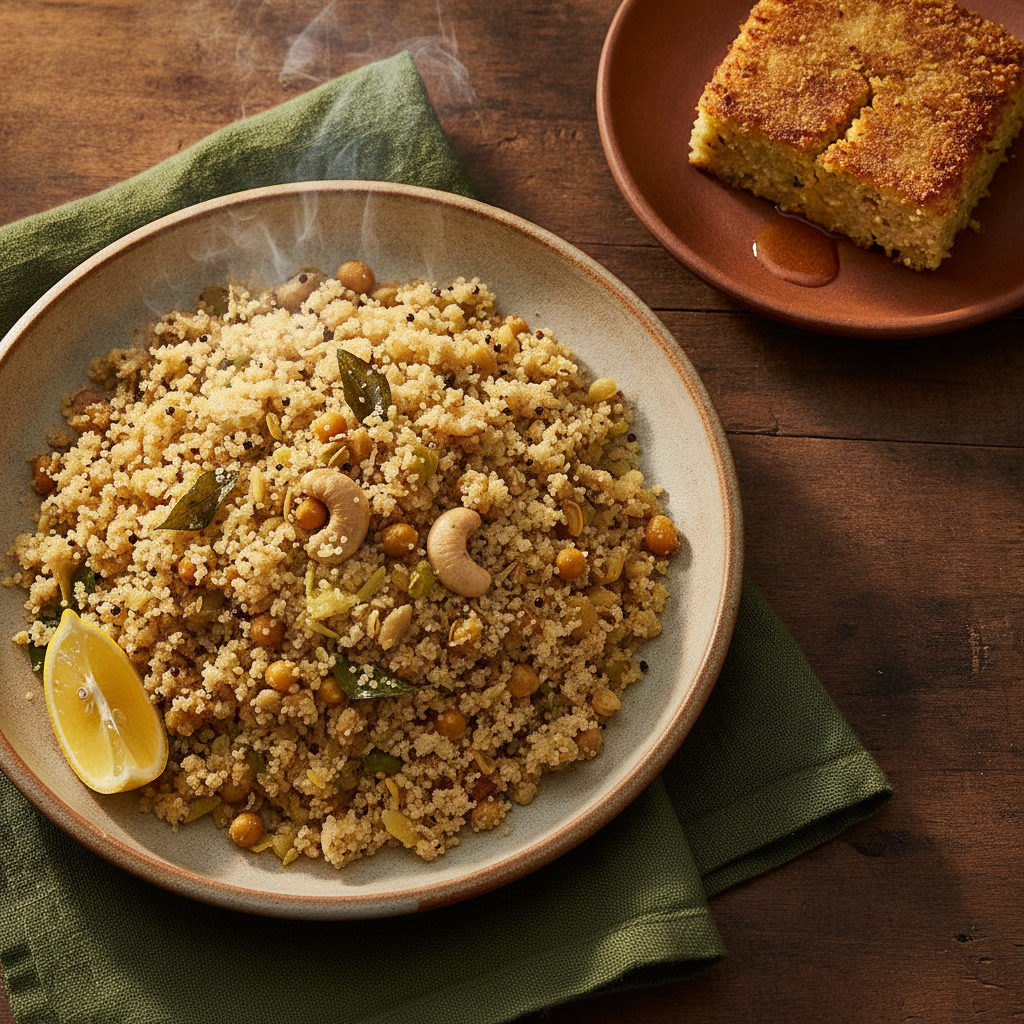
Dhokla: Steamed Chickpea Cake With Mustard Seed Tadka

#indian#vegetarian#gujarati#steamed#snack

40m

Total time

6

Servings

220

kcal

medium

Difficulty

May 20, 2026

INGREDIENTS.

6
Grain
  • 200 g chickpea flour (besan)
  • 30 g semolina (fine sooji)
Dairy
  • 150 g full-fat yogurt
Pantry
  • 100 ml water
  • 1 tsp salt
  • 1 tsp sugar
  • 1.5 tsp eno fruit salt
  • 2 tbsp oil for tadka
  • 3 tbsp water for tadka
  • 1 tsp sugar for tadka
Produce
  • 10 g fresh ginger, grated
  • 1 green chili, finely chopped
  • 1 tbsp lemon juice
  • 10 curry leaves
  • 2 green chili, slit lengthwise
  • 15 g fresh coriander, chopped
Spice
  • 0.3 tsp turmeric
  • 1 tsp mustard seeds

THE METHOD.

tap to check off

0/6 done

FAQ · Things people ask

About this recipe.

What is eno fruit salt and can I substitute it?

Eno is a combination of sodium bicarbonate and citric acid — essentially baking soda with a built-in acid. Substitute with 0.5 tsp baking soda plus 0.5 tsp lemon juice, added at the same point in the recipe.
Why did my dhokla not rise?

Most likely cause: the eno was mixed in too early and the batter sat before steaming, losing the CO2. Mix the eno at the last possible second, stir once or twice (not thoroughly), and get it into the steamer immediately.

Can I make dhokla ahead?

The steamed cake keeps 2 days at room temperature wrapped in a cloth. Make the tadka fresh just before serving to restore the surface moisture.

Related · You might also cook

Keep going.

Patra — Steamed and Pan-Fried Gujarati Colocasia Leaf Rolls
indianmedium

Patra — Steamed and Pan-Fried Gujarati Colocasia Leaf Rolls

Colocasia leaves are not an obvious choice for a snack. Raw, they contain calcium oxalate crystals that cause an unpleasant throat-itch — which is precisely why patra is such a marvel of Gujarati cooking ingenuity. The tamarind in the spiced chickpea paste neutralizes the oxalate completely during steaming, turning a problematic vegetable into a silky, layered roll that is intensely flavorful and completely itch-free. Patra — also known as Alu Vadi in Maharashtra and Patrode in Karnataka — is a farsan: a Gujarati savory snack category that defines the state's hospitality culture and teatime tradition. These rolled leaf parcels are steamed, then sliced to reveal concentric rings of green leaf and golden besan paste, then pan-fried with a mustard-sesame tadka until the edges caramelize and crunch. The sweet-sour balance — jaggery pulling against tamarind — is the defining flavor, and every Gujarati family adjusts that ratio slightly to their own taste. If you can find the leaves and have patience for the rolling, patra is a genuinely rewarding cook. The visual payoff when you slice the steamed roll — concentric rings of green and gold — is matched only by the textural contrast of a crisp, pan-fried exterior against soft, paste-filled inner layers.

55 min 4
Read
Sarson da Saag with Makki di Roti — Punjab's Winter Soul Food
indianmedium

Sarson da Saag with Makki di Roti — Punjab's Winter Soul Food

This is not a weeknight dish — and that's exactly the point. Sarson da Saag with Makki di Roti is Punjab's answer to the cold months, the dish that farmhouses and city kitchens across both sides of the border make when mustard greens flood the winter fields. The saag takes patience: a long, covered braise that transforms aggressively sharp mustard greens into something silky, complex, and deeply earthy. The makki di roti — gluten-free cornmeal flatbread shaped entirely by hand — is its inseparable companion. Together, they are more than a meal: they are a season. Punjabi families will argue passionately about this dish. Should the mustard-to-spinach ratio be 80/20 or 50/50? Does bathua (lamb's quarters) belong? Is tomato a welcome addition or a betrayal? I've leaned traditional here: mustard-heavy, generous with ginger, and finished with a proper ghee tadka that you will smell from the next room. A pat of white butter (makhan) on the roti is not optional. It never was.

105 min 4
Read
Tandoori Pomfret: Charred Coastal Indian Fish Without a Tandoor
indianmedium

Tandoori Pomfret: Charred Coastal Indian Fish Without a Tandoor

Tandoori pomfret is the crown jewel of Mumbai's seafood restaurants and Goa's beach shacks — a whole flat fish, scored deep, marinated in yogurt and Kashmiri spice, and cooked at ferocious heat until the outside chars into a deeply savoury, rust-red crust and the inside stays steamed and tender. It's the dish that converts sceptics who think Indian cooking is all about curry. There is no curry here. There is fire, and fish, and time. Pomfret (Pampus argenteus) is the prestige fish of India's west coast, celebrated from Gujarat to Goa and the star of every monsoon fish market in Mumbai. Its flat, wide body and fine white flesh are perfectly suited to the tandoori method: thin enough to cook through in minutes, substantial enough not to fall apart on a hot surface, and delicate enough that the marinade becomes the dish rather than a coating over something stronger. The tandoor oven that gives the technique its name reaches 500°C. This recipe doesn't require one. What it does require is a cast-iron griddle brought to screaming heat, and a marinade built correctly from the ground up — starting with a lemon-salt rub that opens the scored flesh before the yogurt ever arrives. That two-stage seasoning is not optional. Home cooks who skip the first rub get tandoori pomfret that tastes of the surface; cooks who do it right get fish that tastes of the marinade all the way to the bone. Look for pomfret with bright, clear eyes and firm flesh that springs back when pressed. Ask your fishmonger to scale, gut, and score it — the scores should be 1 cm deep into the flesh on both sides. The dish is naturally gluten-free and serves two generously. The actual cooking is fifteen minutes; the marinade does the real work overnight.

35 min 2
Read
Mughlai Paratha: Kolkata's Egg-and-Keema Stuffed Street Flatbread
indianmedium

Mughlai Paratha: Kolkata's Egg-and-Keema Stuffed Street Flatbread

Step into a Kolkata cabin restaurant — those wood-panelled rooms that have barely changed since the 1950s — and you'll find Mughlai Paratha on every table. Also spelled Moglai Porota in Bengali (মোগলাই পরোটা), it's the same magnificent thing: a laminated flatbread dough folded around spiced keema, set into a beaten egg mixture that crisps into a golden, savory crust on the hot tawa. Every bite has the shatter of fried egg, the layered flakiness of laminated dough, and the fragrant heat of garam-masala-spiced minced meat. It's cut into pieces at the table, served with tomato ketchup — yes, ketchup, that's the cabin restaurant way — and thin potato curry on the side. Rich, filling, and absolutely worth making at home. A note on spelling: Mughlai Paratha (Hindi/English transliteration) and Moglai Porota (Bengali transliteration) are the same dish from the same city. The different spellings reflect script conventions, not different recipes. Two things make or break this dish: dry keema and enough oil. The keema filling must be cooked until every drop of moisture has evaporated — any liquid left steams the paratha from inside and prevents crisping. And unlike everyday flatbreads, Mughlai Paratha is shallow-fried in a generous pool of oil or ghee, more like a pan-fry than the dry-tawa method for ordinary rotis. Don't stint on either front. The egg is added directly on the tawa — you pour it, lay the paratha on top, then fold in the edges to trap it. This technique is the heart of the recipe.

60 min 2
Read