Where do I find sour orange?
Latin grocery stores carry naranja agria bottled. In a pinch, mix 2 parts orange juice with 1 part lime juice and a small amount of grapefruit juice. Do not use lemon alone; it lacks the floral note.
Mexican · dinner
270m
Total time
8
Servings
—
kcal
medium
Difficulty
tap to check off
FAQ · Things people ask
Latin grocery stores carry naranja agria bottled. In a pinch, mix 2 parts orange juice with 1 part lime juice and a small amount of grapefruit juice. Do not use lemon alone; it lacks the floral note.
Frozen banana leaves are available in most Latin, Asian, and Caribbean grocery stores. Thaw completely before use. If unavailable, wrap tightly in two layers of foil — you lose the aroma but maintain the steam environment.
Cebollas en escabeche: thinly sliced red onion marinated in sour orange juice, habanero, salt, and a little vinegar for at least 1 hour. It is the essential acidic, spicy counterpoint to the rich, sweet pork.
Related · You might also cook
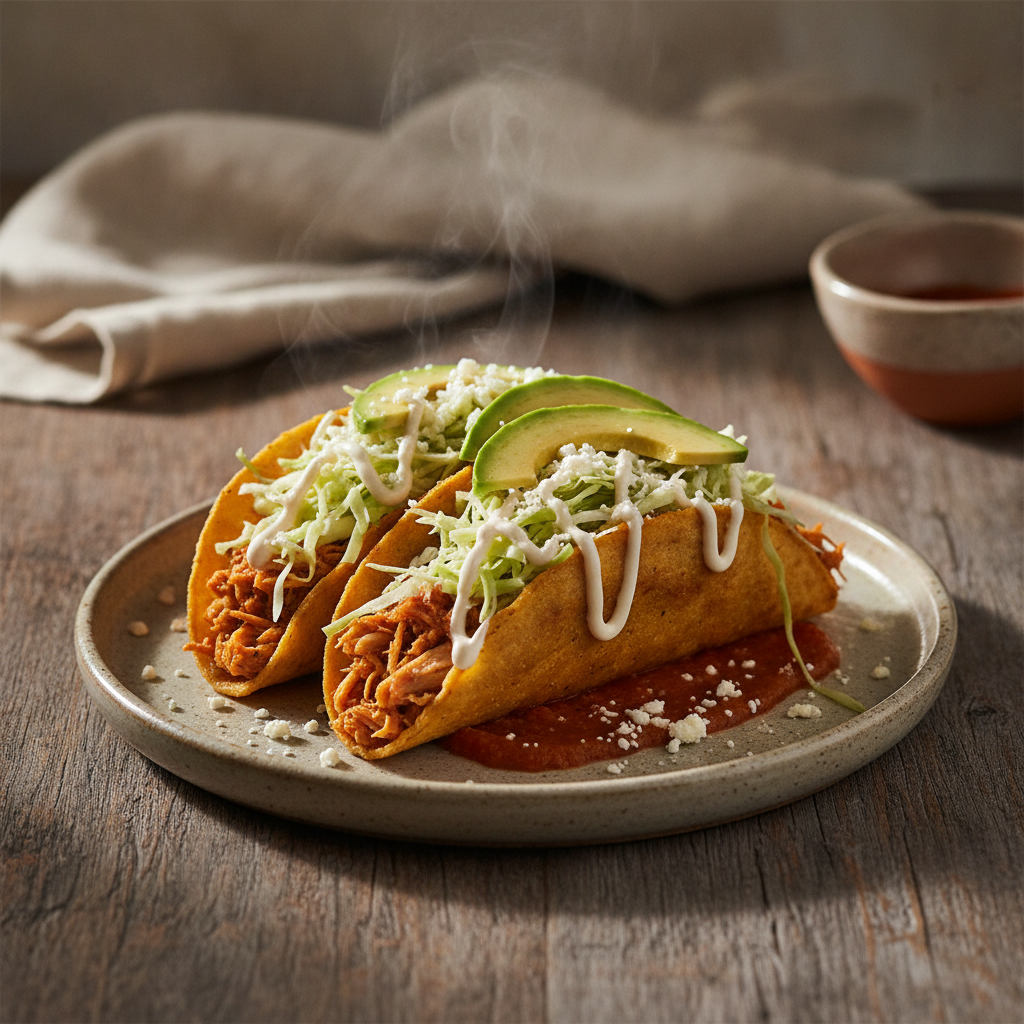
Tacos dorados are Mexico's golden fried tacos — corn tortillas folded in half around a savory filling, secured with a toothpick, and shallow-fried until they shatter with a deep, earthy masa crunch. Unlike flautas and taquitos (which are rolled into cylinders), a dorado is always folded: a half-moon that opens into toppings. These are the everyday comfort food of Mexico City lunch counters, school cafeterias, and family kitchens across Jalisco, Guerrero, and Oaxaca. The two most beloved fillings are shredded chicken (pollo deshebrado) and seasoned mashed potato — and the potato version is arguably more beloved than the meat version, especially on Fridays in Catholic Mexico. Whichever filling you use, the architecture is the same: hot, shattering golden shell on the bottom, then toppings layered in sequence — salsa first to warm against the shell, then cold shredded cabbage for crunch, cool crema in zigzags, crumbled cotija for salt, and sliced avocado over everything. Two technique points matter above all others: warm your tortillas until pliable before folding (cold corn tortillas crack in half — this is the most common failure point for home cooks), and keep your frying oil at 175–180°C. Get those two right and the rest follows naturally.
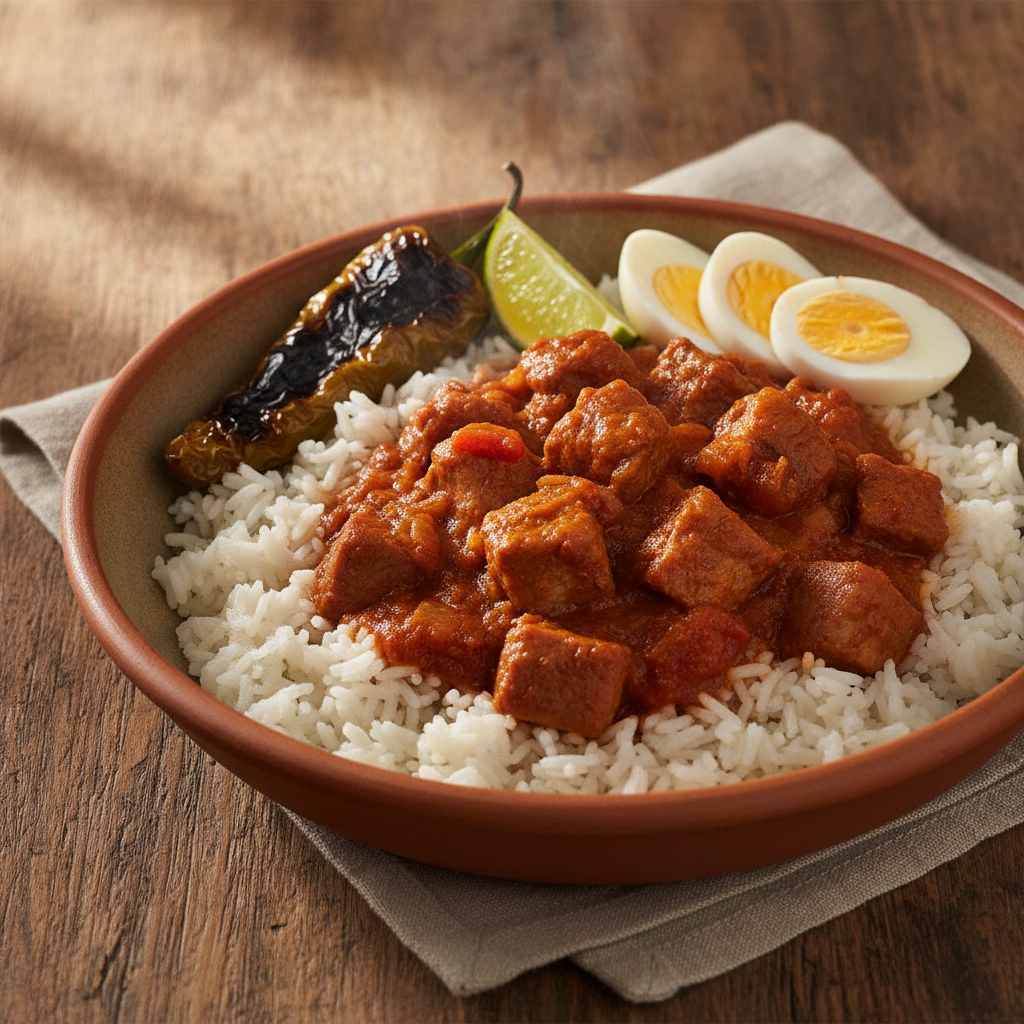
Lomitos de Valladolid is one of the quiet glories of Yucatecan home cooking — not the famous cochinita pibil that fills tourist menus, but the stovetop braise that Valladolid families have been eating for lunch on weekdays for generations. Named for the colonial city in eastern Yucatán, a pueblo mágico that sits at the crossroads of the old Maya trade routes and the road to Chichén Itzá, the dish is credited by local culinary legend to Doña Hermelinda, a home cook whose recipe spread through the city's comedores and kitchens until it became synonymous with the place itself. What makes lomitos taste the way it does is layered charring at every stage. The tomatoes, onion, and garlic all spend time directly on a hot comal until they're blackened in spots — that caramelized bitterness becomes the backbone of the sauce. The pork gets browned hard in lard, building a fond on the pan bottom. Then the blended sauce goes back into that same pan and cooks down in the fat until it darkens and thickens before the pork returns. By the time the braise is done, you've built three separate Maillard layers into a single pot. This is not primarily an achiote dish — that's a common misconception that conflates lomitos with cochinita pibil. The achiote in this recipe is optional, adding a faint earthiness and the orange-red color that signals Yucatán, but the dish exists and is authentic without it. The tomato is the star. The sliced hard-boiled egg placed on top before serving is not decoration — it's a traditional textural foil, mild and cooling against the spiced pork, and it appears on every lomitos plate in Valladolid's lunch spots. Don't skip it. --- ## Ingredients ### Pork - 1½ lbs (680g) **pork loin**, cut into 3 cm (1¼-inch) cubes — pork shoulder works if the loin seems too lean - 2 tablespoons **lard** or vegetable oil (lard is traditional and gives better flavor) - 1 teaspoon fine sea salt - ½ teaspoon black pepper, freshly ground ### Tomato-Chile Sauce - 1½ lbs (680g) **ripe tomatoes** (about 4 medium; Roma or vine-ripened) - 1 medium **white onion**, halved through the root — one half for charring, one half left raw for the table - 4 cloves **garlic**, unpeeled for charring - 2 to 3 **chiles de árbol** or chile seco, stemmed (use 2 for medium heat, 3 for more) - 1 teaspoon **Yucatecan oregano**, dried — Mexican oregano is a usable substitute; the Yucatecan variety is more floral - 1 tablespoon **achiote paste (recado rojo)**, optional but traditional; dissolved in the sour orange before adding - 3 tablespoons **naranja agria** (sour orange juice) — substitute: 2 tablespoons fresh orange juice + 1 tablespoon fresh lime juice - 1 cup **water or light chicken broth** - Salt to taste ### For Serving - 2 cups **long-grain white rice**, cooked (makes about 4 cups cooked) - 2 **hard-boiled eggs**, peeled and sliced into rounds - 1 to 2 **habanero peppers**, charred whole on the comal and served on the side - 1 **lime**, cut into wedges --- ## Instructions **1. Season and dry the pork.** Pat the pork cubes completely dry with paper towels — moisture is the enemy of a good sear. Season generously on all sides with the salt and pepper. Set aside while you prepare the sauce ingredients. **2. Char the tomatoes, onion, and garlic.** Heat a dry comal or cast iron skillet over high heat until smoking. Place the tomatoes, one onion half (cut side down), and the unpeeled garlic cloves directly on the dry surface. Char, turning occasionally, until the tomatoes are blistered and blackened in spots (10–12 minutes), the onion cut face is deeply caramelized (8–10 minutes), and the garlic skin is scorched and the cloves are softened (6–8 minutes). They don't need to be uniformly blackened — you want patches of deep char, not ash. Transfer everything to a plate. Peel the garlic when cool enough to handle. **3. Toast and rehydrate the chiles.** On the same dry comal, toast the dried chiles over medium heat for 30–45 seconds per side, pressing them flat with a spatula, until they darken slightly and smell fragrant. Don't let them blacken — the seeds will turn bitter. Transfer to a small bowl, cover with hot water, and soak for 10 minutes until pliable. Drain. **4. Blend the sauce.** In a blender, combine the charred tomatoes (with any accumulated juices), charred onion half, peeled garlic, drained soaked chiles, oregano, and ½ teaspoon salt. If using achiote paste, dissolve it in the sour orange juice first, then add it to the blender. Add the sour orange juice (or orange-lime substitute). Blend until smooth, about 1 minute. The sauce will be deeply colored — brick-red to mahogany. **5. Brown the pork in batches.** In a large heavy pot or Dutch oven, heat the lard over high heat until shimmering and a drop of water sizzles on contact. Working in two batches (do not crowd the pan — crowding steams the pork instead of browning it), add the pork cubes in a single layer. Sear without moving for 3–4 minutes until deeply golden on the bottom, then turn and brown at least one more side, 2–3 minutes more. Transfer to a plate. Repeat with the second batch. The fond (browned bits) on the pan bottom is flavor — leave it. **6. Fry the blended sauce.** Reduce the heat to medium-high. Without cleaning the pot, carefully pour the blended sauce directly into the hot fat — it will splatter, so stand back and use a lid as a shield if needed. Stir to incorporate the fond from the pan bottom. Cook the sauce, stirring frequently, for 8–10 minutes until it darkens further, thickens visibly, and the raw tomato taste mellows into something deeper. The sauce is ready when it holds its shape briefly in a spoon trail. **7. Braise the pork.** Add the browned pork and any resting juices back to the pot. Pour in the water or chicken broth. Stir to coat the pork with sauce. Bring to a boil, then reduce heat to low, cover, and braise for 60–70 minutes, stirring every 20 minutes, until the pork is completely tender — it should yield easily to a fork with no resistance. In the last 10 minutes, remove the lid and raise the heat slightly to reduce the sauce to a thick, glossy consistency that coats each piece of pork. Taste and adjust salt. **8. Char the habaneros.** While the pork finishes, place the habanero peppers on the dry comal over high heat and char on all sides until blistered, 5–6 minutes. Keep them whole — the heat releases the fragrant oils but the intact skin holds back most of the fiery capsaicin. Serve them whole on the side; diners pierce or bite as desired. **9. Serve over rice with egg.** Spoon a mound of white rice into each bowl or onto each plate. Ladle the lomitos over and around the rice, making sure each portion gets plenty of sauce. Lay 2–3 slices of hard-boiled egg across the top — this is the traditional Valladolid presentation, not optional garnish. Place a whole charred habanero alongside and a lime wedge at the edge. Serve immediately. --- ## Tips **Don't skip the charring.** The charring of tomatoes, onion, and garlic is what gives this sauce its complexity. Plain simmered tomato produces a flat, acidic braise. The char adds a bittersweet depth — this step is non-negotiable. **Brown in batches, seriously.** Crowding the pan drops the oil temperature and the pork steams instead of sears. Brown in two batches minimum. **Achiote is optional, not central.** Many recipes online — especially those written outside Yucatán — portray lomitos as an achiote-forward dish. It isn't. It's a tomato braise. The achiote adds color and a faint earthiness. If you don't have recado rojo, skip it. **This dish is better the next day.** Like most braises, lomitos improves significantly after resting overnight. Reheat gently over low heat with a splash of water or broth to loosen the sauce.
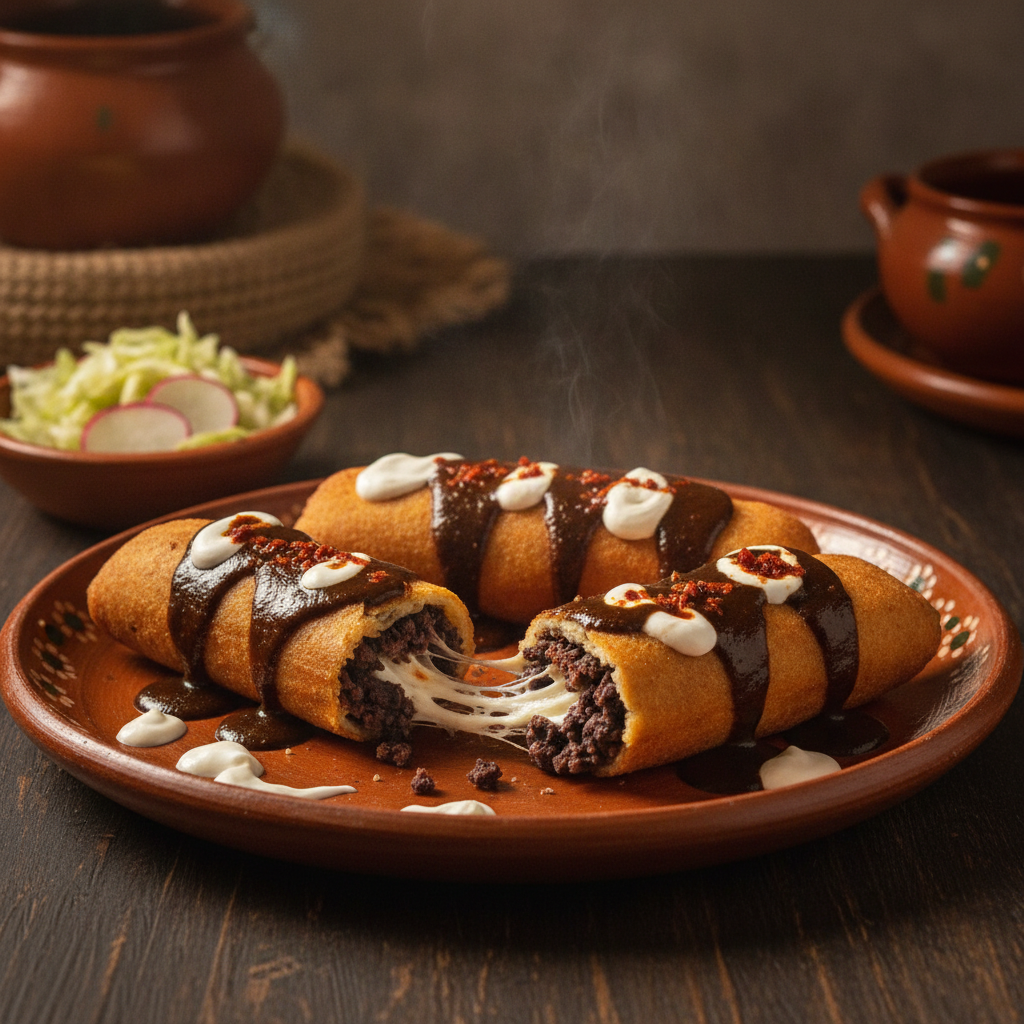
Walk through Oaxaca City as evening falls and you will smell molotes before you see them — the hot lard smell drifting from puestos in the market halls and street corners, the vendors pressing masa into their distinctive elongated shapes and lowering them into oil for the dusk crowd. Molotes are an antojito, a snack or light meal, and in Oaxaca they are definitively evening food: sold at the mercado stalls that come alive after six, eaten standing up with a paper napkin or carried away wrapped in a tortilla to eat while walking. They are the Oaxacan answer to the empanada — same concept of sealed filling inside a dough, but made with nixtamal corn masa instead of wheat, fried gold-brown, and served with crema and salsa instead of chimichurri. The name molote may derive from the elongated oval shape, sometimes compared to a football or a spindle. The form is distinct: not round like a gordita or flat like a tlayuda, but a sealed pocket with tapered ends, thick enough to hold up to frying. The black bean and chorizo filling is the classic — the combination of earthy frijoles negros and the richly spiced pork of Oaxacan chorizo negro is what you will find at every puesto. Potato and chorizo is the close second; plain black bean with epazote is the vegetarian version. The optional quesillo (Oaxacan string cheese) strip inside each molote is a variation worth trying — the mild, stretchy cheese melts into the filling and pulls when you bite in. The salsa served on top is where this dish distinguishes itself most sharply from generic Mexican antojitos. In Oaxaca, that salsa is salsa negra — made from dried pasilla negro and mulato chiles, with a deep, chocolaty, smoky character that is different from anything a green tomatillo salsa gives you. Salsa verde works fine, but if you want the authentic Oaxacan flavor, finding or making salsa negra is worth the extra step. Two technique points that separate good molotes from burst, soggy ones: the masa must be properly hydrated (pliable but not sticky), and the bean-chorizo filling must be genuinely dry before it goes in. Wet filling steams inside the sealed pocket, creates moisture pressure, and blows the seam open in the oil. Cook the filling until it holds its shape when pressed — then cook it two minutes more. --- ## Ingredients ### Masa Dough - 2 cups (240g) **masa harina** (Maseca or similar nixtamal corn flour — not coarse cornmeal or polenta) - 1¼ to 1½ cups **warm water**, added gradually - 1 tablespoon **lard** or vegetable shortening - ½ teaspoon fine **sea salt** ### Black Bean and Chorizo Filling - 1½ cups **cooked black beans (frijoles negros)**, well-drained — canned works, drain and rinse thoroughly - 6 oz (170g) **Oaxacan chorizo** (chorizo negro), casing removed — Mexican fresh chorizo is a workable substitute; Spanish cured chorizo is not - 3 sprigs **fresh epazote**, leaves only (about 1 tablespoon); or ½ teaspoon dried epazote - ½ teaspoon fine **sea salt**, plus more to taste - 1 tablespoon **lard** or neutral oil for frying the chorizo ### Optional (but recommended) - 2 oz (55g) **quesillo (Oaxacan string cheese)**, torn into 12 thin strips — low-moisture mozzarella is the closest substitute ### For Frying - 2 to 3 cups **neutral oil** or **lard**, for shallow or deep frying (lard gives more authentic flavor) ### For Serving - **Crema mexicana** (or sour cream loosened with a little whole milk) - **Salsa negra** (Oaxacan dried chile salsa) or salsa verde - Shredded cabbage or thinly sliced radishes, optional --- ## Instructions **1. Make the filling first.** Heat 1 tablespoon lard in a medium skillet over medium-high heat. Add the chorizo and use a wooden spoon to break it into small crumbles as it fries. Cook for 6–8 minutes, stirring frequently, until deeply browned and the fat has fully rendered. Add the epazote leaves and stir for 30 seconds until fragrant. **2. Mash and dry the beans into the chorizo.** Add the drained black beans to the skillet and mash roughly with a fork or potato masher — you want a textured paste, not completely smooth. Stir to combine with the chorizo and its rendered fat. Continue cooking over medium heat, stirring frequently, for 5–7 minutes until the mixture is thick, nearly dry, and holds its shape when pressed with a spoon. It should not spread or release liquid. Season with salt. Spread the filling on a plate to cool completely — warm filling will steam in the masa. **3. Mix the masa dough.** Combine the masa harina and salt in a medium bowl. Add 1 tablespoon of lard and rub it into the dry masa with your fingertips until there are no visible fat lumps. Add the warm water gradually — start with 1¼ cups, mix until a dough forms, then add more tablespoon by tablespoon until the dough is pliable and smooth. Test: press a ball of dough flat — the edges should not crack. If they crack, add a little more water. The dough should not stick to your palms. Knead gently for 1 minute. Cover with a damp towel and rest 10 minutes. **4. Divide and shape the dough.** Divide the dough into 12 equal balls (about the size of a golf ball, roughly 40g each). Keep the unused balls covered under the damp towel as you work. **5. Fill and seal the molotes.** Working one at a time, place a dough ball between two pieces of plastic (a cut zip-lock bag works well) and press or roll into a circle roughly 12 cm (5 inches) across and about 4 mm thick — slightly thicker than a tortilla. Place 1½ tablespoons of the bean-chorizo filling in the center. If using quesillo, add one strip of cheese on top of the beans. Fold the dough over the filling to form a half-moon, then press the edges firmly together, overlapping slightly and pinching to seal completely. Gently shape the sealed pocket into an elongated oval with tapered ends — the classic molote shape, like a small football. Check for any cracks or gaps in the seam and seal them with a dampened fingertip. Place on a parchment-lined tray. **6. Heat the oil.** Pour oil or lard into a heavy-bottomed skillet or Dutch oven to a depth of 2–3 cm (about 1 inch) for shallow-frying, or 5 cm (2 inches) for deeper frying. Heat over medium heat until the oil reaches 170–175°C (338–345°F). If you do not have a thermometer, test with a small piece of dough — it should sizzle immediately and float within 5 seconds. Too hot and the outside browns before the masa cooks through; too cool and the molotes absorb excess oil. **7. Fry in batches.** Working in batches of 3–4 (do not crowd the pan), lower the molotes gently into the oil using a slotted spoon. Fry for 3–4 minutes on the first side without moving, until deep golden brown. Flip carefully and fry 3–4 minutes on the second side. The thick masa needs this time — resist turning too early. Transfer to a wire rack or paper-towel-lined plate to drain. Hold finished batches in a 150°C (300°F) oven while you fry the rest. **8. Serve immediately.** Arrange the molotes on a platter or plates. Drizzle generously with crema mexicana, then spoon salsa negra or salsa verde over the top. Add shredded cabbage or radish slices alongside if desired. Molotes are street food — serve them hot and eat them immediately; they soften as they cool. --- ## Tips **Dry filling is non-negotiable.** The most common reason molotes burst in the fryer is wet filling. Steam builds inside the sealed pocket under frying heat and blows the seam apart. Cook the bean-chorizo mixture until it is paste-like and dry, then let it cool fully before filling. **Seal the seam properly.** After forming the half-moon, press the edges firmly with overlapping pressure — do not just crimp. Any crack or hole is an oil entry point that will leak filling into the fryer. Run a damp finger along any suspicious seams before frying. **Temperature control matters more than with thinner fried foods.** At 170–175°C the molotes take 3–4 minutes per side to cook the masa through. If the oil is too hot (above 185°C), the exterior is done in 2 minutes and the masa inside is still raw. Use a thermometer, or adjust heat mid-batch if the color is coming in too fast. **Salsa negra is the authentic choice.** Oaxacan salsa negra — made from pasilla negro and mulato dried chiles — has a deep, chocolaty, complex smoke that is entirely different from fresh tomatillo salsa. If you can find it prepared or the chiles to make it, the difference is significant. Salsa verde is a fine substitute but gives a different dish. **Make the filling a day ahead.** The bean-chorizo mixture keeps well refrigerated for up to 3 days and is better cold when filling the molotes (cold filling will not start melting the raw dough). The shaped, unfried molotes can be held on a tray in the refrigerator for up to 2 hours before frying.
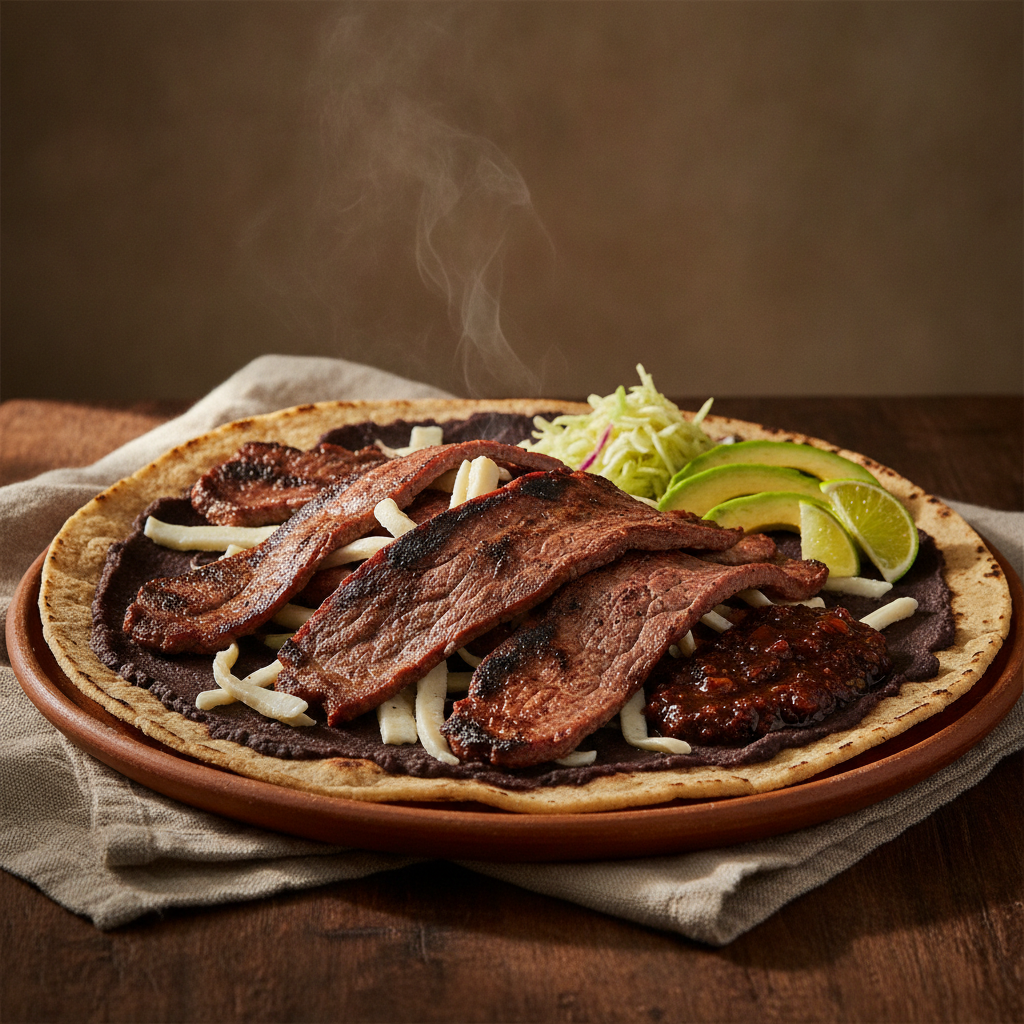
Walk into the Mercado 20 de Noviembre in Oaxaca City after noon and you'll find the Pasillo de Humo — the Smoke Corridor. It's a charcoal-lined indoor lane where vendors grill three meats side by side, the smoke pooling under the low ceiling until the air smells of coals and salt: tasajo, cecina enchilada, and chorizo verde. The Oaxacan meat triad appears together on tlayudas across the Central Valleys, but among the three, tasajo is the one that most repays close attention. Tasajo is beef — specifically, lean beef leg or flank, spiral-cut or sliced into thin sheets, rubbed with coarse salt, and air-dried until pliable but not hard. That's the entire cure: salt, time, and dry air. No garlic. No chiles. No herbs. The flavor comes from what salt does to beef: it draws out moisture, tightens the muscle, and concentrates whatever beefy character was already there. Then charcoal does the rest — a ferocious two-minute encounter that chars the surface and caramelizes whatever moisture remains, creating a rough, uneven crust that catches the heat in patches. The cecina distinction matters and is worth stating clearly. In Oaxaca, tasajo is beef (salt-only cure) and cecina enchilada is pork rubbed with dried chiles. Elsewhere in Mexico — particularly in Morelos — "cecina" often means beef: the Yecapixtla style, a national institution in its own right. If you're talking to someone outside Oaxaca about cecina, clarify the animal. Tasajo means beef, salt, and nothing else. Oaxaca's Central Valleys have an entrenched culture of dry-curing meats, born from the region's hot, arid climate and pre-refrigeration preservation needs. In Oaxaca City, the Mercado 20 de Noviembre's Pasillo de Humo is the symbolic home of all three cured meats — one of the most cited market dining experiences in Mexican food writing — where vendors grill each cut to order over charcoal and serve it directly onto tlayudas spread with black beans. Pati Jinich (PBS) has demonstrated that the home refrigerator replicates the Central Valley's dry air well enough. The key is a wire rack: cold air circulates around all sides, removing surface moisture without Oaxacan weather. Three technique points are non-negotiable. First: pound the meat to under 3 mm (1/8 inch) — this is not optional. Traditional butchers spiral-cut leg beef into 2–3 mm sheets; at home, slice flank steak against the grain as thin as possible and pound further between parchment. The thinness creates the surface-to-mass ratio that lets charcoal do its job in under two minutes. Second: do not rinse the cure salt before grilling — the salty exterior is intentional, not a mistake. All accompaniments should be lightly seasoned to balance. Third: the accompaniments are doing the flavor layering that the salt-only cure deliberately withholds. Pasilla negro salsa, black bean paste, and the soft corn of the tlayuda are structural components of the dish, not optional sides. --- ## Ingredients ### The Beef - 1½ lbs (680g) **flank steak** or beef round — lean, flat cuts that dry-cure well; fatty cuts risk going rancid during the cure - 3 to 4 tablespoons **coarse sea salt** or kosher salt — this is the only seasoning; no spice rub, no marinade, no garlic, no herbs ### For Serving (traditional tlayuda presentation) - 4 **tlayudas** (large, dried Oaxacan corn tortillas, 12–14 inches) — or large corn tortillas briefly dried on a comal until semi-firm - 1 cup **black bean paste (frijoles negros refritos)** — Oaxacan black beans simmered until very soft and mashed smooth; should be thick, not soupy; make with minimal or no added salt - 1 cup **pasilla negro salsa** — dried pasilla negro chiles blended with charred tomato and garlic; this is where the flavor complexity lives - 3 oz (85g) **quesillo (Oaxacan string cheese)**, torn into strips — optional but traditional; low-moisture mozzarella is the closest substitute ### Optional garnishes - Sliced avocado - Shredded cabbage - Lime wedges --- ## Instructions **1. Slice the beef as thin as possible.** Working against the grain, cut the flank steak into sheets as thin as you can manage — aim for 3–4 mm or thinner. Lay each sheet between two pieces of parchment paper and pound with a meat mallet or the flat side of a heavy skillet until under 3 mm (roughly 1/8 inch). The edges will be rough and irregular — that's correct. The rough, uneven surface is what catches char and creates the eating experience. Don't try to make them neat. **2. Salt the beef.** Lay the pounded sheets on a clean work surface. Rub coarse salt generously on both sides of each sheet, pressing it in with your palm so it adheres firmly. You want full coverage without pools of undissolved salt. This is a cure, not a seasoning — it should feel like significantly more salt than you'd normally use on raw beef. **3. Air-cure in the refrigerator.** Transfer the salted sheets to a wire rack set over a sheet pan. Place uncovered in the refrigerator for 3 to 8 hours. The beef is ready when the surface is dry to the touch and the color has deepened to a darker red, but the sheets remain pliable — they should fold without cracking. This is semi-dry, not jerky. The cold, dry refrigerator air removes surface moisture just as the Central Valley climate does. Do not exceed 8 hours; beyond that the exterior becomes too hard. **4. Prepare the grill.** Build a hot charcoal fire — the coals should be fully ashed over and glowing red, with the grill grate positioned close to the heat source. You need fierce, direct heat. A gas grill on its highest setting or a cast-iron comal (griddle) preheated until smoking are the home workarounds. If using a comal or cast-iron skillet, heat it dry with no oil — the cured surface will color and release cleanly from a properly hot surface. **5. Grill fast and hot.** Remove the cured beef from the refrigerator. Do not rinse it, do not pat it dry. Lay the sheets directly on the hot grill. Grill for 1 to 2 minutes per side — maximum. Watch closely: on a very hot grill, the thin sheets can be done in under a minute per side. The target is deeply charred and caramelized on the surface, with the interior barely past hot. Remove immediately when done. Rest briefly, loosely tented with foil, for 2 minutes. **6. Assemble the tlayuda.** Warm the tlayuda briefly on the grill or comal until lightly charred at the edges and slightly pliable. Spread a generous layer of black bean paste across the surface. Lay the grilled tasajo slices over the beans, folding or tearing as needed. Spoon pasilla negro salsa over the meat. Add quesillo strips, avocado slices, or shredded cabbage as desired. Serve immediately. --- ## Tips **Paper-thin is the key variable.** Every other step depends on the meat being thin enough. At 3 mm or under, charcoal can char both sides in under 2 minutes without toughening the interior. Thicker slices require longer cooking, which dries the beef out and intensifies the saltiness past balance. If in doubt, pound more. **All accompaniments should be minimally seasoned.** The cure salt is not rinsed off — the beef is intentionally salty by design. Black bean paste, pasilla negro salsa, and quesillo should all be made with little or no added salt. The salt in the beef seasons the entire dish. **The salsa does the flavor work the cure doesn't.** Pasilla negro salsa provides the complexity, heat, and acidity that the salt-only cure deliberately withholds. Without it, tasajo is salty charred beef. With it, it's a complete dish. A bottled dried-chile salsa can substitute in a pinch, but the dried pasilla negro character — chocolaty, smoky, not fiery — is important. Fresh salsa verde is too bright and doesn't complement the concentrated beef the same way. **Tlayuda vs. corn tortilla.** A tlayuda is a large, slightly dried Oaxacan corn tortilla — denser and more substantial than a soft tortilla, with a dry, cracker-like center and pliable edges. If unavailable, briefly dry a large corn tortilla on a hot comal until half-crisped. The substantial base balances the intensity of the beef. **On charcoal vs. alternatives.** Charcoal delivers the irreplaceable smoky caramelization of the Pasillo de Humo. A gas grill on high is a legitimate substitute — preheat on maximum with the lid down for 10 minutes before grilling. A cast-iron comal or large skillet works without smoke; the char and caramelization will still develop on properly preheated cast iron.